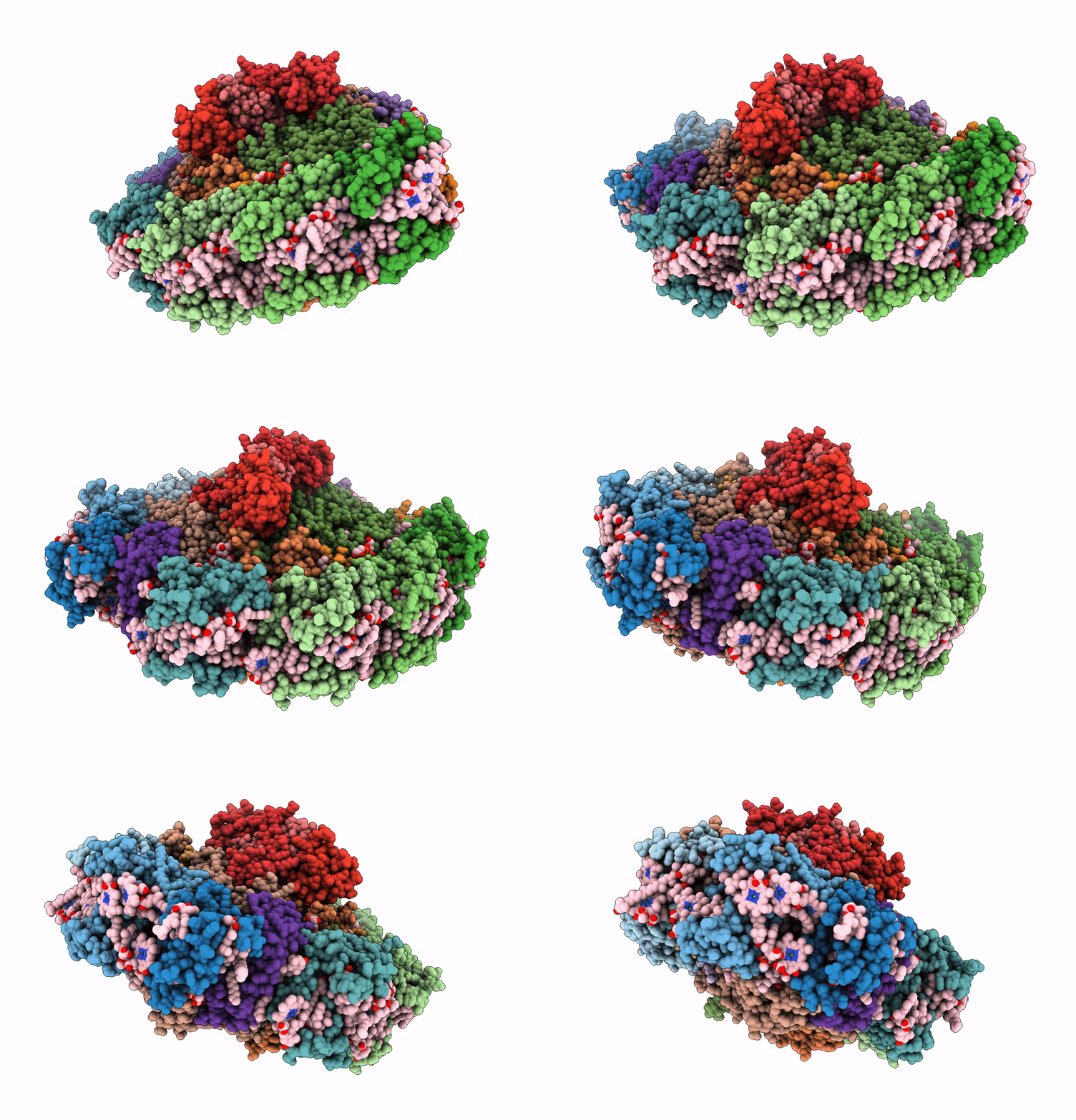
9KC5 image
Deposition Date 2024-11-01
Release Date 2025-04-23
Last Version Date 2025-05-28
Entry Detail
PDB ID:
9KC5
Keywords:
Title:
PSI-LHCI of the red alga Galdieria sulphuraria NIES-3638
Biological Source:
Source Organism:
Method Details:
Experimental Method:
Resolution:
2.19 Å
Aggregation State:
PARTICLE
Reconstruction Method:
SINGLE PARTICLE

Macromolecular Entities
Structures with similar UniProt ID
Protein Blast
Polymer Type:polypeptide(L)
Molecule:RedCAP
Gene (Uniprot):Gasu_47790
Chain IDs:N (auth: 1)
Chain Length:177
Number of Molecules:1
Biological Source:Galdieria sulphuraria
Structures with similar UniProt ID
Protein Blast
Polymer Type:polypeptide(L)
Molecule:Light-harvesting complex protein
Gene (Uniprot):Gasu_15240
Chain IDs:O (auth: 2)
Chain Length:162
Number of Molecules:1
Biological Source:Galdieria sulphuraria
Structures with similar UniProt ID
Protein Blast
Polymer Type:polypeptide(L)
Molecule:Light-harvesting complex protein
Gene (Uniprot):Gasu_15230, Gasu_64440
Chain IDs:P (auth: 3)
Chain Length:131
Number of Molecules:1
Biological Source:Galdieria sulphuraria
Structures with similar UniProt ID
Protein Blast
Polymer Type:polypeptide(L)
Molecule:Light-harvesting complex protein
Gene (Uniprot):Gasu_29620
Chain IDs:Q (auth: 4)
Chain Length:178
Number of Molecules:1
Biological Source:Galdieria sulphuraria
Structures with similar UniProt ID
Protein Blast
Polymer Type:polypeptide(L)
Molecule:Light-harvesting complex protein
Gene (Uniprot):Gasu_57520
Chain IDs:R (auth: 5)
Chain Length:178
Number of Molecules:1
Biological Source:Galdieria sulphuraria
Structures with similar UniProt ID
Protein Blast
Polymer Type:polypeptide(L)
Molecule:Light-harvesting complex protein
Chain IDs:S (auth: 6)
Chain Length:178
Number of Molecules:1
Biological Source:Galdieria sulphuraria
Structures with similar UniProt ID
Protein Blast
Polymer Type:polypeptide(L)
Molecule:Light-harvesting complex protein
Gene (Uniprot):Gasu_11610
Chain IDs:T (auth: 7)
Chain Length:168
Number of Molecules:1
Biological Source:Galdieria sulphuraria
Structures with similar UniProt ID
Protein Blast
Polymer Type:polypeptide(L)
Molecule:Photosystem I P700 chlorophyll a apoprotein A1
Gene (Uniprot):psaA
Chain IDs:A
Chain Length:739
Number of Molecules:1
Biological Source:Galdieria sulphuraria
Structures with similar UniProt ID
Protein Blast
Polymer Type:polypeptide(L)
Molecule:Photosystem I P700 chlorophyll a apoprotein A2
Gene (Uniprot):psaB
Chain IDs:B
Chain Length:732
Number of Molecules:1
Biological Source:Galdieria sulphuraria
Structures with similar UniProt ID
Protein Blast
Polymer Type:polypeptide(L)
Molecule:Photosystem I iron-sulfur center
Gene (Uniprot):psaC
Chain IDs:C
Chain Length:80
Number of Molecules:1
Biological Source:Galdieria sulphuraria
Structures with similar UniProt ID
Protein Blast
Polymer Type:polypeptide(L)
Molecule:Photosystem I reaction center subunit II
Gene (Uniprot):psaD
Chain IDs:D
Chain Length:138
Number of Molecules:1
Biological Source:Galdieria sulphuraria
Structures with similar UniProt ID
Protein Blast
Polymer Type:polypeptide(L)
Molecule:Photosystem I subunit IV
Gene (Uniprot):psaE
Chain IDs:E
Chain Length:64
Number of Molecules:1
Biological Source:Galdieria sulphuraria
Structures with similar UniProt ID
Protein Blast
Polymer Type:polypeptide(L)
Molecule:Photosystem I reaction center subunit III
Gene (Uniprot):psaF
Chain IDs:F
Chain Length:161
Number of Molecules:1
Biological Source:Galdieria sulphuraria
Structures with similar UniProt ID
Protein Blast
Polymer Type:polypeptide(L)
Molecule:Photosystem I reaction center subunit VIII
Gene (Uniprot):psaI
Chain IDs:G (auth: I)
Chain Length:34
Number of Molecules:1
Biological Source:Galdieria sulphuraria
Structures with similar UniProt ID
Protein Blast
Polymer Type:polypeptide(L)
Molecule:Photosystem I reaction center subunit IX
Gene (Uniprot):psaJ
Chain IDs:H (auth: J)
Chain Length:42
Number of Molecules:1
Biological Source:Galdieria sulphuraria
Structures with similar UniProt ID
Protein Blast
Polymer Type:polypeptide(L)
Molecule:PSI-K
Gene (Uniprot):psaK
Chain IDs:I (auth: K)
Chain Length:65
Number of Molecules:1
Biological Source:Galdieria sulphuraria
Structures with similar UniProt ID
Protein Blast
Polymer Type:polypeptide(L)
Molecule:Photosystem I reaction center subunit XI
Gene (Uniprot):psaL
Chain IDs:J (auth: L)
Chain Length:139
Number of Molecules:1
Biological Source:Galdieria sulphuraria
Structures with similar UniProt ID
Protein Blast
Polymer Type:polypeptide(L)
Molecule:Photosystem I reaction center subunit XII
Gene (Uniprot):psaM
Chain IDs:K (auth: M)
Chain Length:28
Number of Molecules:1
Biological Source:Galdieria sulphuraria
Structures with similar UniProt ID
Protein Blast
Polymer Type:polypeptide(L)
Molecule:Photosystem I subunit O
Gene (Uniprot):Gasu_42970
Chain IDs:L (auth: O)
Chain Length:95
Number of Molecules:1
Biological Source:Galdieria sulphuraria
Structures with similar UniProt ID
Protein Blast
Polymer Type:polypeptide(L)
Molecule:Psa28
Gene (Uniprot):Gasu_14300
Chain IDs:M (auth: Z)
Chain Length:84
Number of Molecules:1
Biological Source:Galdieria sulphuraria
Primary Citation
Structure of a photosystem I supercomplex from Galdieria sulphuraria close to an ancestral red alga.
Sci Adv 11 eadv7488 eadv7488 (2025)
PMID: 40378202 DOI: 10.1126/sciadv.adv7488

Abstact

Red algae exhibit unique photosynthetic adaptations, characterized by photosystem I (PSI) supercomplexes containing light-harvesting complexes (LHCs), forming PSI-LHCI supercomplexes. In this study, we solved the PSI-LHCI structure of Galdieria sulphuraria NIES-3638 at 2.19-angstrom resolution using cryo-electron microscopy, revealing a PSI monomer core associated with seven LHCI subunits. Structural analysis uncovered the absence of phylloquinones, the common secondary electron acceptor in PSI of photosynthetic organisms, suggesting adaptation to a benzoquinone-like molecule. Phylogenetic analysis suggests that G. sulphuraria retains traits characteristic of an ancestral red alga, including distinctive LHCI binding and interaction patterns. Variations in LHCI composition and interactions across red algae, particularly in red-lineage chlorophyll a/b-binding-like protein and red algal LHCs, highlight evolutionary divergence and specialization. These findings not only deepen our understanding of red algal PSI-LHCI diversification but also enable us to predict features of an ancestral red algal PSI-LHCI supercomplex, providing a framework to explore evolutionary adaptations from an ancestral red alga.

Legend

Protein

Chemical

Disease

Primary Citation of related structures
Feedback Form
Name
Email
Institute
Feedback