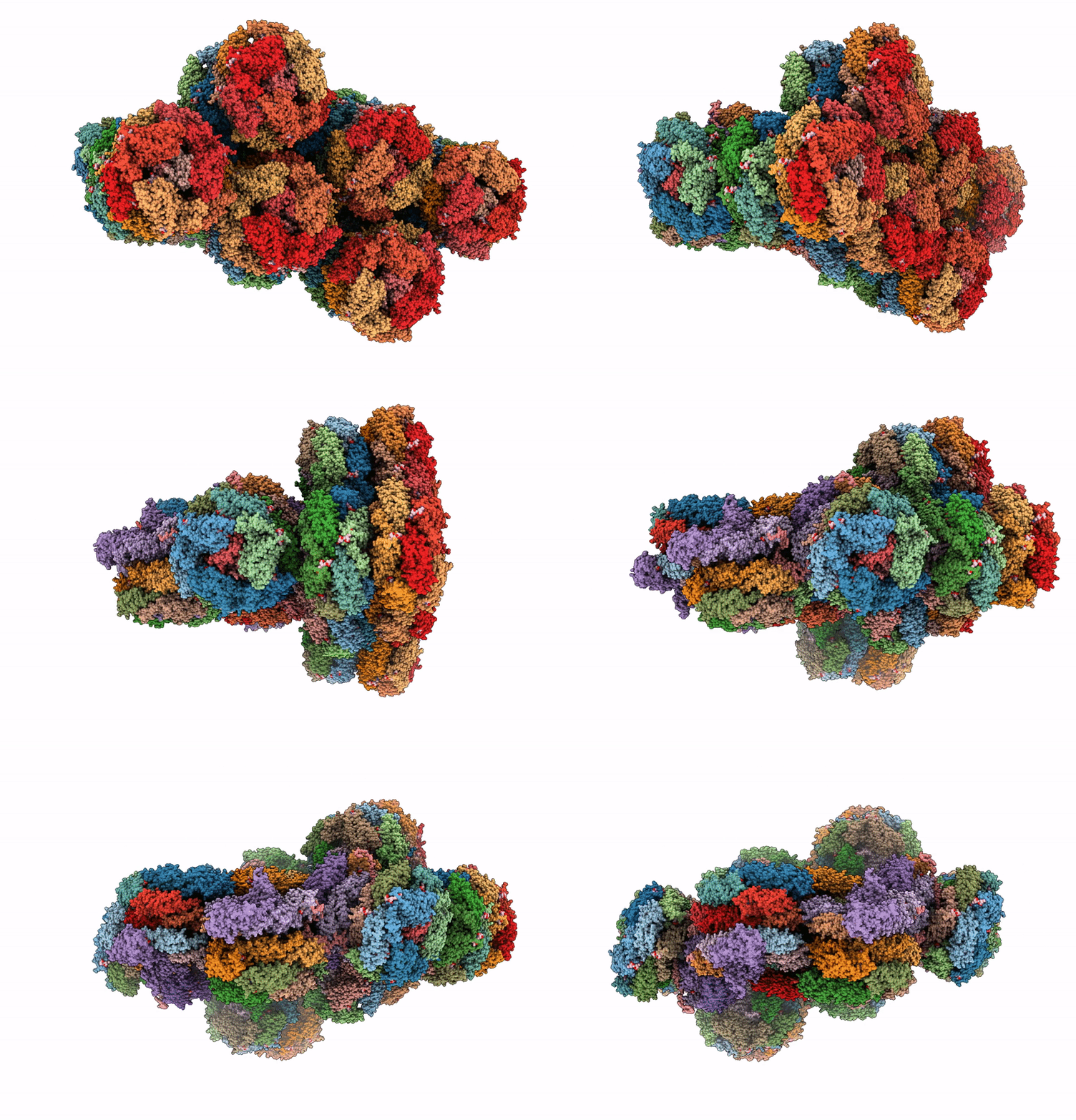
9K9W image
Deposition Date 2024-10-28
Release Date 2025-12-03
Last Version Date 2025-12-10
Entry Detail
PDB ID:
9K9W
Keywords:
Title:
structure of bundle-shaped PBS with short rod
Biological Source:
Source Organism(s):
Method Details:
Experimental Method:
Resolution:
2.80 Å
Aggregation State:
PARTICLE
Reconstruction Method:
SINGLE PARTICLE
Macromolecular Entities
Structures with similar UniProt ID
Protein Blast
Polymer Type:polypeptide(L)
Molecule:Allophycocyanin beta subunit
Gene (Uniprot):apcB
Chain IDs:A, B (auth: Z), PC (auth: L5), RC (auth: N5), XC (auth: B5), ZC (auth: D5), BD (auth: F5), DD (auth: H5), FD (auth: J5), ID (auth: d5), KD (auth: f5), LD (auth: P5), ND (auth: R5), PD (auth: T5), RD (auth: V5), TD (auth: X5), VD (auth: Z5), XD (auth: b5), TE (auth: P7), VE (auth: R7), XE (auth: B7), ZE (auth: D7), BF (auth: F7), DF (auth: H7), FF (auth: J7), HF (auth: L7), JF (auth: N7), LF (auth: h7), NF (auth: j7), PF (auth: T7), RF (auth: V7), TF (auth: X7), VF (auth: Z7), XF (auth: b7), ZF (auth: d7), BG (auth: f7), IG (auth: l7), KG (auth: n7), MG (auth: p7), OG (auth: r7), QG (auth: t7), SG (auth: v7)
Chain Length:161
Number of Molecules:42
Biological Source:Gloeobacter violaceus PCC 7421
Structures with similar UniProt ID
Protein Blast
Polymer Type:polypeptide(L)
Molecule:Phycocyanin alpha chain
Gene (Uniprot):cpcA
Chain IDs:C (auth: AA), E (auth: CA), G (auth: EA), I (auth: GA), K (auth: IA), M (auth: KA), Q (auth: OA), S (auth: QA), U (auth: SA), W (auth: UA), Y (auth: WA), AA (auth: YA), CA (auth: O1), EA (auth: Q1), GA (auth: S1), HA (auth: A1), IA (auth: G3), KA (auth: I3), MA (auth: K3), NA (auth: G2), PA (auth: I2), RA (auth: K2), VA (auth: A3), XA (auth: C3), ZA (auth: E3), CB (auth: A4), EB (auth: C4), JB (auth: O3), LB (auth: Q3), NB (auth: S3), PB (auth: U3), RB (auth: W3), TB (auth: Y3), WB (auth: T4), YB (auth: V4), AC (auth: E4), CC (auth: G4), EC (auth: I4), GC (auth: K4), JC (auth: N4), LC (auth: P4), NC (auth: R4), TC (auth: X4), GD (auth: C1), ZD (auth: K6), IE (auth: A6), KE (auth: C6), ME (auth: E6), OE (auth: G6), QE (auth: I6), CG (auth: E1), DG (auth: A8), FG (auth: C8), HG (auth: E8), XG (auth: T8), ZG (auth: V8), BH (auth: X8), DH (auth: G8), FH (auth: I8), HH (auth: K8), KH (auth: N8), MH (auth: P8), OH (auth: R8), UH (auth: O9), WH (auth: Q9), ZH (auth: A9), BI (auth: C9), DI (auth: E9), FI (auth: G9), HI (auth: I9), JI (auth: K9), LI (auth: S9), NI (auth: U9), PI (auth: W9), RI (auth: Y9), TI (auth: G1), XI (auth: I1), ZI (auth: K1), EJ (auth: U1), GJ (auth: W1), IJ (auth: Y1), KJ (auth: A2), MJ (auth: C2), OJ (auth: E2)
Chain Length:162
Number of Molecules:84
Biological Source:Gloeobacter violaceus PCC 7421
Structures with similar UniProt ID
Protein Blast
Polymer Type:polypeptide(L)
Molecule:Phycocyanin beta chain
Gene (Uniprot):cpcB
Chain IDs:D (auth: BA), F (auth: DA), H (auth: FA), J (auth: HA), L (auth: JA), N (auth: LA), R (auth: PA), T (auth: RA), V (auth: TA), X (auth: VA), Z (auth: XA), BA (auth: ZA), DA (auth: P1), FA (auth: R1), JA (auth: H3), LA (auth: J3), OA (auth: H2), QA (auth: J2), SA (auth: L2), WA (auth: B3), YA (auth: D3), AB (auth: F3), BB (auth: Z3), DB (auth: B4), FB (auth: D4), GB (auth: L3), KB (auth: P3), MB (auth: R3), OB (auth: T3), QB (auth: V3), SB (auth: X3), UB (auth: B1), VB (auth: S4), XB (auth: U4), ZB (auth: W4), BC (auth: F4), DC (auth: H4), FC (auth: J4), HC (auth: L4), KC (auth: O4), MC (auth: Q4), UC (auth: Y4), YD (auth: J6), AE (auth: L6), JE (auth: B6), LE (auth: D6), NE (auth: F6), PE (auth: H6), RE (auth: D1), EG (auth: B8), GG (auth: D8), YG (auth: U8), AH (auth: W8), CH (auth: F8), EH (auth: H8), GH (auth: J8), IH (auth: L8), LH (auth: O8), NH (auth: Q8), PH (auth: S8), QH (auth: F1), RH (auth: L9), VH (auth: P9), XH (auth: Y8), AI (auth: B9), CI (auth: D9), EI (auth: F9), GI (auth: H9), II (auth: J9), KI (auth: R9), MI (auth: T9), OI (auth: V9), QI (auth: X9), SI (auth: Z9), WI (auth: H1), YI (auth: J1), AJ (auth: L1), DJ (auth: T1), FJ (auth: V1), HJ (auth: X1), JJ (auth: Z1), LJ (auth: B2), NJ (auth: D2), PJ (auth: F2)
Chain Length:172
Number of Molecules:84
Biological Source:Gloeobacter violaceus PCC 7421
Structures with similar UniProt ID
Protein Blast
Polymer Type:polypeptide(L)
Molecule:Allophycocyanin alpha subunit
Gene (Uniprot):apcA
Chain IDs:OC (auth: K5), QC (auth: M5), SC (auth: O5), WC (auth: A5), YC (auth: C5), AD (auth: E5), CD (auth: G5), ED (auth: I5), HD (auth: c5), JD (auth: e5), MD (auth: Q5), OD (auth: S5), QD (auth: U5), SD (auth: W5), UD (auth: Y5), WD (auth: a5), DE (auth: A7), SE (auth: O7), UE (auth: Q7), WE (auth: S7), YE (auth: C7), AF (auth: E7), CF (auth: G7), EF (auth: I7), GF (auth: K7), IF (auth: M7), KF (auth: g7), MF (auth: i7), OF (auth: k7), QF (auth: U7), SF (auth: W7), UF (auth: Y7), WF (auth: a7), YF (auth: c7), AG (auth: e7), JG (auth: m7), LG (auth: o7), NG (auth: q7), PG (auth: s7), RG (auth: u7)
Chain Length:161
Number of Molecules:40
Biological Source:Gloeobacter violaceus PCC 7421
Structures with similar UniProt ID
Protein Blast
Polymer Type:polypeptide(L)
Molecule:Glr2806 protein
Gene (Uniprot):glr2806
Chain IDs:TA (auth: M2), BE (auth: M6)
Chain Length:729
Number of Molecules:2
Biological Source:Gloeobacter violaceus PCC 7421
Structures with similar UniProt ID
Protein Blast
Polymer Type:polypeptide(L)
Molecule:Phycocyanin-associated rod linker protein
Gene (Uniprot):cpcC
Chain IDs:O (auth: MA), HB (auth: M3), IC (auth: M4), JH (auth: M8), SH (auth: M9), BJ (auth: M1)
Chain Length:274
Number of Molecules:6
Biological Source:Gloeobacter violaceus PCC 7421
Structures with similar UniProt ID
Protein Blast
Polymer Type:polypeptide(L)
Molecule:CpcD protein
Gene (Uniprot):cpcD
Chain IDs:UA (auth: N2), CE (auth: N6)
Chain Length:70
Number of Molecules:2
Biological Source:Gloeobacter violaceus PCC 7421
Structures with similar UniProt ID
Protein Blast
Polymer Type:polypeptide(L)
Molecule:Phycocyanin-associated rod linker protein
Gene (Uniprot):cpcC
Chain IDs:P (auth: NA), IB (auth: N3), VC (auth: Z4), TH (auth: N9), YH (auth: Z8), CJ (auth: N1)
Chain Length:275
Number of Molecules:6
Biological Source:Gloeobacter violaceus PCC 7421
Structures with similar UniProt ID
Protein Blast
Polymer Type:polypeptide(L)
Molecule:Glr1262 protein
Gene (Uniprot):glr1262
Chain IDs:UI (auth: a9), VI (auth: aA)
Chain Length:824
Number of Molecules:2
Biological Source:Gloeobacter violaceus PCC 7421
Structures with similar UniProt ID
Protein Blast
Polymer Type:polypeptide(L)
Molecule:Phycobiliprotein ApcE
Gene (Uniprot):apcE
Chain IDs:GE (auth: j5), HE (auth: k5)
Chain Length:161
Number of Molecules:2
Biological Source:Gloeobacter violaceus PCC 7421
Structures with similar UniProt ID
Protein Blast
Polymer Type:polypeptide(L)
Molecule:Phycobilisome 7.8 kDa linker polypeptide, allophycocyanin-associated, core
Gene (Uniprot):apcC
Chain IDs:EE (auth: z5), FE (auth: i5), TG (auth: z7), UG (auth: w7), VG (auth: x7), WG (auth: y7)
Chain Length:161
Number of Molecules:6
Biological Source:Gloeobacter violaceus PCC 7421
Modified Residue
Compound ID Chain ID Parent Comp ID Details 2D Image
MEN A ASN modified residue
Ligand Molecules
Primary Citation
Light-induced structural adaptation of the bundle-shaped phycobilisome from thylakoid-lacking cyanobacterium Gloeobacter violaceus.
Nat Commun 16 5956 5956 (2025)
PMID: 40593595 DOI: 10.1038/s41467-025-60673-w

Abstact

Gloeobacter diverged from other lineages early in cyanobacterial evolution, preferentially growing under low light intensity conditions. Among cyanobacteria, G. violaceus exhibits unique features, including lack of a thylakoid membrane and bundle-shaped antenna phycobilisomes (PBSs), densely packed and well-organized on the plasma membrane. However, without high-resolution structures, it has remained unclear how G. violaceus PBSs assemble into a bundle-shaped configuration. Here we solve the cryo-EM structures of PBSs from G. violaceus cells cultured under low (Sr-PBS) or moderate (Lr-PBS) light intensity. These structures reveal two unique linker proteins, LRC91kDa and LRC81kDa, that play a key role in the PBS architecture. Analysis of the bilin arrangement indicates that the bundle-shaped structure allows efficient energy transfer among rods. Moreover, comparison between Lr-PBS and Sr-PBS uncovers a distinct mode of adaption to increased light intensity wherein the ApcA2-ApcB3-ApcD layer can be blocked from binding to the core by altering structural elements exclusively found in the G. violaceus LCM. This study illustrates previously unrecognized mechanisms of assembly and adaptation to varying light intensity in the bundle-shaped PBS of G. violaceus.

Legend

Protein

Chemical

Disease

Primary Citation of related structures
Feedback Form
Name
Email
Institute
Feedback