9K8V image
Deposition Date 2024-10-24
Release Date 2025-10-29
Last Version Date 2025-11-19
Entry Detail
PDB ID:
9K8V
Title:
Cryo-EM structure of the Type II secretion system protein from Vibrio cholerae
Biological Source:
Source Organism:
Vibrio cholerae (Taxon ID: 666)
Host Organism:
Method Details:
Experimental Method:
Resolution:
2.39 Å
Aggregation State:
PARTICLE
Reconstruction Method:
SINGLE PARTICLE
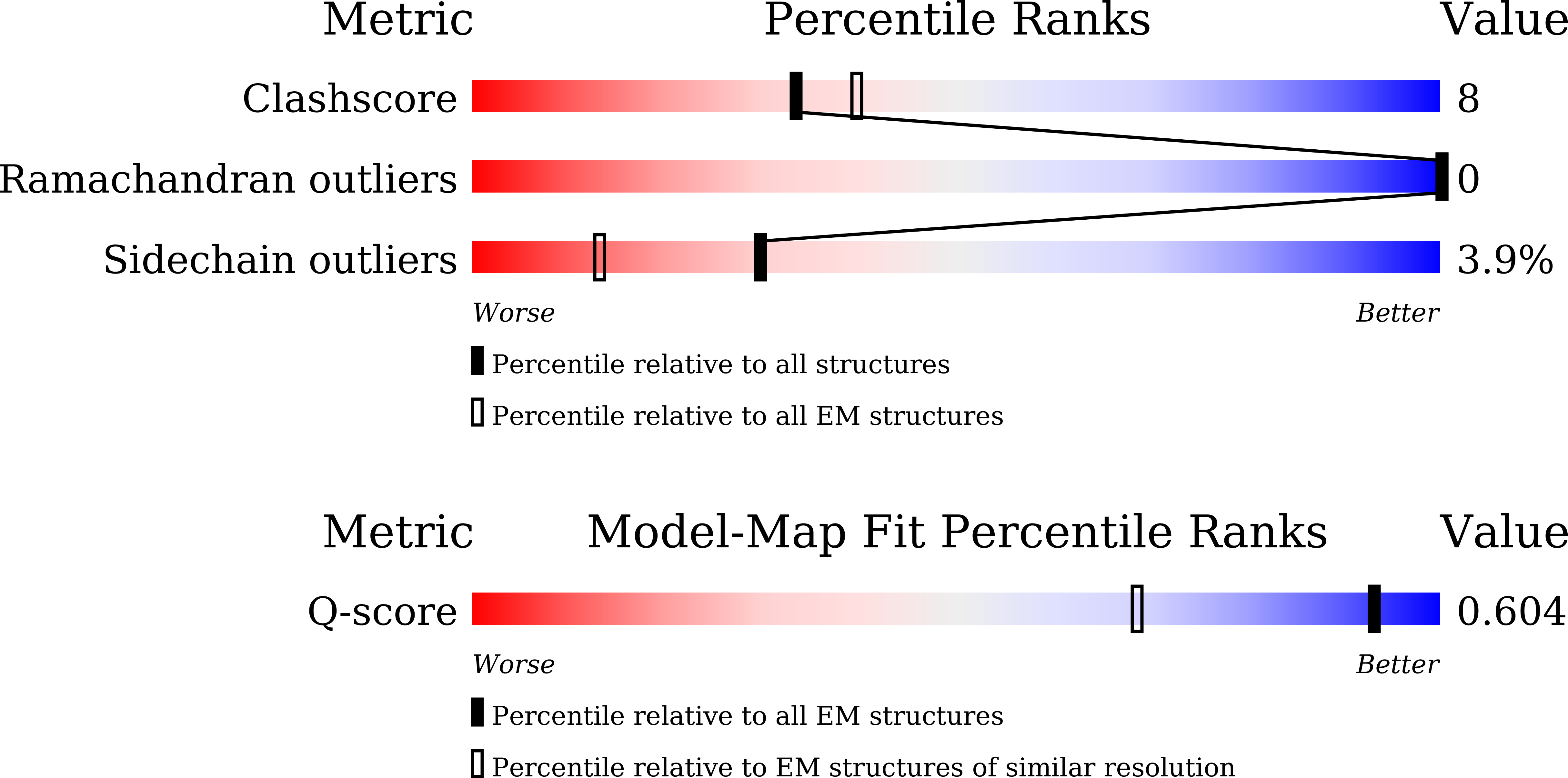
Macromolecular Entities
Structures with similar UniProt ID
Protein Blast
Polymer Type:polypeptide(L)
Molecule:General secretion pathway protein D
Gene (Uniprot):gspD
Chain IDs:A, B, C, D, E, F, G, H, I, J, K, L, M, N, O
Chain Length:420
Number of Molecules:15
Biological Source:Vibrio cholerae
Ligand Molecules
Primary Citation
Tailoring Vibrio-Type Secretin Channel Protein GspD Toward "One-Take" Dual-Constriction Nanopore Sensors.
Small ? e05878 e05878 (2025)
PMID: 41110147 DOI: 10.1002/smll.202505878

Abstact

Dual-constriction nanopores offer a second sensing region that enhances the interactions with analytes at the single-molecule level. However, existing biological nanopore complexes, i.e., CsgG-CsgF, are prone to dissociation upon high voltages, enforcing the development of robust "one-take" platforms. Here, Type II general secretin protein D from Vibrio cholerae (VcGspD) as a promising scaffold with dual-constrictions is proposed and engineered. Biochemical analysis reveals that truncation of the N0-N2 domains yields stable multimerization, with the N3 domain being essential. Cryo-electron microscopy (Cryo-EM) resolves the truncated VcGspD (N0-N2) as a 15-mer architecture, confirming its structural integrity and determining localizations of P471 and F472. By introducing a point mutation at position 346 (S346C) and conjugating cholesterol-maleimide, stable channel insertion in lipid bilayers is achieved. Electrophysiological characterization demonstrates a predominantly low-conductance dual-constriction architecture with constriction diameters of ≈2 nm both at the cap and central constriction sites. The F472A mutation, together with the mutations on both constrictions, gives rise to convergent open-channel current and confers high-voltage stability, thus enabling efficient sensing of both single-stranded DNA and polypeptides. The findings establish VcGspD as a promising platform toward dual-constriction nanopore sensing, paving the way for advancements in the development and engineering of secretin channels.

Legend

Protein

Chemical

Disease

Primary Citation of related structures
Feedback Form
Name
Email
Institute
Feedback