9K6J image
Deposition Date 2024-10-22
Release Date 2026-01-07
Last Version Date 2026-01-07
Entry Detail
PDB ID:
9K6J
Title:
Crystal structure of SARS-CoV-2 WT RBD bound with P5-1C8 Fab
Biological Source:
Expression System(s):
Method Details:
Experimental Method:
Resolution:
2.39 Å
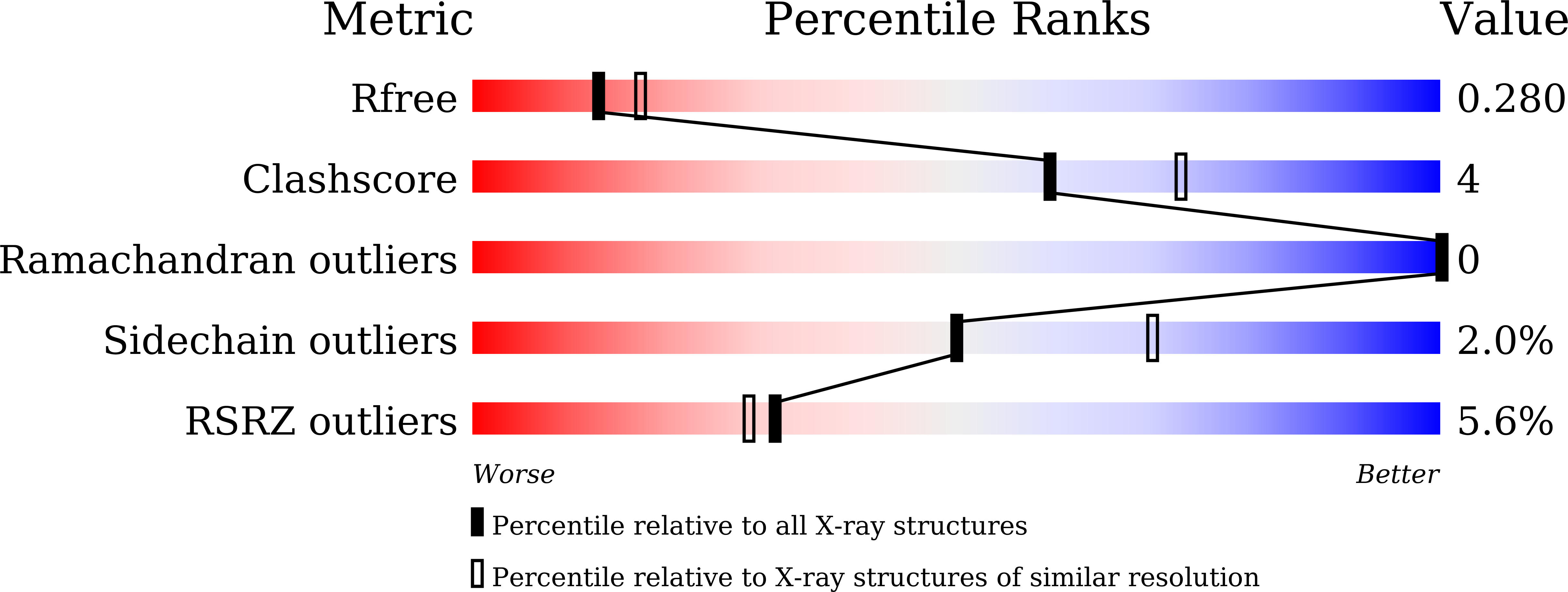
R-Value Free:
0.28
R-Value Work:
0.23
R-Value Observed:
0.23
Space Group:
P 21 21 21
Macromolecular Entities
Polymer Type:polypeptide(L)
Molecule:H chain of P5-1C8 Fab
Chain IDs:B (auth: A)
Chain Length:217
Number of Molecules:1
Biological Source:Homo sapiens
Polymer Type:polypeptide(L)
Molecule:L chain of P5-1C8 Fab
Chain IDs:C (auth: B)
Chain Length:211
Number of Molecules:1
Biological Source:Homo sapiens
Structures with similar UniProt ID
Protein Blast
Polymer Type:polypeptide(L)
Molecule:Spike protein S1
Gene (Uniprot):S
Chain IDs:A (auth: C)
Chain Length:271
Number of Molecules:1
Biological Source:Severe acute respiratory syndrome coronavirus 2
Ligand Molecules
Primary Citation
IgG-Bridging-Seeded Synergistic Aggregation of SARS-CoV-2 Spikes Underlies Potent Neutralization by a Low-Affinity Antibody.
Adv Sci ? e17192 e17192 (2025)
PMID: 41355083 DOI: 10.1002/advs.202517192

Abstact

Mechanistic studies of viral neutralization typically prioritize high-affinity antibodies, relegating low-affinity binders to the sidelines. P5‑1C8, a Class 1 SARS-CoV-2 antibody that exemplifies this underexplored "low‑affinity yet high‑potency" phenotype is reported, retaining strong neutralization of Omicron JN.1 despite markedly weakened trimer binding (KD = 225 nM; IC50 = 0.06 nM). Structural and biophysical analyses reveal that P5-1C8 engages WT and BA.1 spikes through canonical intra-spike bivalency, but with JN.1 it induces aggregation. Using virion-like nanoparticles displaying multiple spikes, it is shown that IgG remains bound with no detectable dissociation and triggers pronounced aggregation. Coarse-grained molecular dynamics delineate the stepwise pathway in which weak IgG-spike contacts seed aggregation via transient inter-spike bridging. Together, these findings establish the first mechanistic framework demonstrating how weak-binding antibodies can nonetheless achieve potent neutralization through higher-order aggregation, thereby expanding the conceptual landscape of antibody function and opening new directions for antibody evaluation and design.

Legend

Protein

Chemical

Disease

Primary Citation of related structures
Feedback Form
Name
Email
Institute
Feedback