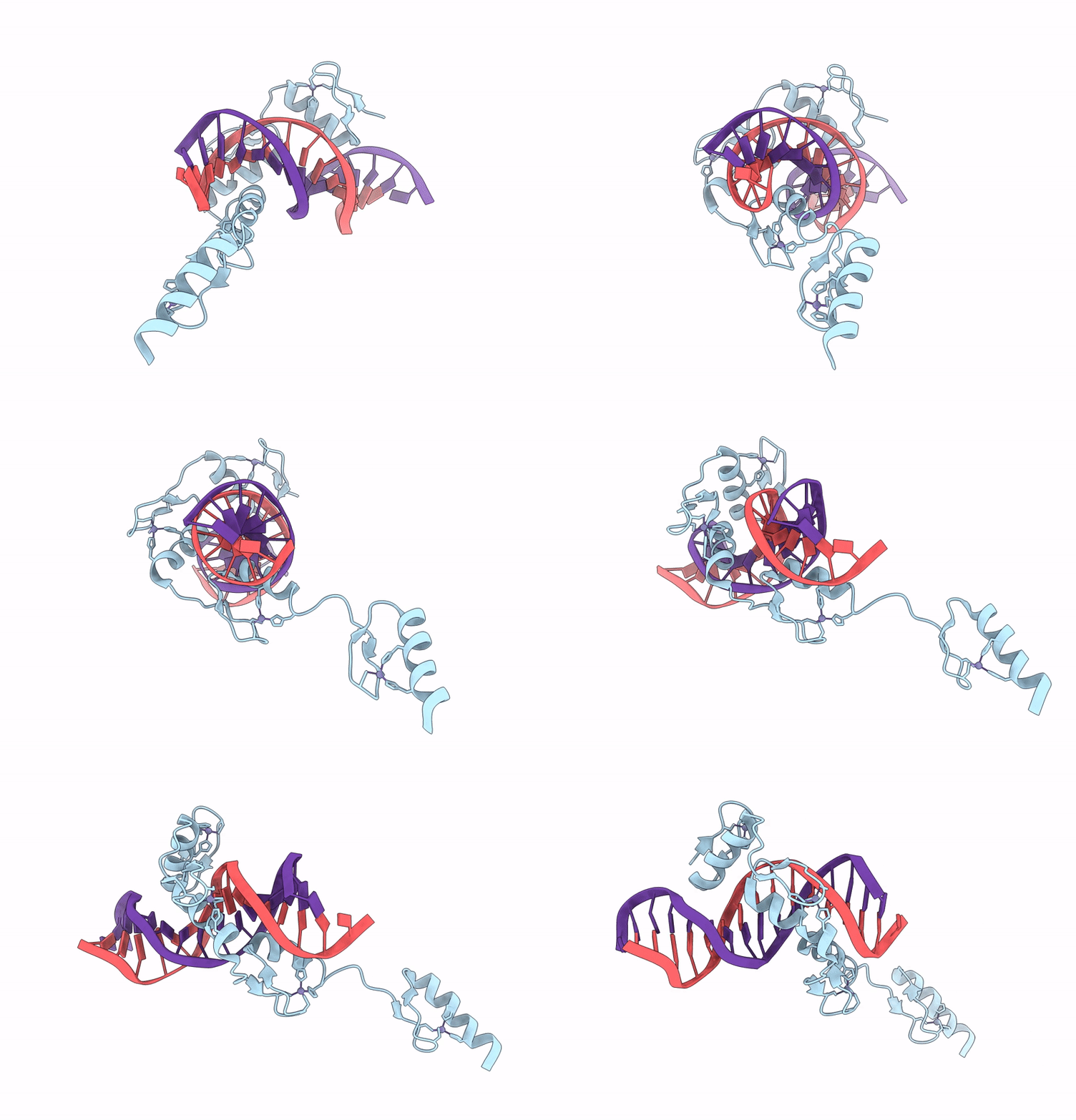
9JZT image
Deposition Date 2024-10-14
Release Date 2025-10-15
Last Version Date 2025-10-15
Entry Detail
PDB ID:
9JZT
Keywords:
Title:
Crystal structure of ZBTB20 in complex with mouse AFP promoter
Biological Source:
Source Organism:
Homo sapiens (Taxon ID: 9606)
Mus musculus (Taxon ID: 10090)
Host Organism:
Method Details:
Experimental Method:
Resolution:
3.10 Å
R-Value Free:
0.24
R-Value Work:
0.20
R-Value Observed:
0.20
Space Group:
P 42 21 2

Macromolecular Entities
Structures with similar UniProt ID
Protein Blast
Polymer Type:polypeptide(L)
Molecule:Zinc finger and BTB domain-containing protein 20
Gene (Uniprot):ZBTB20
Chain IDs:A
Chain Length:118
Number of Molecules:1
Biological Source:Homo sapiens
Polymer Type:polydeoxyribonucleotide
Molecule:DNA (5'-D(*CP*TP*TP*CP*CP*TP*TP*AP*CP*GP*TP*TP*GP*AP*AP*G)-3')
Chain IDs:B
Chain Length:16
Number of Molecules:1
Biological Source:Mus musculus
Polymer Type:polydeoxyribonucleotide
Molecule:DNA (5'-D(*GP*CP*TP*TP*CP*AP*AP*CP*GP*TP*AP*AP*GP*GP*AP*A)-3')
Chain IDs:C
Chain Length:16
Number of Molecules:1
Biological Source:Mus musculus
Ligand Molecules
Primary Citation
Structural insights into ZBTB20 action at the AFP promoter.
Structure 33 1398 1407.e2 (2025)
PMID: 40494351 DOI: 10.1016/j.str.2025.05.009

Abstact

ZBTB20, a C2H2 zinc finger and broad-complex, tramtrack and bric-à-brac (BTB) domain-containing protein, is crucial for organ development and metabolic homeostasis. Its functionality is dependent on its DNA-binding zinc fingers, and heterozygous mutations within these regions are linked to Primrose syndrome, which is characterized by various physical and developmental abnormalities. However, the molecular basis underlying ZBTB20 zinc finger recognition of DNA remains largely unknown. Here, we present the crystal structure of ZBTB20 zinc fingers 1-4 (ZF1-4) in complex with the mouse alpha-fetoprotein (AFP) promoter in the region spanning positions -104 to -90. In combination with calorimetric analysis, we established that ZF1-3 is essential for the recognition of the AFP promoter and identified key residues involved in DNA binding. Furthermore, our data allow us to correlate Primrose syndrome mutations with alterations in DNA-binding efficacy. Overall, our study provides mechanistic insights into the physiological and pathological roles of ZBTB20 zinc fingers.

Legend

Protein

Chemical

Disease

Primary Citation of related structures
Feedback Form
Name
Email
Institute
Feedback