Planned Maintenance: Some services may turn out to be unavailable from 15th January, 2026 to 16th January, 2026. We apologize for the inconvenience!

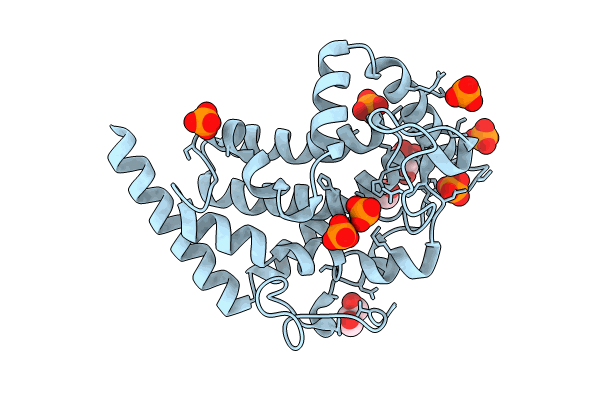
9JQ0 image
Deposition Date 2024-09-27
Release Date 2024-11-06
Last Version Date 2025-11-19
Entry Detail
PDB ID:
9JQ0
Keywords:
Title:
Acid phosphatase KpAP mutant - E104G
Biological Source:
Source Organism(s):
Expression System(s):
Method Details:
Experimental Method:
Resolution:
1.93 Å
R-Value Free:
0.19
R-Value Work:
0.17
R-Value Observed:
0.17
Space Group:
P 63 2 2
Macromolecular Entities
Structures with similar UniProt ID
Protein Blast
Polymer Type:polypeptide(L)
Molecule:Acid phosphatase
Gene (Uniprot):KPK_3238
Mutagens:E122G
Chain IDs:A
Chain Length:233
Number of Molecules:1
Biological Source:Klebsiella pneumoniae
Primary Citation
Modulating phosphate transfer process for promoting phosphorylation activity of acid phosphatase.
Bioresour Technol 427 132348 132348 (2025)
PMID: 40081774 DOI: 10.1016/j.biortech.2025.132348

Abstact

Klebsiella pneumonia acid phosphatase is widely employed in the large-scale synthesis of nucleotides. It was found that the phosphate acceptance capability of the substrate limited the efficiency of the phosphate transfer process. By reducing steric hindrance and optimizing substrate interaction with the catalytic site, variants of Klebsiella pneumonia acid phosphatase were designed, with the E104G variant showing significantly enhanced hydrolysis activity while maintaining high phosphorylation activity. Crystal structure and quantum mechanics/molecular mechanics analyses of the E104G variant revealed that the mutation promotes substrate binding and lowers the energy barrier. Based on these insights, several mutations were designed, achieving significantly improved conversion rates. By knocking out degradation-related enzymes, the degradation rates of inosinic acid and guanylic acid were successfully controlled. This study provides a structure-based top-down design strategy that effectively enhances enzyme specificity, offering a promising enzyme candidate for large-scale nucleotide synthesis.

Legend

Protein

Chemical

Disease

Primary Citation of related structures
Feedback Form
Name
Email
Institute
Feedback