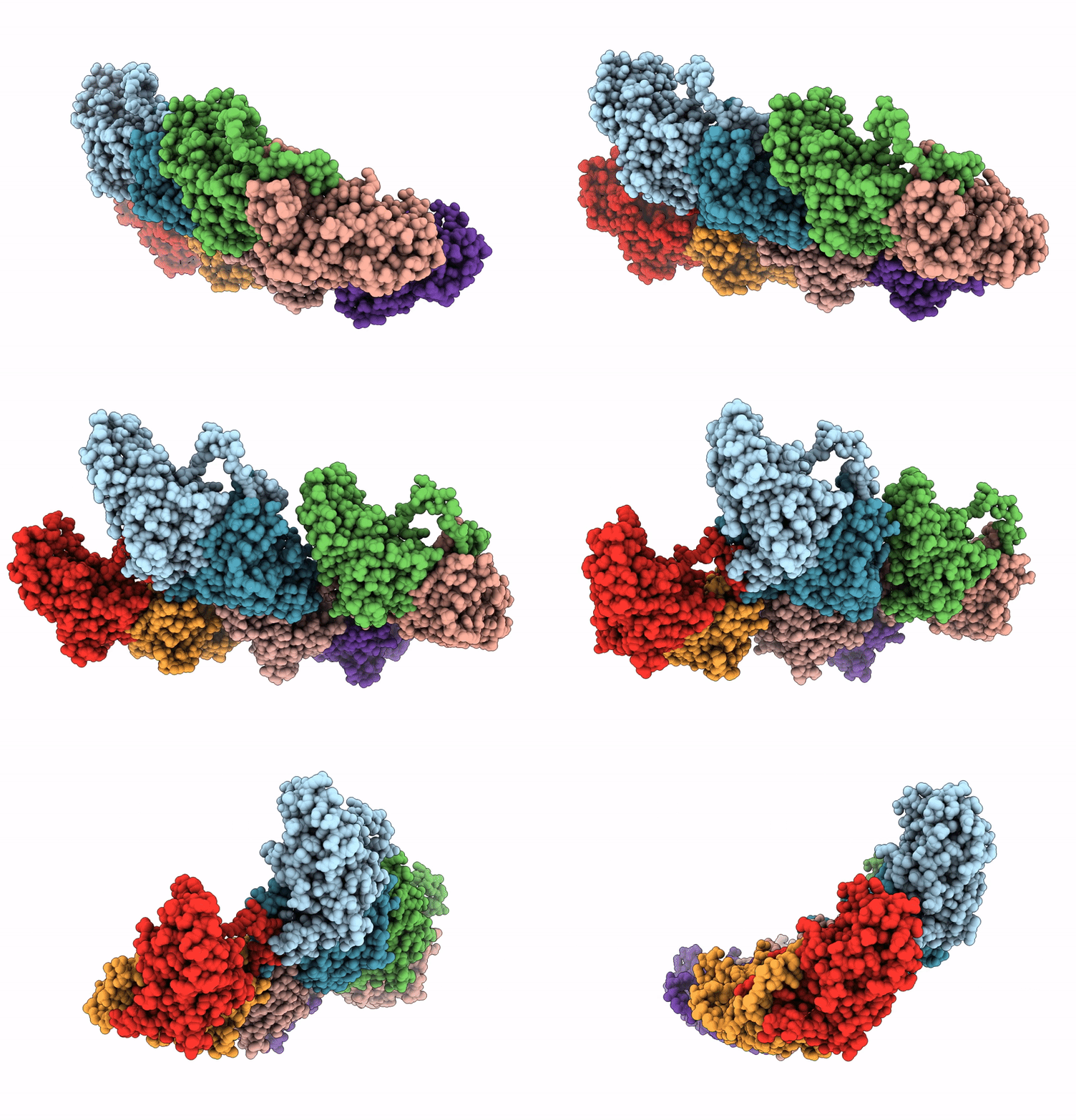
9JPR image
Deposition Date 2024-09-26
Release Date 2025-10-22
Last Version Date 2026-01-28
Entry Detail
PDB ID:
9JPR
Keywords:
Title:
Local refinement of H11 nanotubes assembled from baculovirus capsid protein
Biological Source:
Expression System(s):
Method Details:
Experimental Method:
Resolution:
2.80 Å
Aggregation State:
HELICAL ARRAY
Reconstruction Method:
SINGLE PARTICLE

Macromolecular Entities
Protein Blast
Polymer Type:polypeptide(L)
Molecule:Glutathione S-transferase class-mu 26 kDa isozyme,Viral capsid 39 protein
Gene (Uniprot):ORF-77, ORF-78
Chain IDs:A, B, C, D, E, F, G, H
Chain Length:529
Number of Molecules:8
Biological Source:Schistosoma japonicum, Helicoverpa armigera nucleopolyhedrovirus
Ligand Molecules
Primary Citation
Structural polymorphism of two-dimensional lattices assembled from baculoviral capsid proteins.
Virol Sin 40 935 945 (2025)
PMID: 41265796 DOI: 10.1016/j.virs.2025.11.005

Abstact

Protein nanotubes (PNTs) can be regarded as two-dimensional (2D) lattices with p1 or p2 symmetry rolled into tubes. However, attempts to re-assemble their building blocks into stable 2D nanomaterials often fail. Here, starting from two baculoviral capsid proteins, we screened protein variants for the in vitro assembly of various nanotubes and nanosheets. These high-order assemblies were structurally characterized by cryo-electron microscopy techniques. Interfacial analysis of three groups of PNTs revealed that helical heterogeneity is largely the result of the redundancy of p2 symmetry-related contacting interfaces. The assembled nanosheets showed similar interfacial networks to their nanotubular counterparts. In addition, foreign macromolecules could be efficiently displayed on the size-controllable double-layered nanosheets. This study sheds light on the rational design of flexible nanosheets, and it also provides novel 2D protein scaffolds for developing biocompatible materials.

Legend

Protein

Chemical

Disease

Primary Citation of related structures
Feedback Form
Name
Email
Institute
Feedback