Planned Maintenance: Some services may turn out to be unavailable from 15th January, 2026 to 16th January, 2026. We apologize for the inconvenience!

9JMS image
Deposition Date 2024-09-21
Release Date 2025-09-24
Last Version Date 2026-01-14
Entry Detail
PDB ID:
9JMS
Title:
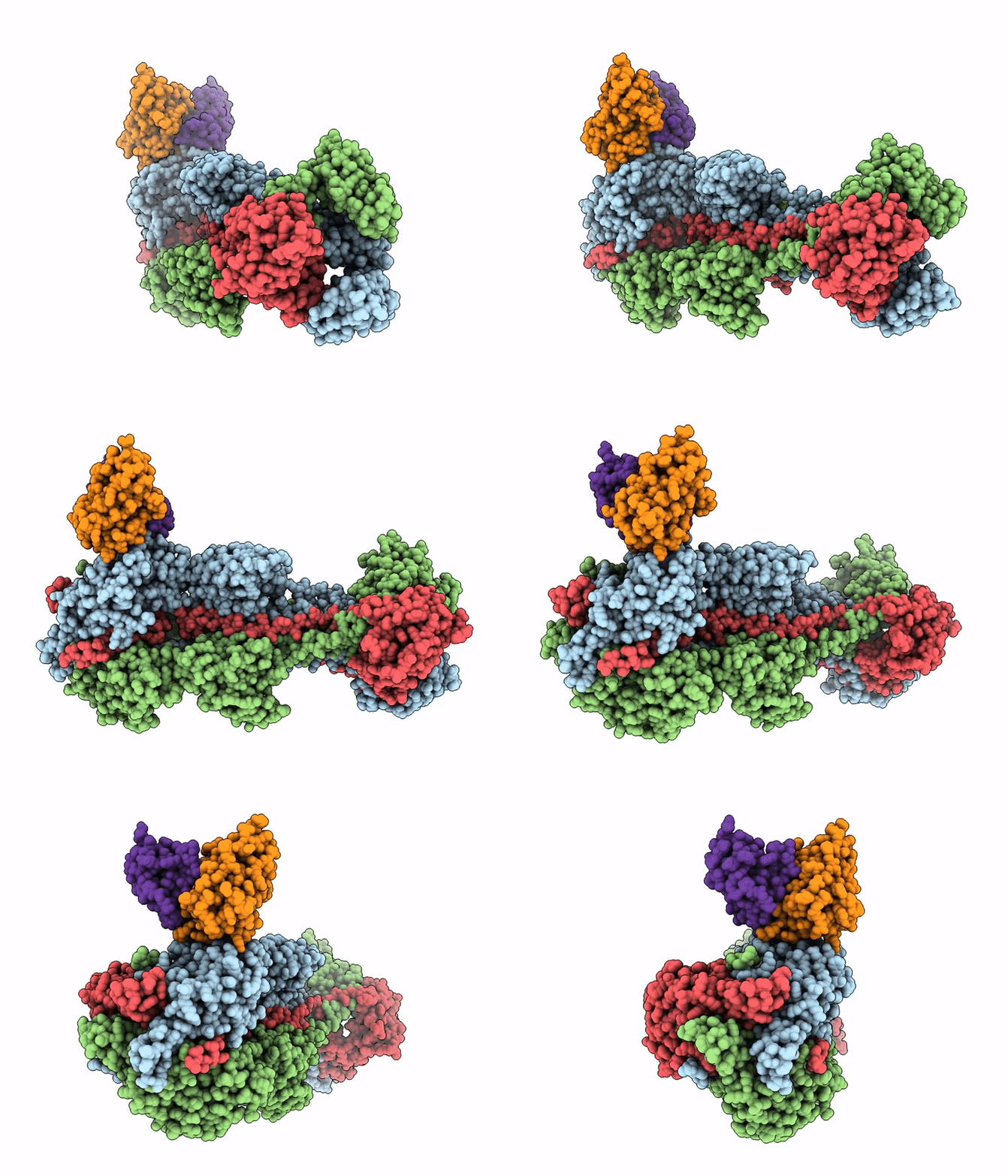
Cryo-EM structure of VZV gB and FAB 16F9 complex
Biological Source:
Source Organism(s):
Expression System(s):
Method Details:
Experimental Method:
Resolution:
3.12 Å
Aggregation State:
PARTICLE
Reconstruction Method:
SINGLE PARTICLE

Macromolecular Entities
Structures with similar UniProt ID
Protein Blast
Polymer Type:polypeptide(L)
Molecule:Glycoprotein B
Chain IDs:A, B, C
Chain Length:752
Number of Molecules:3
Biological Source:Human herpesvirus 3
Polymer Type:polypeptide(L)
Molecule:16F9 VH
Chain IDs:D (auth: H)
Chain Length:477
Number of Molecules:1
Biological Source:Mus musculus
Polymer Type:polypeptide(L)
Molecule:16F9 VL
Chain IDs:E (auth: L)
Chain Length:232
Number of Molecules:1
Biological Source:Mus musculus
Ligand Molecules
Primary Citation
A broadly neutralizing antibody confers cross-genus protection against alphaherpesviruses by inhibiting gB-mediated membrane fusion.
Nat Commun 16 11144 11144 (2025)
PMID: 41402251 DOI: 10.1038/s41467-025-66099-8

Abstact

The global prevalence and disease burden of alphaherpesviruses infections, including human-infecting viruses such as HSV-1, HSV-2, and VZV, as well as animal-infecting viruses like PRV, BHV, CHV, and FHV, highlight the unmet need for more effective and universal antiviral strategies. However, there has been no significant progress in developing broad-spectrum interventions against herpesvirus. Here we report the identification of a broadly neutralizing antibody against alphaherpesviruses, 16F9, which targets the glycoprotein B (gB) of alphaherpesviruses and offers cross-protection against multiple viruses such as HSV-1, HSV-2, and PRV in mice. 16F9 demonstrated robust therapeutic efficacy in various female mouse models of herpesvirus diseases including PRV-induced viral encephalitis, HSV-1-induced viral encephalitis, viral keratitis, cutaneous herpes, and neonatal herpesvirus infections. High-resolution cryo-electron microscopy structures revealed that 16F9 binds a conserved site of vulnerability on Domain I of gB. The binding of 16F9 disrupts the interaction between pre-gB and gHgL complex, thereby preventing viral membrane fusion and blocking viral infection. This study provides a foundation for advancing antiviral strategies and underscores the potential of gB-targeted interventions for combating herpesvirus infections.

Legend

Protein

Chemical

Disease

Primary Citation of related structures
Feedback Form
Name
Email
Institute
Feedback