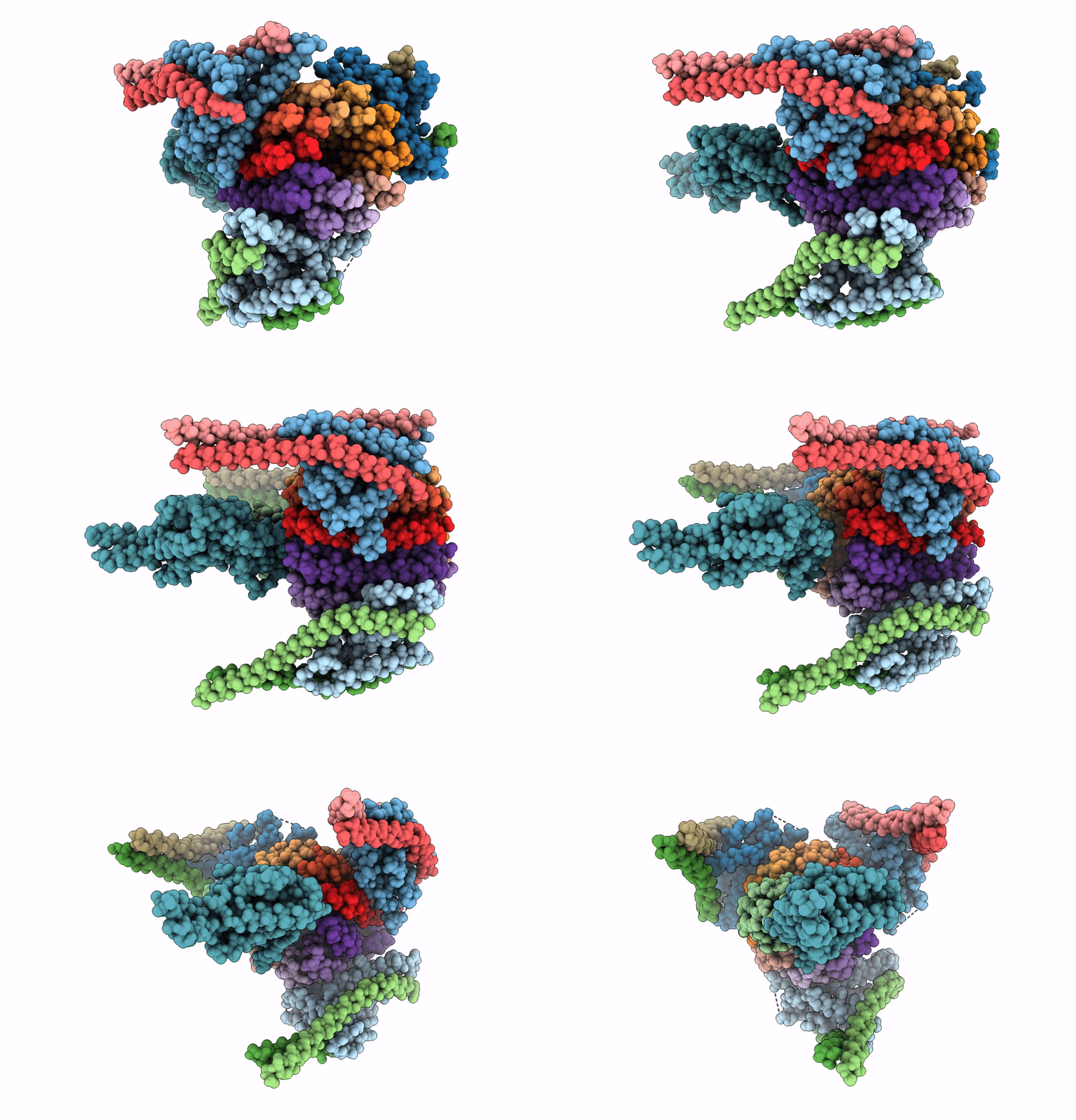
9JC2 image
Deposition Date 2024-08-28
Release Date 2025-07-09
Last Version Date 2025-07-16
Entry Detail
PDB ID:
9JC2
Title:
Engineering of ATP synthase Fo
Biological Source:
Source Organism:
Host Organism:
Method Details:
Experimental Method:
Resolution:
3.96 Å
Aggregation State:
PARTICLE
Reconstruction Method:
SINGLE PARTICLE

Macromolecular Entities
Polymer Type:polypeptide(L)
Molecule:ATP synthase subunit a
Chain IDs:A, B, C
Chain Length:237
Number of Molecules:3
Biological Source:Bacillus sp. PS3
Structures with similar UniProt ID
Protein Blast
Polymer Type:polypeptide(L)
Molecule:ATP synthase gamma chain
Gene (Uniprot):uncG
Chain IDs:D
Chain Length:285
Number of Molecules:1
Biological Source:Bacillus sp. PS3
Structures with similar UniProt ID
Protein Blast
Polymer Type:polypeptide(L)
Molecule:ATP synthase epsilon chain
Gene (Uniprot):uncC
Chain IDs:E
Chain Length:87
Number of Molecules:1
Biological Source:Bacillus sp. PS3
Polymer Type:polypeptide(L)
Molecule:ATP synthase subunit b
Chain IDs:F, G, H, I, J, K
Chain Length:169
Number of Molecules:6
Biological Source:Bacillus sp. PS3
Structures with similar UniProt ID
Protein Blast
Polymer Type:polypeptide(L)
Molecule:ATP synthase subunit c
Gene (Uniprot):atpE
Chain IDs:L, M, N, O, P, Q, R, S, T, U
Chain Length:72
Number of Molecules:10
Biological Source:Bacillus sp. PS3
Ligand Molecules
Primary Citation
Engineering of ATP synthase for enhancement of proton-to-ATP ratio.
Nat Commun 16 5410 5410 (2025)
PMID: 40610443 DOI: 10.1038/s41467-025-61227-w

Abstact

FoF1-ATP synthase (FoF1) interconverts the energy of the proton motive force (pmf) and that of ATP through the mechanical rotation. The H+/ATP ratio, one of the most crucial parameters in bioenergetics, varies among species due to differences in the number of H+-binding c-subunits, resulting in H+/ATP ratios ranging from 2.7 to 5. In this study, we seek to significantly enhance the H+/ATP ratio by employing an alternative approach that differs from that of nature. We engineer FoF1 to form multiple peripheral stalks, each bound to a proton-conducting a-subunit. The engineered FoF1 exhibits an H+/ATP ratio of 5.8, surpassing the highest ratios found in naturally occurring FoF1s, enabling ATP synthesis under low pmf conditions where wild-type enzymes cannot synthesize ATP. Structural analysis reveals that the engineered FoF1 forms up to three peripheral stalks and a-subunits. This study not only provides valuable insights into the H+-transport mechanism of FoF1 but also opens up possibilities for engineering the foundation of cellular bioenergetics.

Legend

Protein

Chemical

Disease

Primary Citation of related structures
Feedback Form
Name
Email
Institute
Feedback