9J4V image
Deposition Date 2024-08-10
Release Date 2025-08-13
Last Version Date 2026-01-07
Entry Detail
PDB ID:
9J4V
Title:
Structural basis for recognition of SARS-CoV-2 conserved nucleocapside epitopes by dominant T cell receptors
Biological Source:
Expression System(s):
Method Details:
Experimental Method:
Resolution:
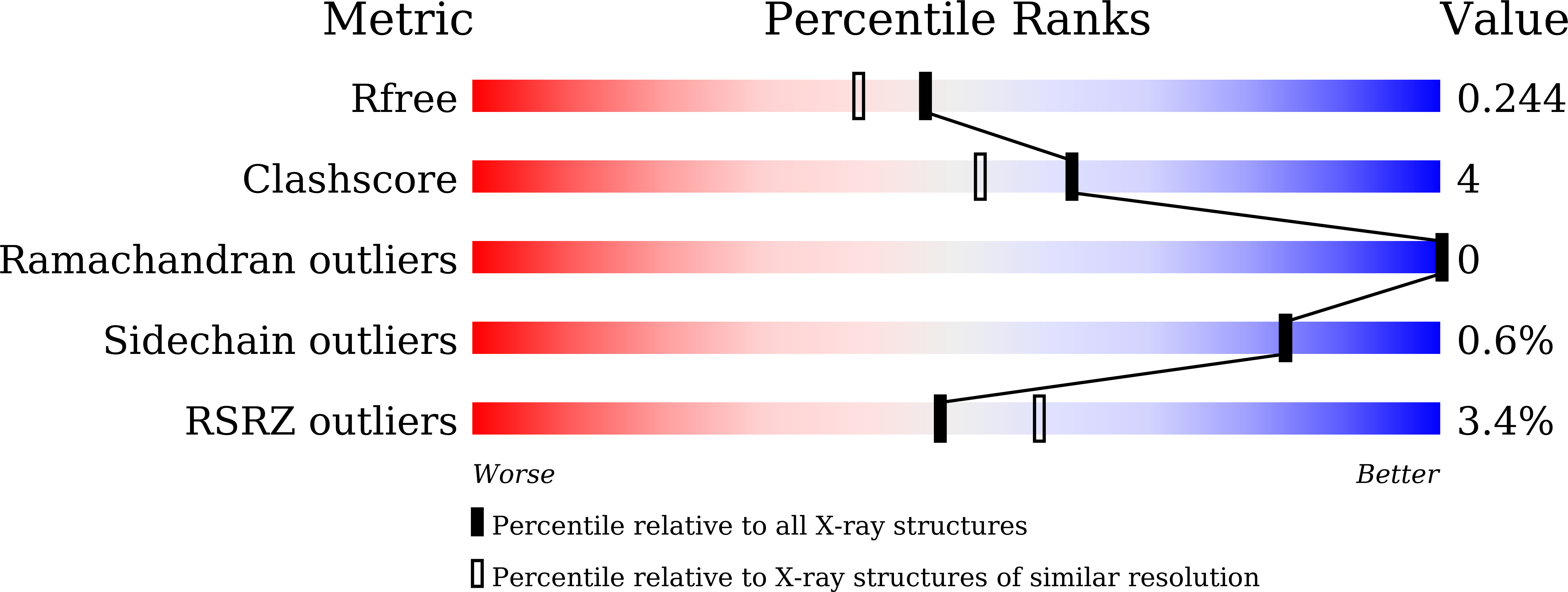
1.98 Å
R-Value Free:
0.24
R-Value Work:
0.21
R-Value Observed:
0.21
Space Group:
P 21 21 2
Macromolecular Entities
Structures with similar UniProt ID
Protein Blast
Polymer Type:polypeptide(L)
Molecule:HLA class I histocompatibility antigen, B alpha chain
Gene (Uniprot):HLA-B
Chain IDs:A, C
Chain Length:276
Number of Molecules:2
Biological Source:Homo sapiens
Structures with similar UniProt ID
Protein Blast
Polymer Type:polypeptide(L)
Molecule:Beta-2-microglobulin
Gene (Uniprot):B2M
Chain IDs:B, D
Chain Length:100
Number of Molecules:2
Biological Source:Homo sapiens
Structures with similar UniProt ID
Protein Blast
Polymer Type:polypeptide(L)
Molecule:Nucleoprotein
Gene (Uniprot):N
Chain IDs:E, F
Chain Length:9
Number of Molecules:2
Biological Source:Severe acute respiratory syndrome coronavirus 2
Primary Citation
Structural insights into clonal restriction and diversity in T cell recognition of two immunodominant SARS-CoV-2 nucleocapsid epitopes.
Nat Commun 16 11457 11457 (2025)
PMID: 41372155 DOI: 10.1038/s41467-025-66322-6

Abstact

T cells play a crucial role in clearing SARS-CoV-2 and in forming long-term memory responses to that coronavirus. The highly immunogenic nucleocapsid (N) protein of SARS-CoV-2 is much more conserved than the spike (S) protein across variants of concern, making it an attractive vaccine target for activating cytotoxic CD8+ T cells. Of particular interest are the immunodominant N epitopes LLL and SPR. Whereas LLL elicits a clonally restricted T cell response, the response to SPR is highly diverse. To understand the basis for this difference, here we determine structures of T cell receptors (TCRs) bound to LLL-HLA-A2 and SPR-HLA-B7, revealing the structural underpinnings of highly restricted Vα gene usage by LLL-specific TCRs, as well as multiple structural solutions to recognizing SPR and thereby generating a clonally diverse T cell response to that epitope. These structures also provide frameworks for understanding T cell recognition of SARS-CoV-2 variants and other coronaviruses. Finally, we compare the X-ray structures of TCR-LLL-HLA-A2 and TCR-SPR-HLA-B7 complexes with models predicted by multiple versions of AlphaFold, highlighting some success while showing room for improvement. Overall, our findings expand understanding of coronavirus T cell recognition, informing vaccine design and advances in computational modeling approaches.

Legend

Protein

Chemical

Disease

Primary Citation of related structures
Feedback Form
Name
Email
Institute
Feedback