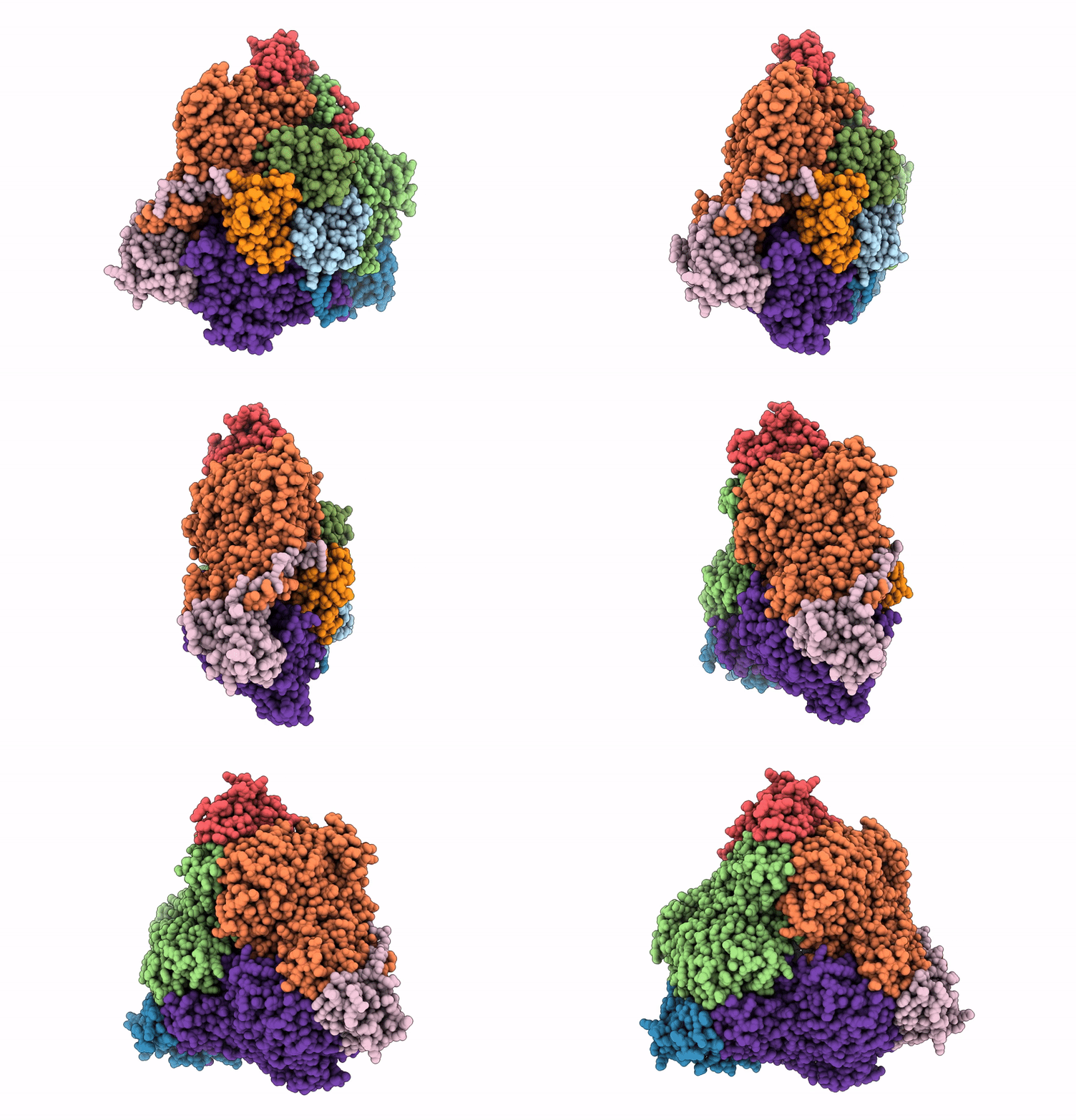
9IT2 image
Deposition Date 2024-07-19
Release Date 2025-08-20
Last Version Date 2025-08-20
Entry Detail
PDB ID:
9IT2
Keywords:
Title:
Cryo-EM structure of urease from Ureaplasma parvum
Biological Source:
Method Details:
Experimental Method:
Resolution:
2.03 Å
Aggregation State:
PARTICLE
Reconstruction Method:
SINGLE PARTICLE
Macromolecular Entities
Structures with similar UniProt ID
Protein Blast
Polymer Type:polypeptide(L)
Molecule:Urease subunit gamma
Gene (Uniprot):ureA
Chain IDs:A, D, G
Chain Length:101
Number of Molecules:3
Biological Source:Ureaplasma parvum serovar 3 (strain ATCC 700970)
Structures with similar UniProt ID
Protein Blast
Polymer Type:polypeptide(L)
Molecule:Urease subunit beta
Gene (Uniprot):ureB
Chain IDs:B, E, H
Chain Length:124
Number of Molecules:3
Biological Source:Ureaplasma parvum serovar 3 (strain ATCC 700970)
Structures with similar UniProt ID
Protein Blast
Polymer Type:polypeptide(L)
Molecule:Urease subunit alpha
Gene (Uniprot):ureC
Chain IDs:C, F, I
Chain Length:598
Number of Molecules:3
Biological Source:Ureaplasma parvum serovar 3 (strain ATCC 700970)
Modified Residue
Compound ID Chain ID Parent Comp ID Details 2D Image
KCX C LYS modified residue
Primary Citation
Structural Analysis and Molecular Dynamics Simulations of Urease From Ureaplasma parvum.
J.Mol.Biol. 437 169368 169368 (2025)
PMID: 40752870 DOI: 10.1016/j.jmb.2025.169368

Abstact

Ureaplasma is one of the smallest pathogenic bacteria, generating approximately 95% of its adenosine triphosphate (ATP) solely through urease. Studies on Ureaplasma parvum, a species of Ureaplasma, have confirmed that adding urease inhibitors inhibits bacterial growth. The Km and Vmax of the urease-mediated reaction were estimated to be 4.3 ± 0.2 mM and 3,333.3 ± 38.0 μmol NH3/min/mg protein, respectively. The cryo-electron microscopy (cryo-EM) structure of Ureaplasma parvum urease (UPU) at a resolution of 2.03 Å reveals a trimer of heterotrimers comprising three proteins: UreA, UreB, and UreC. The active site is well conserved among the known ureases. However, the Vmax of UPU was higher than that of most known ureases, including those ureases derived from Sporosarcina pasteurii (SPU) and Klebsiella aerogenes (KAU) with identical oligomeric state. All-atom molecular dynamics simulations showed that the flap and UreB are more open in UPU than SPU and KAU. His-tagged wild-type recombinant UPU (WT-rUPU) revealed estimated Km and Vmax values of 4.1 ± 0.3 mM and 769.2 ± 7.4 µmol NH3/min/mg protein, respectively. Amino acid substitutions of recombinant UPUs within the flap region to SPU. Amongst the flap region variants, the Vmax of K331N variant was 48-fold lower than that of WT-rUPU. ICP-MS analysis reveals that one molecule of UPU, WT-rUPU, and K331N-rUPU contains 3.7, 0.8, and 0.1 Ni2+ atoms, respectively, suggesting that a wide-open flap of urease may contribute to delivering nickel into the enzyme, resulting in a high Vmax. Ureaplasma evolved highly efficient UPU through a few amino acid substitutions in the disorganized loop of the mobile flap region.

Legend

Protein

Chemical

Disease

Primary Citation of related structures
Feedback Form
Name
Email
Institute
Feedback