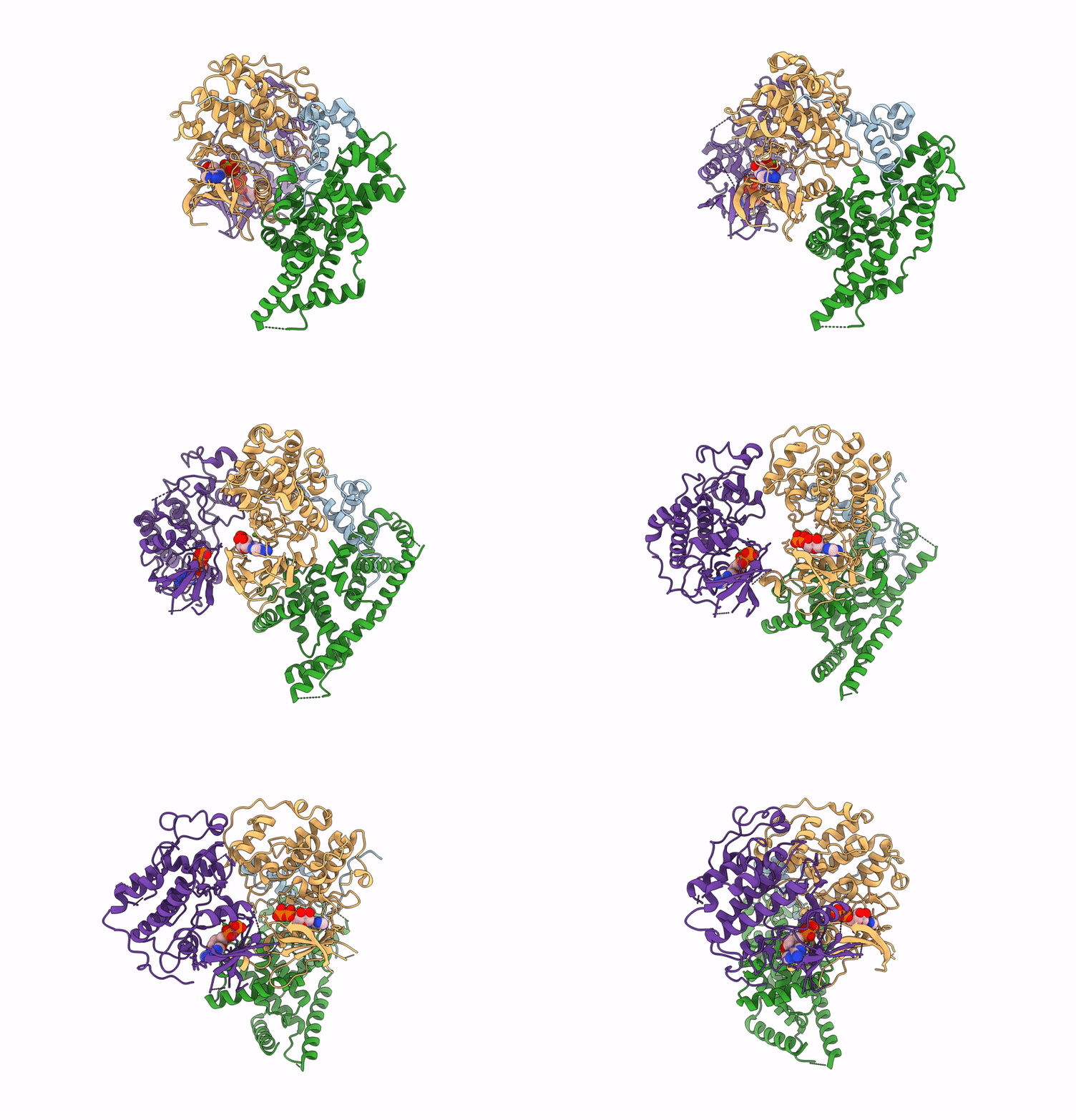
9I9I image
Deposition Date 2025-02-06
Release Date 2025-10-15
Last Version Date 2025-12-10
Entry Detail
PDB ID:
9I9I
Keywords:
Title:
Cryo-EM structure of CAK-CDK11
Biological Source:
Source Organism:
Homo sapiens (Taxon ID: 9606)
Host Organism:
Method Details:
Experimental Method:
Resolution:
3.50 Å
Aggregation State:
PARTICLE
Reconstruction Method:
SINGLE PARTICLE
Macromolecular Entities
Structures with similar UniProt ID
Protein Blast
Polymer Type:polypeptide(L)
Molecule:CDK-activating kinase assembly factor MAT1
Gene (Uniprot):MNAT1
Chain IDs:B (auth: H)
Chain Length:328
Number of Molecules:1
Biological Source:Homo sapiens
Structures with similar UniProt ID
Protein Blast
Polymer Type:polypeptide(L)
Molecule:Cyclin-H
Gene (Uniprot):CCNH
Chain IDs:C (auth: I)
Chain Length:324
Number of Molecules:1
Biological Source:Homo sapiens
Structures with similar UniProt ID
Protein Blast
Polymer Type:polypeptide(L)
Molecule:Cyclin-dependent kinase 7
Gene (Uniprot):CDK7
Chain IDs:D (auth: J)
Chain Length:391
Number of Molecules:1
Biological Source:Homo sapiens
Structures with similar UniProt ID
Protein Blast
Polymer Type:polypeptide(L)
Molecule:Isoform 7 of Cyclin-dependent kinase 11B
Gene (Uniprot):CDK11B
Chain IDs:A (auth: K)
Chain Length:442
Number of Molecules:1
Biological Source:Homo sapiens
Modified Residue
Compound ID Chain ID Parent Comp ID Details 2D Image
TPO A THR modified residue
Primary Citation
Structural basis of T-loop-independent recognition and activation of CDKs by the CDK-activating kinase.
Science 390 911 917 (2025)
PMID: 41100585 DOI: 10.1126/science.adw0053

Abstact

Cyclin-dependent kinases (CDKs) are prototypical regulators of the cell cycle. The CDK-activating kinase (CAK) acts as a master regulator of CDK activity by catalyzing the activating phosphorylation of CDKs on a conserved threonine residue within the regulatory T-loop. However, structural data illuminating the mechanism by which the CAK recognizes and activates CDKs have remained elusive. Here, we determine high-resolution structures of the CAK in complex with CDK2 and CDK2-cyclin A2 by cryogenic electron microscopy. Our structures reveal a T-loop-independent kinase-kinase interface with contributions from both kinase lobes. Computational analysis and structures of CAK in complex with CDK1-cyclin B1 and CDK11 indicate that these structures represent the general architecture of CAK-CDK complexes. These results advance our mechanistic understanding of cell cycle regulation and kinase signaling cascades.

Legend

Protein

Chemical

Disease

Primary Citation of related structures
Feedback Form
Name
Email
Institute
Feedback