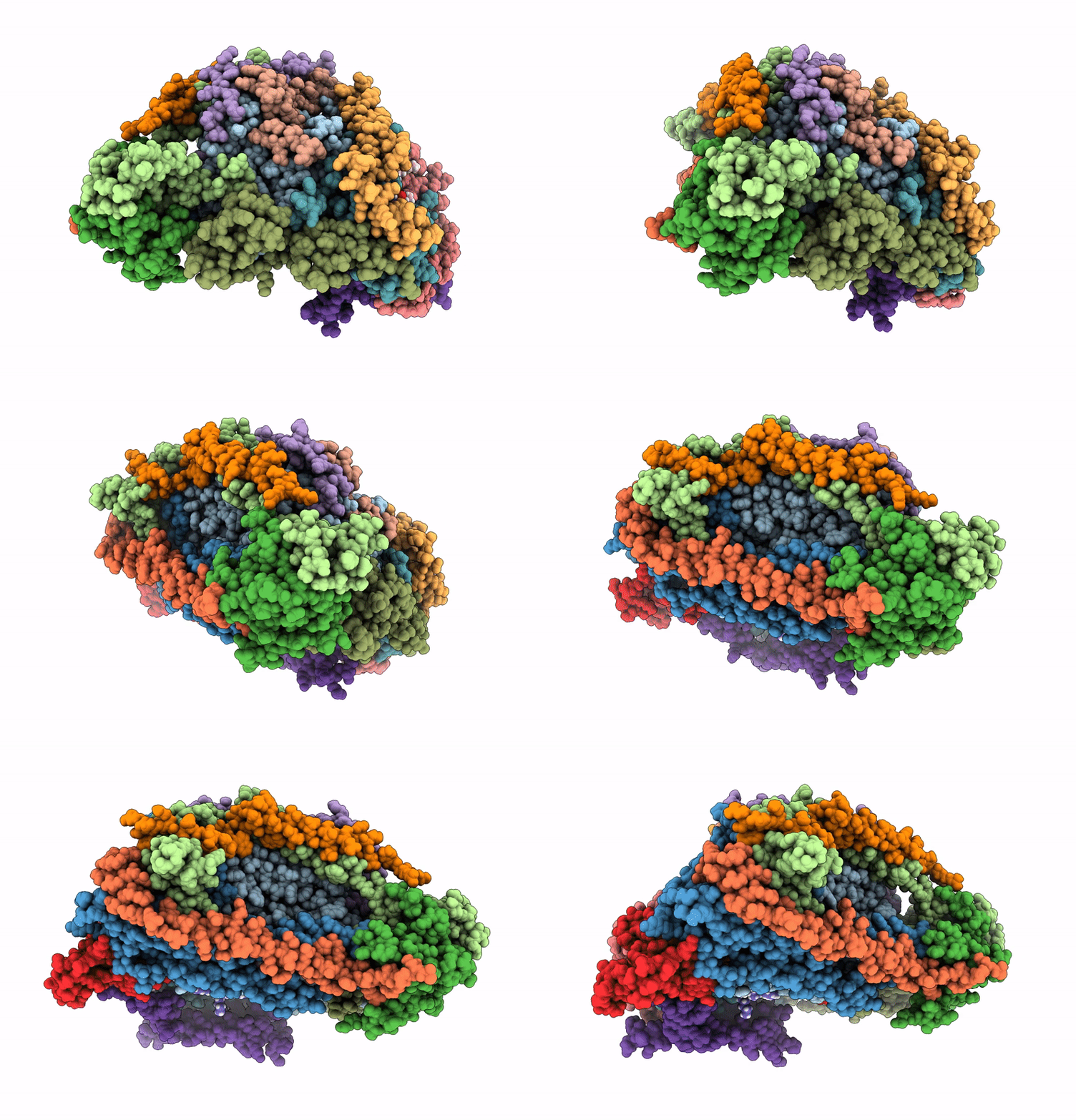
9I6F image
Deposition Date 2025-01-30
Release Date 2025-12-03
Last Version Date 2026-01-21
Entry Detail
PDB ID:
9I6F
Title:
Cryo-EM structure of HIGD2A bound complex IV
Biological Source:
Source Organism(s):
Homo sapiens (Taxon ID: 9606)
Method Details:
Experimental Method:
Resolution:
2.95 Å
Aggregation State:
PARTICLE
Reconstruction Method:
SINGLE PARTICLE
Macromolecular Entities
Structures with similar UniProt ID
Protein Blast
Polymer Type:polypeptide(L)
Molecule:Cytochrome c oxidase subunit 1
Gene (Uniprot):MT-CO1
Chain IDs:B (auth: A)
Chain Length:513
Number of Molecules:1
Biological Source:Homo sapiens
Structures with similar UniProt ID
Protein Blast
Polymer Type:polypeptide(L)
Molecule:Cytochrome c oxidase subunit 2
Gene (Uniprot):MT-CO2
Chain IDs:C (auth: B)
Chain Length:227
Number of Molecules:1
Biological Source:Homo sapiens
Structures with similar UniProt ID
Protein Blast
Polymer Type:polypeptide(L)
Molecule:Cytochrome c oxidase subunit 3
Gene (Uniprot):MT-CO3
Chain IDs:D (auth: C)
Chain Length:261
Number of Molecules:1
Biological Source:Homo sapiens
Structures with similar UniProt ID
Protein Blast
Polymer Type:polypeptide(L)
Molecule:Cytochrome c oxidase subunit 4 isoform 1, mitochondrial
Gene (Uniprot):COX4I1
Chain IDs:E (auth: D)
Chain Length:169
Number of Molecules:1
Biological Source:Homo sapiens
Structures with similar UniProt ID
Protein Blast
Polymer Type:polypeptide(L)
Molecule:Cytochrome c oxidase subunit 5A, mitochondrial
Gene (Uniprot):COX5A
Chain IDs:F (auth: E)
Chain Length:150
Number of Molecules:1
Biological Source:Homo sapiens
Structures with similar UniProt ID
Protein Blast
Polymer Type:polypeptide(L)
Molecule:Cytochrome c oxidase subunit 5B, mitochondrial
Gene (Uniprot):COX5B
Chain IDs:G (auth: F)
Chain Length:129
Number of Molecules:1
Biological Source:Homo sapiens
Structures with similar UniProt ID
Protein Blast
Polymer Type:polypeptide(L)
Molecule:Cytochrome c oxidase subunit 6A1, mitochondrial
Gene (Uniprot):COX6A1
Chain IDs:H (auth: G)
Chain Length:109
Number of Molecules:1
Biological Source:Homo sapiens
Structures with similar UniProt ID
Protein Blast
Polymer Type:polypeptide(L)
Molecule:Cytochrome c oxidase subunit 6B1
Gene (Uniprot):COX6B1
Chain IDs:I (auth: H)
Chain Length:86
Number of Molecules:1
Biological Source:Homo sapiens
Structures with similar UniProt ID
Protein Blast
Polymer Type:polypeptide(L)
Molecule:Cytochrome c oxidase subunit 6C
Gene (Uniprot):COX6C
Chain IDs:J (auth: I)
Chain Length:75
Number of Molecules:1
Biological Source:Homo sapiens
Structures with similar UniProt ID
Protein Blast
Polymer Type:polypeptide(L)
Molecule:Cytochrome c oxidase subunit 7A2, mitochondrial
Gene (Uniprot):COX7A2
Chain IDs:K (auth: J)
Chain Length:83
Number of Molecules:1
Biological Source:Homo sapiens
Structures with similar UniProt ID
Protein Blast
Polymer Type:polypeptide(L)
Molecule:Cytochrome c oxidase subunit 7B, mitochondrial
Gene (Uniprot):COX7B
Chain IDs:L (auth: K)
Chain Length:80
Number of Molecules:1
Biological Source:Homo sapiens
Structures with similar UniProt ID
Protein Blast
Polymer Type:polypeptide(L)
Molecule:Cytochrome c oxidase subunit 7C, mitochondrial
Gene (Uniprot):COX7C
Chain IDs:M (auth: L)
Chain Length:63
Number of Molecules:1
Biological Source:Homo sapiens
Structures with similar UniProt ID
Protein Blast
Polymer Type:polypeptide(L)
Molecule:Cytochrome c oxidase subunit 8A, mitochondrial
Gene (Uniprot):COX8A
Chain IDs:N (auth: M)
Chain Length:69
Number of Molecules:1
Biological Source:Homo sapiens
Structures with similar UniProt ID
Protein Blast
Polymer Type:polypeptide(L)
Molecule:HIG1 domain family member 2A, mitochondrial
Gene (Uniprot):HIGD2A
Chain IDs:A (auth: N)
Chain Length:106
Number of Molecules:1
Biological Source:Homo sapiens
Modified Residue
Compound ID Chain ID Parent Comp ID Details 2D Image
FME B MET modified residue
Primary Citation
Structural basis for late maturation steps of mitochondrial respiratory chain complex IV within the human respirasome.
Nat Commun ? ? ? (2026)
PMID: 41519940 DOI: 10.1038/s41467-025-68274-3

Abstact

The mitochondrial respiratory chain comprises four multimeric complexes (CI-CIV) that drive oxidative phosphorylation by transferring electrons to oxygen and generating the proton gradient required for ATP synthesis. These complexes can associate into supercomplexes (SCs), such as the CI + CIII₂ + CIV respirasome, but how SCs form, by joining preassembled complexes or by engaging partially assembled intermediates, remains unresolved. Here, we use cryo-electron microscopy to determine high-resolution structures of native human CI + CIII₂ + CIV late-assembly intermediates. Together with biochemical analyses, these structures show that respirasome biogenesis concludes with the final maturation of CIV while it is associated with fully assembled CI and CIII₂. We identify HIGD2A as a placeholder factor within isolated and supercomplexed CIV that is replaced by subunit NDUFA4 during the last step of CIV and respirasome assembly. This mechanism suggests that placeholders such as HIGD2A act as molecular timers, preventing premature incorporation of NDUFA4 or its isoforms and ensuring the orderly progression of pre-SC particles into functional respirasomes. Since defects in CIV assembly, including NDUFA4 deficiencies, cause severe encephalomyopathies and neurodegenerative disorders, understanding the molecular architecture and assembly pathways of isolated and supercomplexed CIV offers insight into the pathogenic mechanisms underlying these conditions.

Legend

Protein

Chemical

Disease

Primary Citation of related structures
Feedback Form
Name
Email
Institute
Feedback