9I31 image
Deposition Date 2025-01-22
Release Date 2025-06-11
Last Version Date 2025-07-09
Entry Detail
PDB ID:
9I31
Keywords:
Title:
Alpha-Methylacyl-CoA racemase from Mycobacterium tuberculosis in complex with acetyl-CoA
Biological Source:
Source Organism:
Method Details:
Experimental Method:
Resolution:
1.88 Å
R-Value Free:
0.23
R-Value Work:
0.20
Space Group:
I 4 2 2
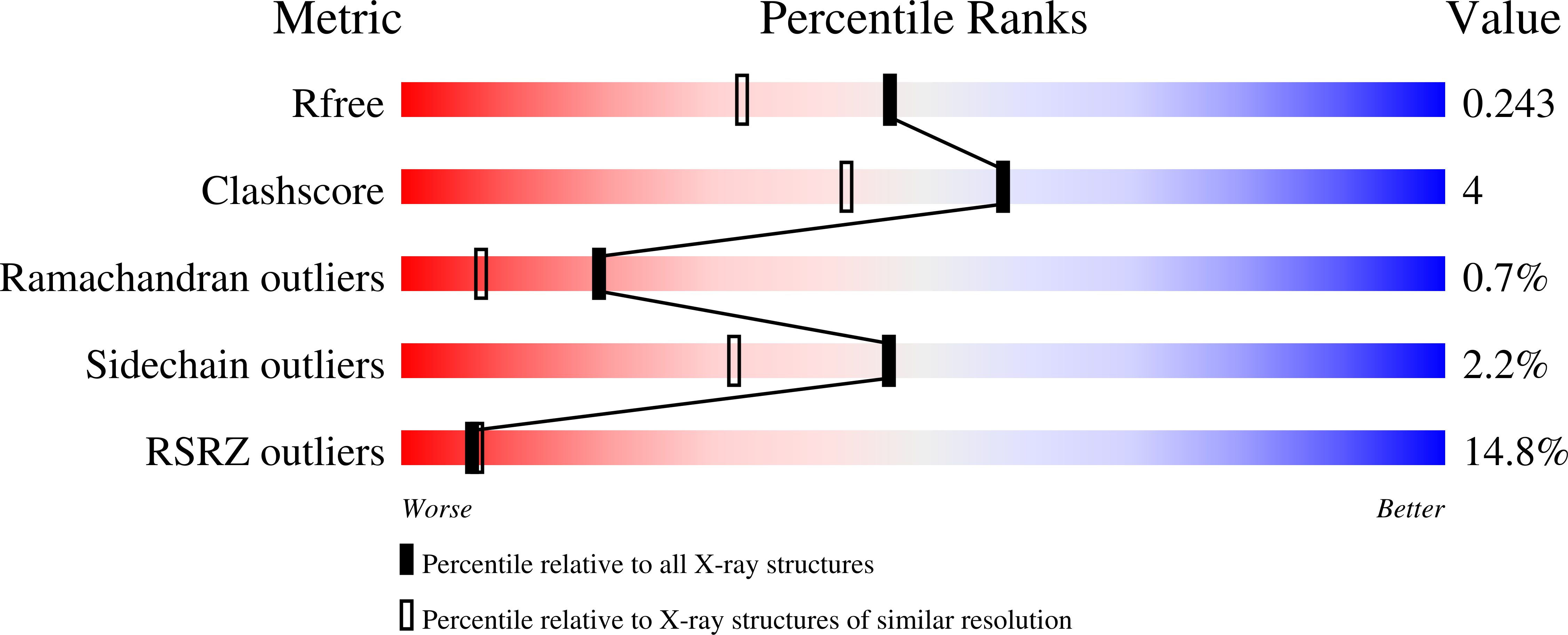
Macromolecular Entities
Structures with similar UniProt ID
Protein Blast
Polymer Type:polypeptide(L)
Molecule:Alpha-methylacyl-CoA racemase
Gene (Uniprot):mcr
Chain IDs:A, B, C, D, E, F, G, H, I, J, K, L
Chain Length:364
Number of Molecules:12
Biological Source:Mycobacterium tuberculosis
Ligand Molecules
Primary Citation
Molecular basis of acyl-CoA ester recognition by alpha-methylacyl-CoA racemase from Mycobacterium tuberculosis.
J.Biol.Chem. 301 110302 110302 (2025)
PMID: 40447188 DOI: 10.1016/j.jbc.2025.110302

Abstact

α-Methylacyl-CoA racemase (AMACR; P504S) enzyme plays a vital role in branched-chain fatty acid metabolism by catalysing the conversion of 2-methyl-branched fatty acyl-CoAs into a near 1 to 1 mixture of the (2R)- and (2S)-epimers, enabling further metabolism. α-Methylacyl-CoA racemase from Mycobacterium tuberculosis (MCR) has been explored as a model to understand the AMACR racemization mechanism and as a drug target. Here we present a detailed analysis of a new MCR wild-type crystal structure to provide insights into the MCR racemization mechanism and the molecular features that contribute enzyme activity and selectivity. Specifically, we report a structure of wild-type MCR (in tetragonal space group I422, a new crystal form) along with 12 structures of MCR in complex with branched-chain 2-methylacyl-CoA esters (ibuprofenoyl-CoA, ±-fenoprofenoyl-CoA, S-ketoprofenoyl-CoA, ±-flurbiprofenoyl-CoA, S-naproxenoyl-CoA, S-2-methyldecanoyl-CoA, and isobutanoyl-CoA) and straight-chain acyl-CoA esters (decanoyl-CoA, octanoyl-CoA, hexanoyl-CoA, butanoyl-CoA, acetyl-CoA) in the range of 1.88 to 2.40 Å resolution. These detailed molecular structures enhance our understanding of substrate recognition and coupled with extensive enzyme inhibition assays provide a framework for the rational structure-based drug design of selective and potent MCR inhibitors to combat Mycobacterium tuberculosis in the future.

Legend

Protein

Chemical

Disease

Primary Citation of related structures
Feedback Form
Name
Email
Institute
Feedback