Planned Maintenance: Some services may turn out to be unavailable from 15th January, 2026 to 16th January, 2026. We apologize for the inconvenience!

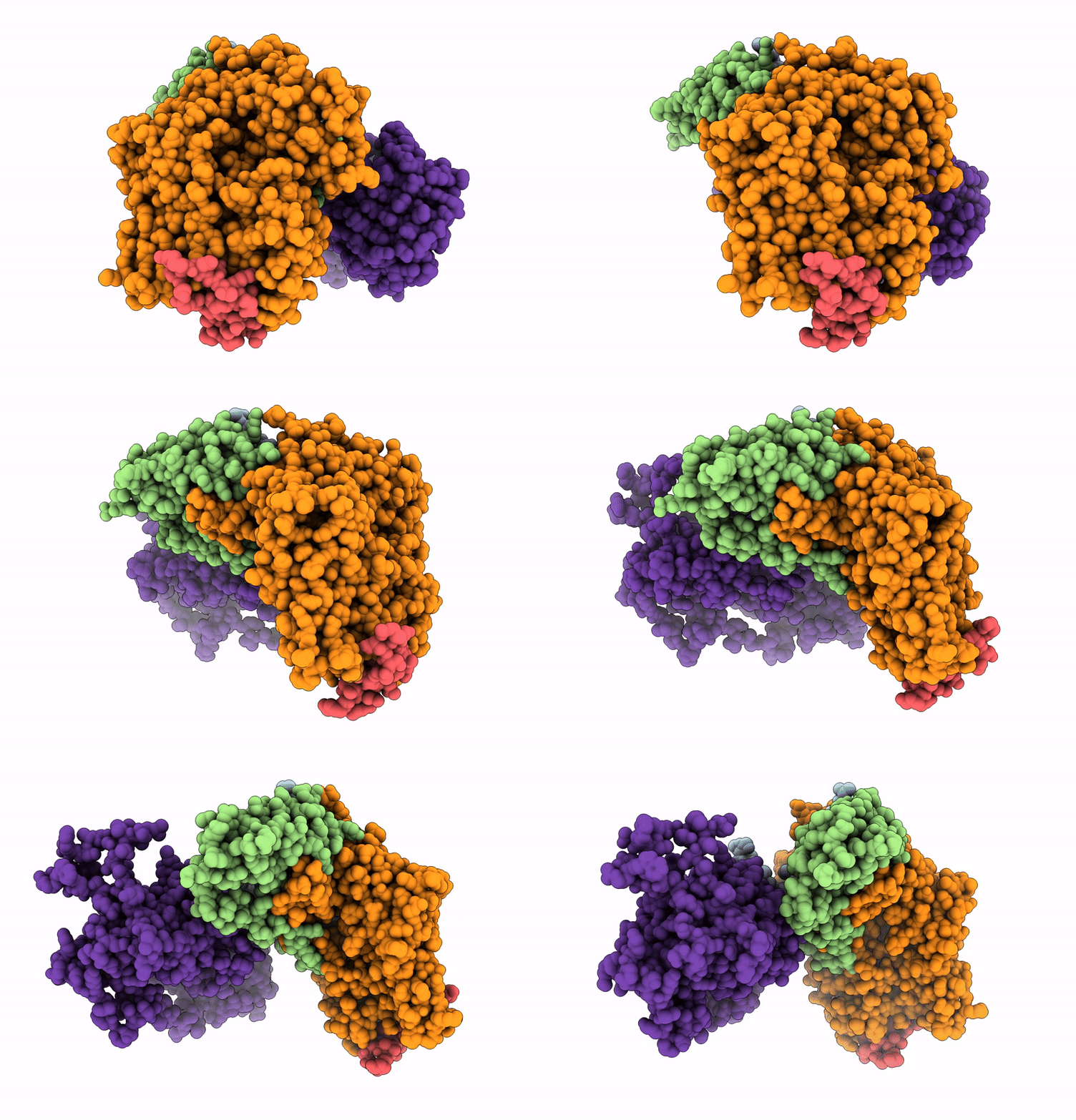
9HVF image
Deposition Date 2024-12-27
Release Date 2025-11-19
Last Version Date 2025-11-26
Entry Detail
PDB ID:
9HVF
Keywords:
Title:
Native human PPP1R15B-P-eIF2-eIF2B complex
Method Details:
Experimental Method:
Resolution:
3.80 Å
Aggregation State:
PARTICLE
Reconstruction Method:
SINGLE PARTICLE
Macromolecular Entities
Structures with similar UniProt ID
Protein Blast
Polymer Type:polypeptide(L)
Molecule:Protein phosphatase 1 regulatory subunit 15B
Gene (Uniprot):PPP1R15B
Chain IDs:B (auth: A)
Chain Length:109
Number of Molecules:1
Biological Source:Homo sapiens
Structures with similar UniProt ID
Protein Blast
Polymer Type:polypeptide(L)
Molecule:Eukaryotic translation initiation factor 2 subunit 1
Gene (Uniprot):EIF2S1
Chain IDs:E (auth: B)
Chain Length:315
Number of Molecules:1
Biological Source:Homo sapiens
Structures with similar UniProt ID
Protein Blast
Polymer Type:polypeptide(L)
Molecule:Eukaryotic translation initiation factor 2 subunit 2
Gene (Uniprot):EIF2S2
Chain IDs:C
Chain Length:333
Number of Molecules:1
Biological Source:Homo sapiens
Structures with similar UniProt ID
Protein Blast
Polymer Type:polypeptide(L)
Molecule:Eukaryotic translation initiation factor 2 subunit 3
Gene (Uniprot):EIF2S3
Chain IDs:D
Chain Length:472
Number of Molecules:1
Biological Source:Homo sapiens
Structures with similar UniProt ID
Protein Blast
Polymer Type:polypeptide(L)
Molecule:Translation initiation factor eIF-2B subunit gamma
Gene (Uniprot):EIF2B3
Chain IDs:A (auth: E)
Chain Length:452
Number of Molecules:1
Biological Source:Homo sapiens
Ligand Molecules
Primary Citation
Termination of the integrated stress response.
Science ? eadw5137 eadw5137 (2025)
PMID: 41231936 DOI: 10.1126/science.adw5137

Abstact

Stress responses enable cells to detect, adapt to, and survive challenges. The benefit of these signaling pathways depends on their reversibility. The integrated stress response (ISR) is elicited by phosphorylation of translation initiation factor eIF2, which traps and inhibits rate-limiting translation factor eIF2B thereby attenuating translation initiation. Termination of this pathway thus requires relieving eIF2B from P-eIF2 inhibition. Here, we found that eIF2 phosphatase subunits PPP1R15A and PPP1R15B (R15B) bound P-eIF2 in complex with eIF2B. Biochemical investigations guided by cryo-EM structures of native eIF2-eIF2B and P-eIF2-eIF2B complexes bound to R15B demonstrated that R15B enabled dephosphorylation of otherwise dephosphorylation-incompetent P-eIF2 on eIF2B. This sheds light on ISR termination, revealing that R15B rescues eIF2B from P-eIF2 inhibition, thereby safeguarding translation and cell fitness.

Legend

Protein

Chemical

Disease

Primary Citation of related structures
Feedback Form
Name
Email
Institute
Feedback