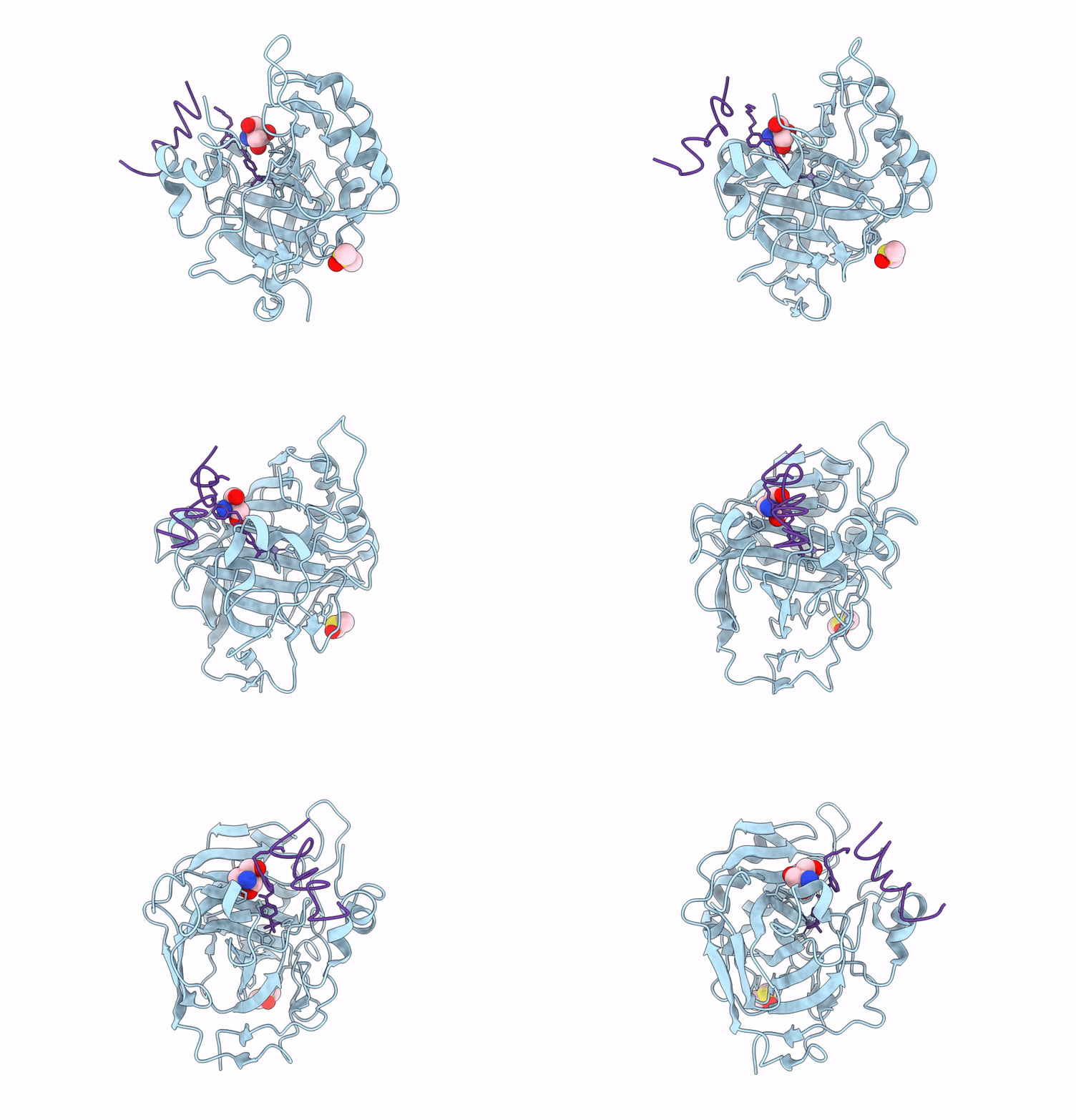
9HGP image
Deposition Date 2024-11-20
Release Date 2025-10-15
Last Version Date 2025-10-15
Entry Detail
PDB ID:
9HGP
Keywords:
Title:
Human Carbonic Anhydrase II in complex with a synthetic aromatic oligoamide foldamer
Biological Source:
Source Organism:
Method Details:
Experimental Method:
Resolution:
2.05 Å
R-Value Free:
0.23
R-Value Work:
0.17
R-Value Observed:
0.17
Space Group:
P 21 21 2

Macromolecular Entities
Structures with similar UniProt ID
Protein Blast
Polymer Type:polypeptide(L)
Molecule:Carbonic anhydrase 2
Gene (Uniprot):CA2
Chain IDs:A
Chain Length:260
Number of Molecules:1
Biological Source:Homo sapiens
Polymer Type:polypeptide(L)
Molecule:Synthetic aromatic oligoamide foldamer
Chain IDs:B (auth: D)
Chain Length:15
Number of Molecules:1
Biological Source:Synthetic construct
Primary Citation
Structure-based design of an aromatic helical foldamer-protein interface.
Chem Sci 16 12385 12396 (2025)
PMID: 40510324 DOI: 10.1039/d5sc01826a

Abstact

The starting point of this study is the solid state structure of a complex between human carbonic anhydrase II (HCAII) and a helically folded tetradecaamide aromatic foldamer with a nanomolar HCAII ligand appended at the N terminus of the helix. In this complex, the foldamer is achiral but its handedness is biased by diastereoselective interaction with the protein. Computational analysis of the HCAII surface and inspection of the initial solid state structure led to the suggestion of main chain and side chain modifications of the foldamer helix that would result in an extension of the foldamer protein interface as well as in absolute helix handedness control. Molecular dynamics simulations validated several of these suggested modifications as potentially resulting in favorable foldamer-protein contacts. Five new Fmoc-protected amino acid building blocks bearing new biogenic-like side chains were synthesized. Nine new tetradecaamide sequences with or without the appended HCAII ligand were synthesized on solid phase and purified by RP-HPLC. The solid state structures of four of these sequences in complex with HCAII were obtained and validated the main design principles: (i) side chains can be predictably introduced at precise positions of the foldamer surface to create new contacts with the protein; (ii) side chains modifications do not alter main chain behavior and can be implemented independent from each other; (iii) some main chain units derived from quinoline-, pyridine-, or benzene-based δ-amino acids are largely interchangeable without altering the overall helix curvature in the context of a complex with a protein. An assessment of the K D values required the adaptation of an existing fluorescence competition assay and suggested that the side chain and main chain modifications introduced in the new sequences did not result in significant improvement of the affinity of the foldamers to HCA.

Legend

Protein

Chemical

Disease

Primary Citation of related structures
Feedback Form
Name
Email
Institute
Feedback