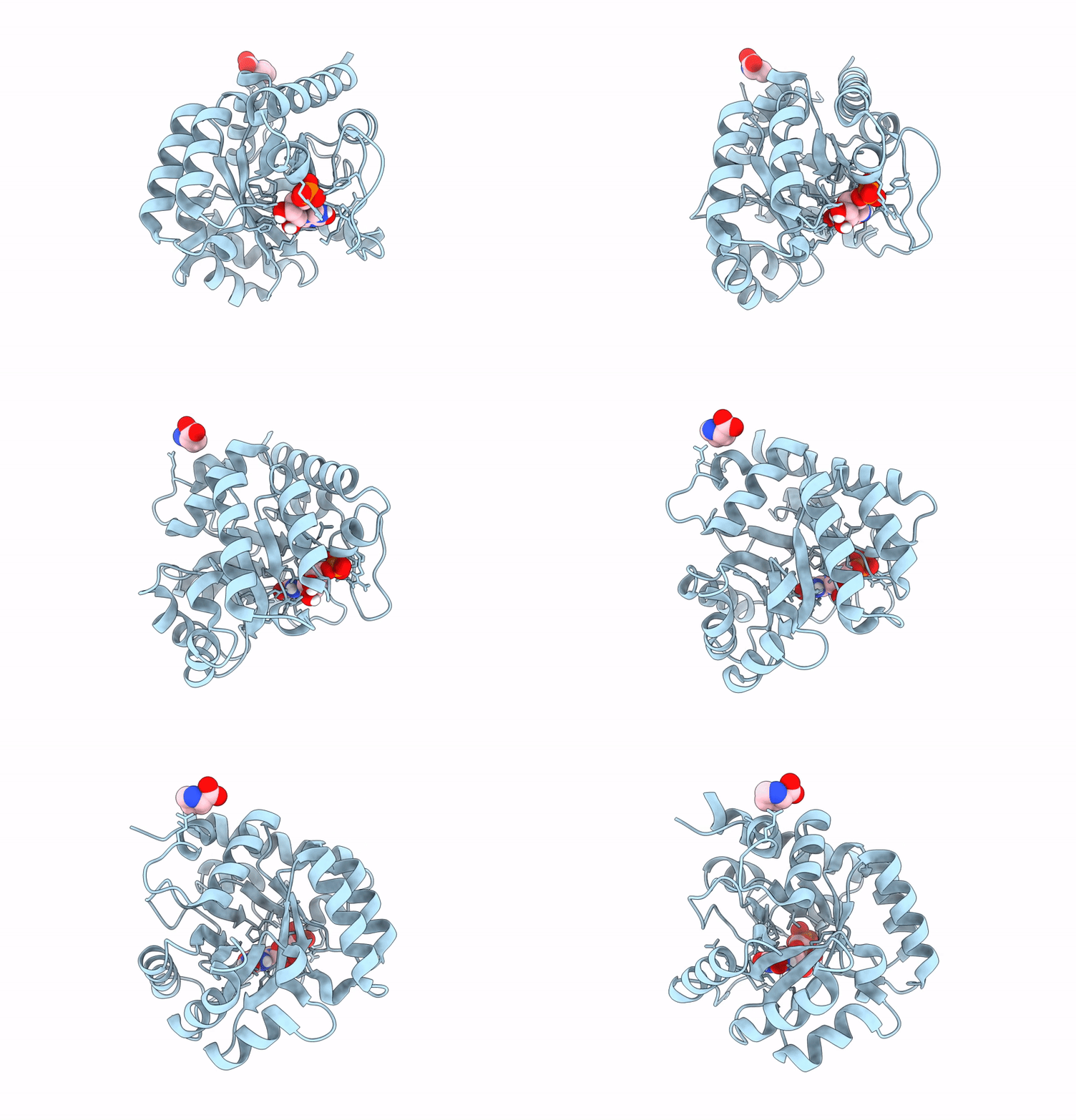
9HDU image
Deposition Date 2024-11-13
Release Date 2025-10-22
Last Version Date 2025-11-26
Entry Detail
PDB ID:
9HDU
Keywords:
Title:
Orotidine 5'-monophosphate decarboxylase-domain of human UMPS in complex with XMP at 1.0 Angstrom resolution
Biological Source:
Source Organism:
Homo sapiens (Taxon ID: 9606)
Method Details:
Experimental Method:
Resolution:
1.00 Å
R-Value Free:
0.13
R-Value Work:
0.11
R-Value Observed:
0.11
Space Group:
C 2 2 21

Macromolecular Entities
Structures with similar UniProt ID
Protein Blast
Polymer Type:polypeptide(L)
Molecule:Uridine 5'-monophosphate synthase
Gene (Uniprot):UMPS
Chain IDs:A
Chain Length:258
Number of Molecules:1
Biological Source:Homo sapiens
Modified Residue
Compound ID Chain ID Parent Comp ID Details 2D Image
CSS A CYS modified residue
Primary Citation
Expected and Unexpected "Guests" at the Active Site of Human Orotidine 5'-Monophosphate Decarboxylase.
Biochemistry 64 4542 4554 (2025)
PMID: 41058608 DOI: 10.1021/acs.biochem.5c00459

Abstact

With an extraordinary rate enhancement of 1017 compared to the uncatalyzed reaction and no need for a cofactor, orotidine 5'-monophosphate decarboxylase (OMPDC) is considered one of the most efficient enzymes. Its mechanism has fascinated researchers for over 50 years. In this study, we used high-resolution X-ray crystallography to examine the molecular interactions between the active site of human OMPDC and various natural and synthetic ligands, including transition-state and product analogues, at the atomic level. Additionally, we evaluated their binding affinities with isothermal titration calorimetry (ITC). During protein expression and subsequent structure analysis, we identified nucleotides xanthosine-5'-monophosphate (XMP) and thymidine-5'-monophosphate (dTMP) bound to the active sites of OMPDC and its Thr321Asn variant, respectively, and confirmed their high binding affinities through ITC. Chemically, we investigated the role of the ribose 2'-OH group using 2'-deoxy OMP and 2'-SH UMP, focusing on validating key binding interactions within the nucleoside moiety. To further explore these interactions, we modified the heterocycles (e.g., GMP and CMP) and synthesized a new transition-state analogue, cyanuryl-5'-monophosphate (YMP). YMP exhibited strong affinity for OMPDC and formed an additional hydrogen bond with a nearby water molecule. However, this enthalpically favorable interaction resulted in an entropic penalty compared to the best-known OMPDC inhibitor, BMP, leading to similar affinities. To address this, we synthesized 5-methyl OMP to further improve ligand-enzyme interactions. This modification enhanced stabilization within the hydrophobic pocket through van der Waals forces, paving the way for designing more effective OMPDC inhibitors with specific substitutions aimed at optimizing binding affinity and enzyme inhibition.

Legend

Protein

Chemical

Disease

Primary Citation of related structures
Feedback Form
Name
Email
Institute
Feedback