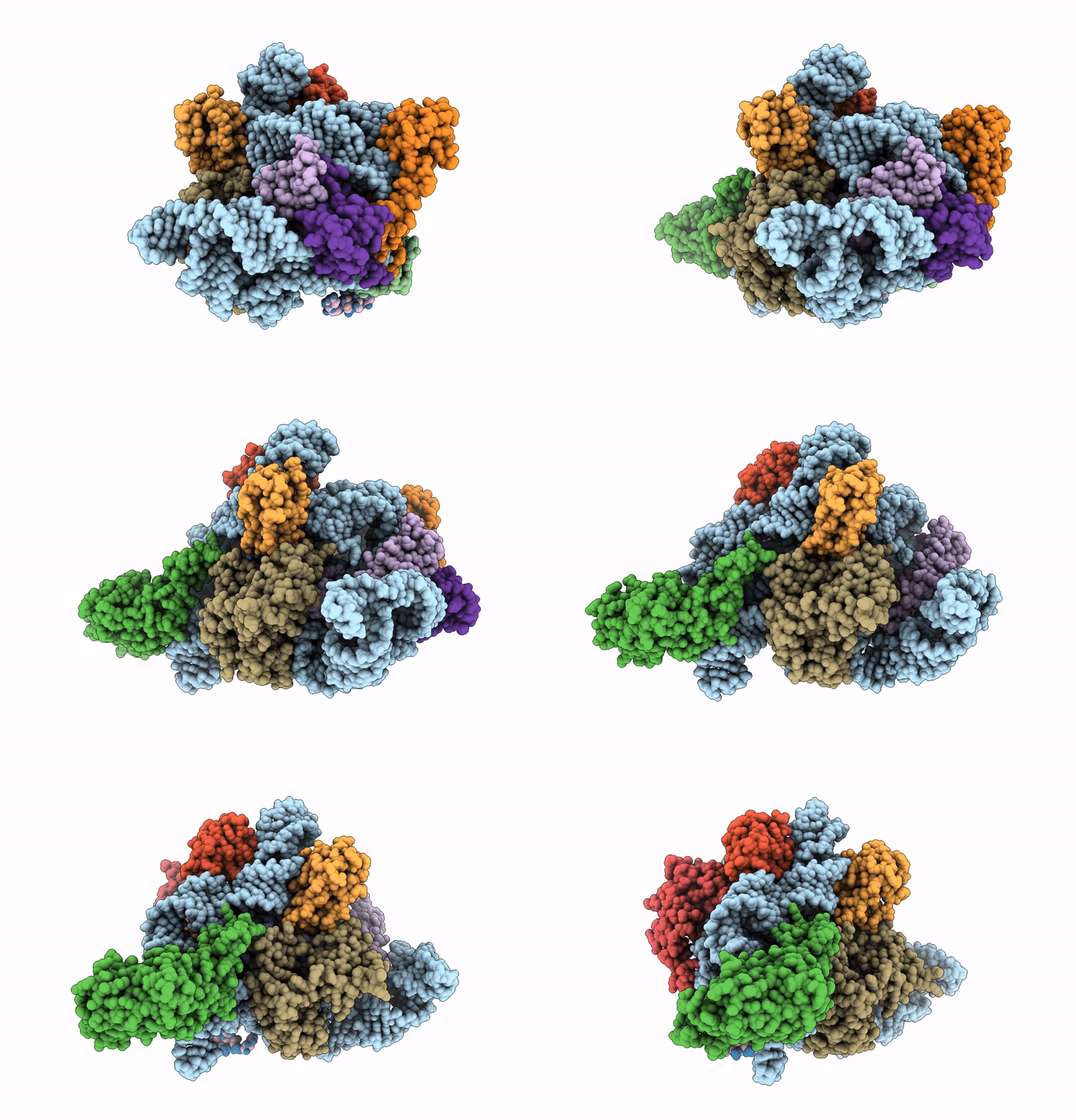
9H9I image
Deposition Date 2024-10-31
Release Date 2025-08-06
Last Version Date 2025-08-06
Entry Detail
PDB ID:
9H9I
Keywords:
Title:
Complex 2 (HEAD) 30S-IF1-IF3-tRNA-GE81112
Biological Source:
Source Organism:
Escherichia coli (Taxon ID: 562)
Host Organism:
Method Details:
Experimental Method:
Resolution:
3.20 Å
Aggregation State:
PARTICLE
Reconstruction Method:
SINGLE PARTICLE
Macromolecular Entities
Polymer Type:polyribonucleotide
Molecule:16S RNA (head domain)
Chain IDs:A (auth: 1)
Chain Length:1541
Number of Molecules:1
Biological Source:Escherichia coli
Polymer Type:polyribonucleotide
Molecule:mRNA (5'-R(P*AP*UP*GP*U)-3')
Chain IDs:B (auth: 2)
Chain Length:4
Number of Molecules:1
Biological Source:Escherichia coli
Polymer Type:polyribonucleotide
Molecule:t-RNA (5'-R(P*UP*CP*GP*GP*GP*CP*UP*CP*AP*UP*AP*AP*CP*CP*CP*GP*A)-3')
Chain IDs:C (auth: 3)
Chain Length:77
Number of Molecules:1
Biological Source:Escherichia coli
Structures with similar UniProt ID
Protein Blast
Polymer Type:polypeptide(L)
Molecule:Small ribosomal subunit protein uS2
Gene (Uniprot):rpsB
Chain IDs:D (auth: B)
Chain Length:241
Number of Molecules:1
Biological Source:Escherichia coli
Structures with similar UniProt ID
Protein Blast
Polymer Type:polypeptide(L)
Molecule:Small ribosomal subunit protein uS3
Gene (Uniprot):rpsC
Chain IDs:E (auth: C)
Chain Length:233
Number of Molecules:1
Biological Source:Escherichia coli
Structures with similar UniProt ID
Protein Blast
Polymer Type:polypeptide(L)
Molecule:Small ribosomal subunit protein uS7
Gene (Uniprot):rpsG
Chain IDs:F (auth: G)
Chain Length:179
Number of Molecules:1
Biological Source:Escherichia coli
Structures with similar UniProt ID
Protein Blast
Polymer Type:polypeptide(L)
Molecule:Small ribosomal subunit protein uS9
Gene (Uniprot):rpsI
Chain IDs:G (auth: I)
Chain Length:130
Number of Molecules:1
Biological Source:Escherichia coli
Structures with similar UniProt ID
Protein Blast
Polymer Type:polypeptide(L)
Molecule:Small ribosomal subunit protein uS10
Gene (Uniprot):rpsJ
Chain IDs:H (auth: J)
Chain Length:103
Number of Molecules:1
Biological Source:Escherichia coli
Structures with similar UniProt ID
Protein Blast
Polymer Type:polypeptide(L)
Molecule:Small ribosomal subunit protein uS13
Gene (Uniprot):rpsM
Chain IDs:I (auth: M)
Chain Length:118
Number of Molecules:1
Biological Source:Escherichia coli
Structures with similar UniProt ID
Protein Blast
Polymer Type:polypeptide(L)
Molecule:Small ribosomal subunit protein uS14
Gene (Uniprot):rpsN
Chain IDs:J (auth: N)
Chain Length:101
Number of Molecules:1
Biological Source:Escherichia coli
Structures with similar UniProt ID
Protein Blast
Polymer Type:polypeptide(L)
Molecule:Small ribosomal subunit protein uS19
Gene (Uniprot):rpsS
Chain IDs:K (auth: S)
Chain Length:92
Number of Molecules:1
Biological Source:Escherichia coli
Primary Citation

Abstact

The initiation phase is the rate-limiting step of protein synthesis (translation) and is finely regulated, making it an important drug target. In bacteria, initiation is guided by three initiation factors and involves positioning the start site on the messenger RNA within the P-site on the small ribosomal subunit (30S), where it is decoded by the initiator tRNA. This process can be efficiently inhibited by GE81112, a natural hydrophilic, noncyclic, nonribosomal tetrapeptide. It is found in nature in three structural variants (A, B and B1 with molecular masses of 643-658 Da). Previous biochemical and structural characterisation of GE81112 indicates that the primary mechanism of action of this antibiotic is to (1) prevent the initiator tRNA from binding correctly to the P-site and (2) block conformational rearrangements in initiation factor IF3, resulting in an unlocked 30S pre/C state. In this study, using cryoEM, we have determined the binding site of GE81112 in initiation complexes (3.2-3.7Å) and on empty ribosomes (2.09 Å). This binding site is within the mRNA channel (E-site) but remote from the binding site of the initiation factors and initiator tRNA. This suggests that it acts allosterically to prevent the initiator tRNA from being locked into place. The binding mode is consistent with previous biochemical studies and recent work identifying the key pharmacophores of GE81112.

Legend

Protein

Chemical

Disease

Primary Citation of related structures
Feedback Form
Name
Email
Institute
Feedback