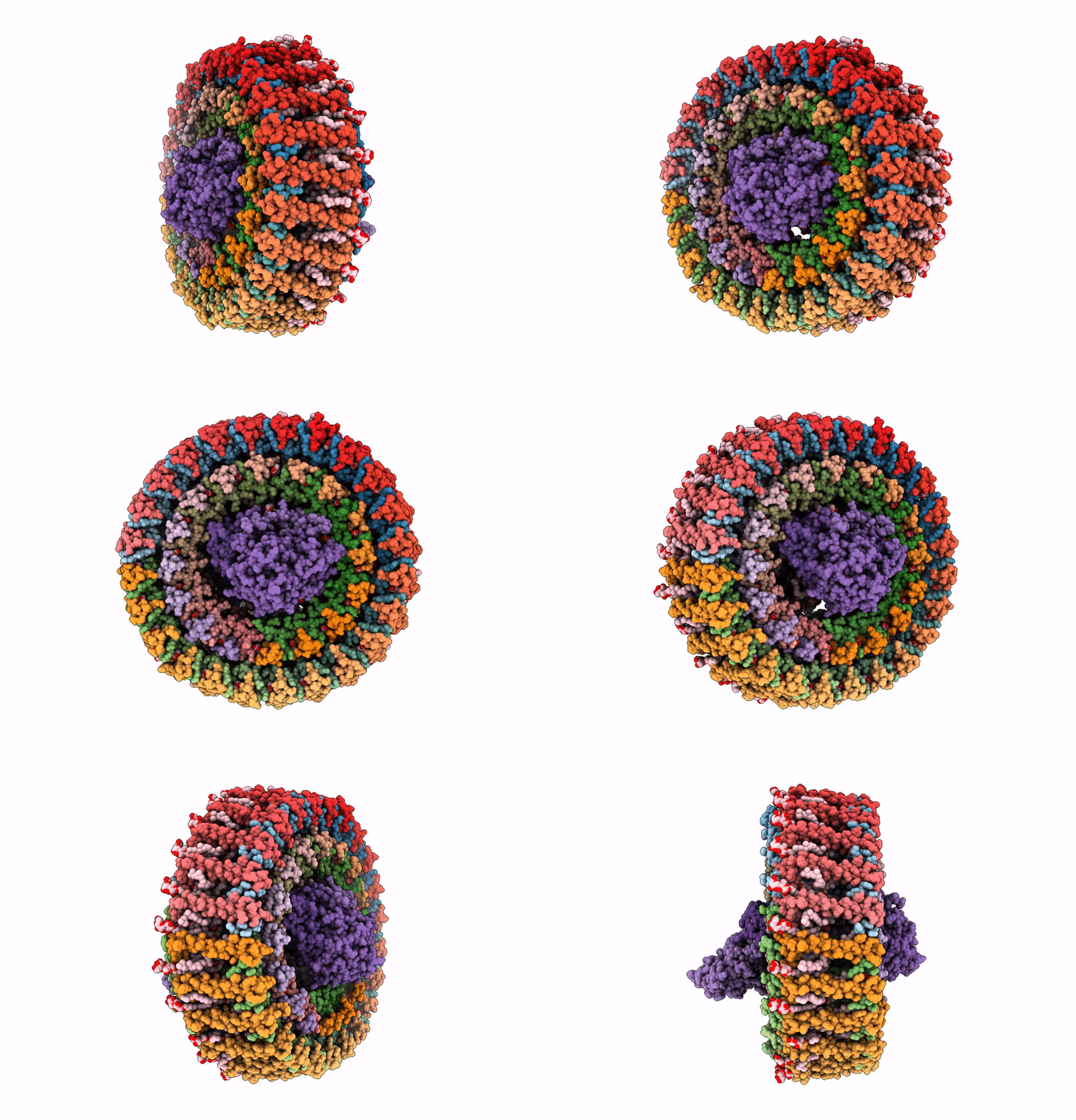
9H22 image
Deposition Date 2024-10-10
Release Date 2025-12-03
Last Version Date 2026-01-28
Entry Detail
PDB ID:
9H22
Keywords:
Title:
Cryo EM structure of RC-dLH complex model II from Gemmatimonas groenlandica
Biological Source:
Source Organism(s):
Method Details:
Experimental Method:
Resolution:
2.30 Å
Aggregation State:
PARTICLE
Reconstruction Method:
SINGLE PARTICLE
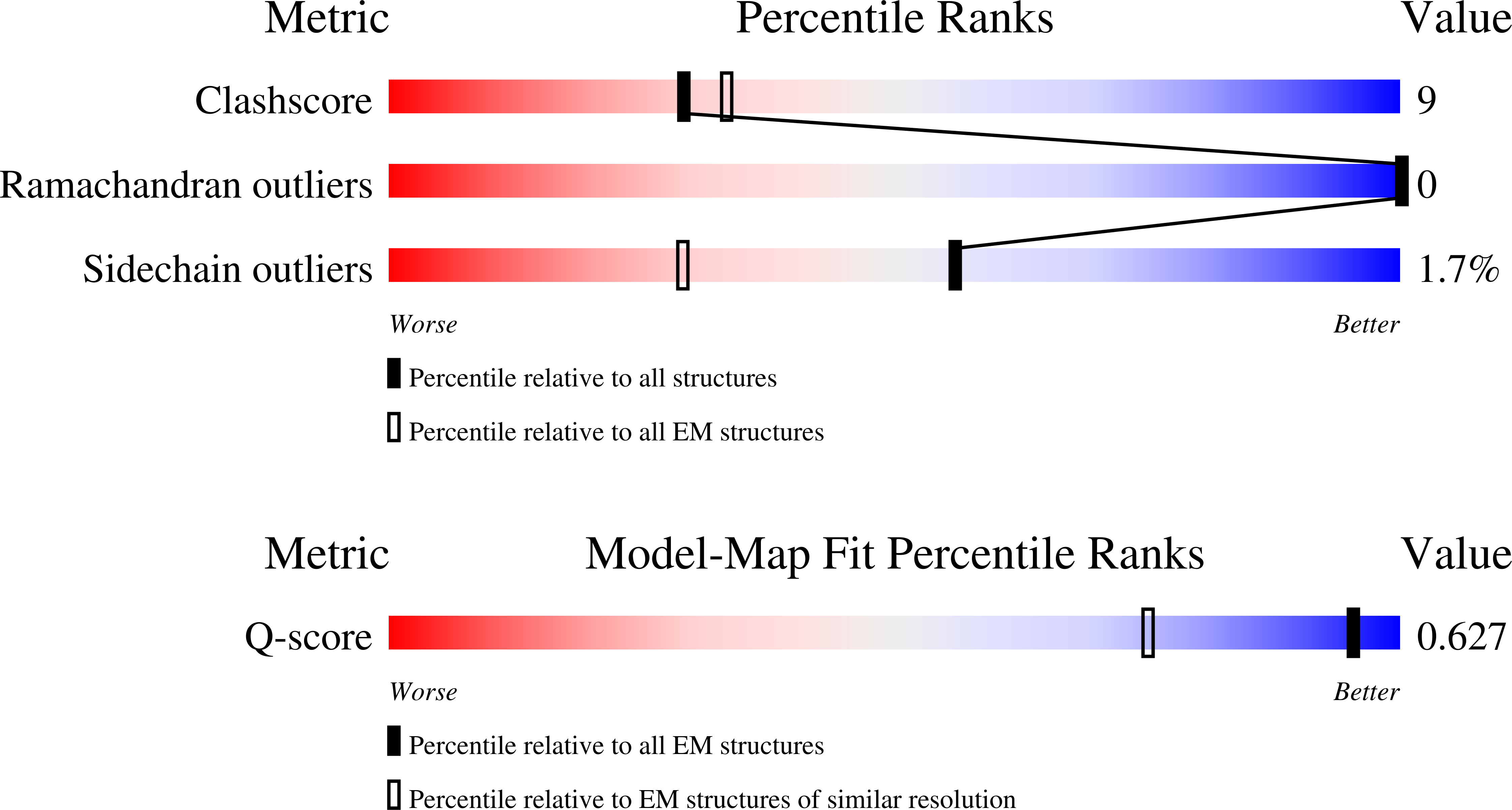
Macromolecular Entities
Structures with similar UniProt ID
Protein Blast
Polymer Type:polypeptide(L)
Molecule:Light-harvesting protein
Gene (Uniprot):HKW67_08790
Chain IDs:G (auth: AA), J (auth: AB), K (auth: AC), N (auth: AD), O (auth: AE), R (auth: AF), S (auth: AG), U (auth: AH), W (auth: AI), Y (auth: AJ), AA (auth: AK), CA (auth: AL), EA (auth: AM), HA (auth: AN), IA (auth: AO), LA (auth: AP), MA (auth: AQ), PA (auth: AR), RA (auth: AS), TA (auth: AT), VA (auth: AU), WA (auth: AV), YA (auth: AW), AB (auth: AX)
Chain Length:71
Number of Molecules:24
Biological Source:Gemmatimonas groenlandica
Structures with similar UniProt ID
Protein Blast
Polymer Type:polypeptide(L)
Molecule:Light-harvesting protein
Gene (Uniprot):HKW67_08795
Chain IDs:CB (auth: Aa), EB (auth: Ab), GB (auth: Ac), IB (auth: Ad), KB (auth: Ae), MB (auth: Af), OB (auth: Ag), QB (auth: Ah), SB (auth: Ai), UB (auth: Aj), WB (auth: Ak), YB (auth: Al), AC (auth: Am), CC (auth: An), EC (auth: Ao), GC (auth: Ap)
Chain Length:71
Number of Molecules:16
Biological Source:Gemmatimonas groenlandica
Structures with similar UniProt ID
Protein Blast
Polymer Type:polypeptide(L)
Molecule:Light-harvesting protein
Gene (Uniprot):HKW67_08785
Chain IDs:H (auth: BA), I (auth: BB), L (auth: BC), M (auth: BD), P (auth: BE), Q (auth: BF), T (auth: BG), V (auth: BH), X (auth: BI), Z (auth: BJ), BA (auth: BK), DA (auth: BL), FA (auth: BM), GA (auth: BN), JA (auth: BO), KA (auth: BP), NA (auth: BQ), OA (auth: BR), QA (auth: BS), SA (auth: BT), UA (auth: BU), XA (auth: BV), ZA (auth: BW), BB (auth: BX), DB (auth: Ba), FB (auth: Bb), HB (auth: Bc), JB (auth: Bd), LB (auth: Be), NB (auth: Bf), PB (auth: Bg), RB (auth: Bh), TB (auth: Bi), VB (auth: Bj), XB (auth: Bk), ZB (auth: Bl), BC (auth: Bm), DC (auth: Bn), FC (auth: Bo), HC (auth: Bp)
Chain Length:44
Number of Molecules:40
Biological Source:Gemmatimonas groenlandica
Structures with similar UniProt ID
Protein Blast
Polymer Type:polypeptide(L)
Molecule:Photosynthetic reaction center cytochrome c subunit
Gene (Uniprot):HKW67_08810
Chain IDs:F (auth: C)
Chain Length:373
Number of Molecules:1
Biological Source:Gemmatimonas groenlandica
Polymer Type:polypeptide(L)
Molecule:reaction centre Ht su unit
Chain IDs:D (auth: H)
Chain Length:66
Number of Molecules:1
Biological Source:Gemmatimonas groenlandica
Polymer Type:polypeptide(L)
Molecule:reaction centre Hc sub unit
Chain IDs:E (auth: K)
Chain Length:180
Number of Molecules:1
Biological Source:Gemmatimonas groenlandica
Structures with similar UniProt ID
Protein Blast
Polymer Type:polypeptide(L)
Molecule:Reaction center protein L chain
Gene (Uniprot):HKW67_08800
Chain IDs:B (auth: L)
Chain Length:274
Number of Molecules:1
Biological Source:Gemmatimonas groenlandica
Structures with similar UniProt ID
Protein Blast
Polymer Type:polypeptide(L)
Molecule:Reaction center protein M chain
Gene (Uniprot):HKW67_08805
Chain IDs:C (auth: M)
Chain Length:392
Number of Molecules:1
Biological Source:Gemmatimonas groenlandica
Structures with similar UniProt ID
Protein Blast
Polymer Type:polypeptide(L)
Molecule:reaction centre S sub unit
Gene (Uniprot):HKW67_10850
Chain IDs:A (auth: S)
Chain Length:204
Number of Molecules:1
Biological Source:Gemmatimonas groenlandica
Primary Citation
Two solutions for efficient light-harvesting in phototrophic Gemmatimonadota.
Msystems 11 e0109425 e0109425 (2026)
PMID: 41342568 DOI: 10.1128/msystems.01094-25

Abstact

Phototrophic Gemmatimonadota represent a unique group of phototrophic bacteria that acquired a complete set of photosynthetic genes via horizontal gene transfer and later evolved independently. Gemmatimonas (Gem.) phototrophica contains photosynthetic complexes with two concentric light-harvesting antenna rings that absorb at 816 and 868 nm, allowing it to better exploit the light conditions found deeper in the water column. The closely related species Gem. groenlandica, with highly similar photosynthetic genes, harvests infrared light using a single 860 nm absorption band. The cryo-electron microscopy structure of the Gem. groenlandica photosynthetic complex reveals that the outer antenna lacks monomeric bacteriochlorophylls, resulting in a smaller optical antenna cross-section. The Gem. groenlandica spectrum is red-shifted relative to Gem. phototrophica due to the formation of a H-bond enabled by a different rotamer conformation of αTrp31 in the outer ring. This H-bond forms with a neighboring bacteriochlorophyll and increases the intra-dimer exciton coupling, affecting the exciton localization probability within the rings and increasing exciton cooperativity between the complexes. The functional consequences of the spectral shift, caused solely by a subtle conformational change of a single residue, represent a novel mechanism in which phototrophic organisms adjust their antennae for particular light conditions and enable Gem. groenlandica to grow higher in the water column where more photons are available.IMPORTANCEThe photoheterotrophic species of the phylum Gemmatimonadota employ unique photosynthetic complexes with two concentric antenna rings around a central reaction center. In contrast to other phototrophic species, these organisms have not evolved any regulatory systems to control the expression of their photosynthetic apparatus under different light conditions. Despite the overall similarity, the complexes present in Gemmatimonas phototrophica and Gemmatimonas groenlandica have different absorption properties in the near-infrared region of the spectrum that make them more suitable for low or medium light, respectively. The main difference in absorption depends on the conformation of a single tryptophan residue that can form an H-bond with a neighboring bacteriochlorophyll. The presence or absence of this H-bond affects how the protein scaffold interacts with the bacteriochlorophylls, which in turn determines how light energy is transferred within and between the photosynthetic complexes.

Legend

Protein

Chemical

Disease

Primary Citation of related structures
Feedback Form
Name
Email
Institute
Feedback