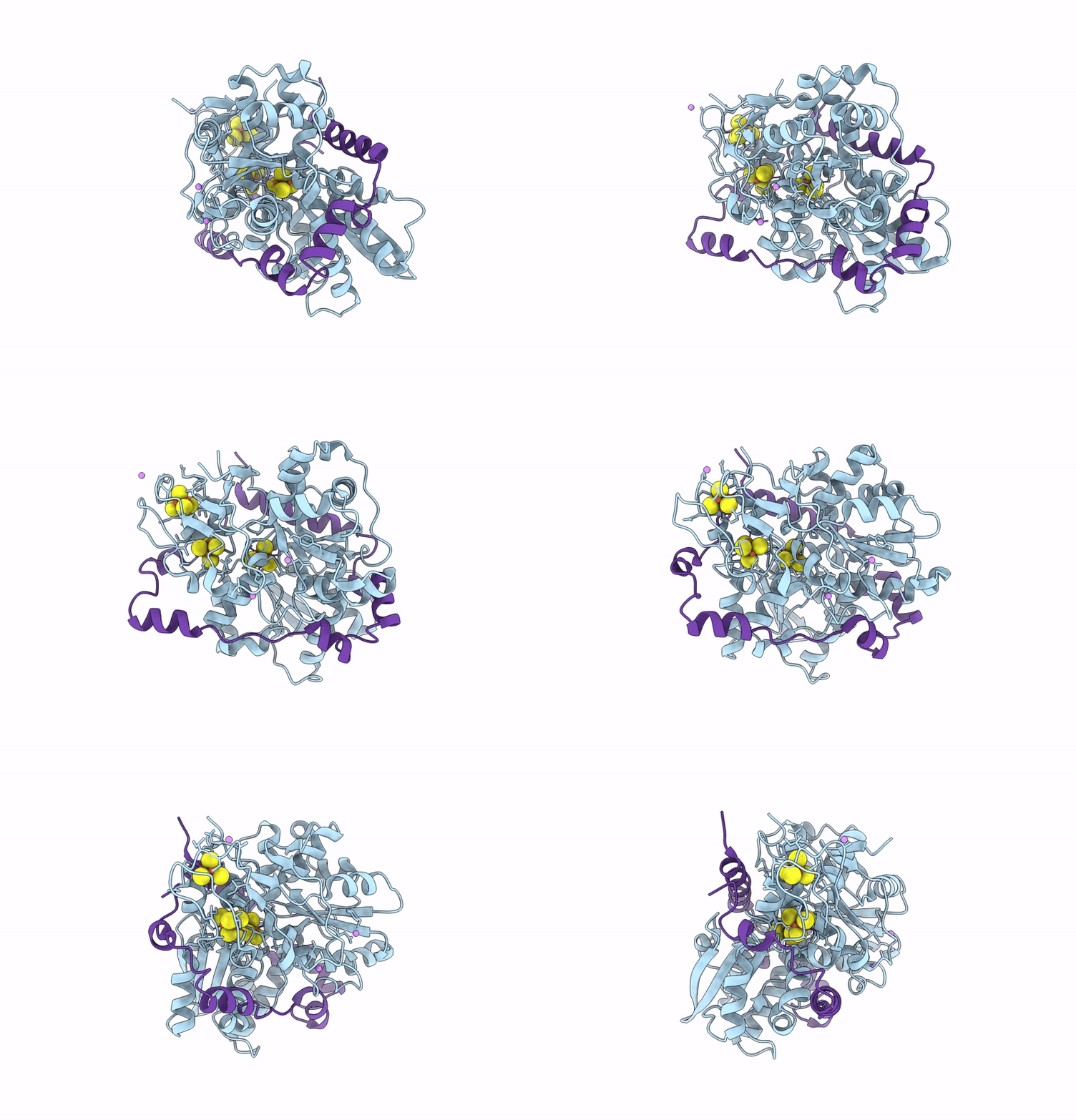
9GZL image
Deposition Date 2024-10-04
Release Date 2025-05-28
Last Version Date 2025-07-30
Entry Detail
PDB ID:
9GZL
Keywords:
Title:
Apo FeFe Hydrogenase from Desulfovibrio desulfuricans labelled with cyanophenylalanine
Biological Source:
Source Organism:
Host Organism:
Method Details:
Experimental Method:
Resolution:
1.02 Å
R-Value Free:
0.15
R-Value Work:
0.13
R-Value Observed:
0.13
Space Group:
P 21 21 21
Macromolecular Entities
Structures with similar UniProt ID
Protein Blast
Polymer Type:polypeptide(L)
Molecule:Periplasmic [Fe] hydrogenase large subunit
Gene (Uniprot):hydA
Chain IDs:A
Chain Length:396
Number of Molecules:1
Biological Source:Desulfovibrio desulfuricans
Structures with similar UniProt ID
Protein Blast
Polymer Type:polypeptide(L)
Molecule:Periplasmic [Fe] hydrogenase small subunit
Gene (Uniprot):hydB
Chain IDs:B
Chain Length:88
Number of Molecules:1
Biological Source:Desulfovibrio desulfuricans
Modified Residue
Compound ID Chain ID Parent Comp ID Details 2D Image
4CF A PHE modified residue
Primary Citation
Cyanophenylalanine as an Infrared Probe for Iron-Sulfur Cluster Redox State in Multicenter Metalloenzymes.
Chembiochem 26 e202500251 e202500251 (2025)
PMID: 40347495 DOI: 10.1002/cbic.202500251

Abstact

The noncanonical amino acid, para-cyanophenylalanine (CNF), when incorporated into metalloproteins, functions as an infrared spectroscopic probe for the redox state of iron-sulfur clusters, offering a strategy for determining electron occupancy in the electron transport chains of complex metalloenzymes. A redshift of ≈1-2 cm-1 in the nitrile (NC) stretching frequency is observed, following reduction of spinach ferredoxin modified to contain CNF close to its [2Fe-2S] center, and this shift is reversed on re-oxidation. We extend this to CNF positioned near to the proximal [4Fe-4S] cluster of the [FeFe] hydrogenase from Desulfovibrio desulfuricans. In combination with a distal [4Fe-4S] cluster and the [4Fe-4S] cluster of the active site 'H-cluster' ([4Fe-4S]H), the proximal cluster forms an electron relay connecting the active site to the surface of the protein. Again, a reversible shift in wavenumber for CNF is observed, following cluster reduction in either apo-protein (containing the iron-sulfur clusters but lacking the active site) or holo-protein with intact active site, demonstrating the general applicability of this approach to studying complex metalloenzymes.

Legend

Protein

Chemical

Disease

Primary Citation of related structures
Feedback Form
Name
Email
Institute
Feedback