9GY5 image
Deposition Date 2024-10-01
Release Date 2025-10-15
Last Version Date 2025-11-26
Entry Detail
PDB ID:
9GY5
Keywords:
Title:
Crystal structure of the catalytic domain from the BoNT-like toxin complex PG1 of Paeniclostridium ghonii
Biological Source:
Source Organism:
Method Details:
Experimental Method:
Resolution:
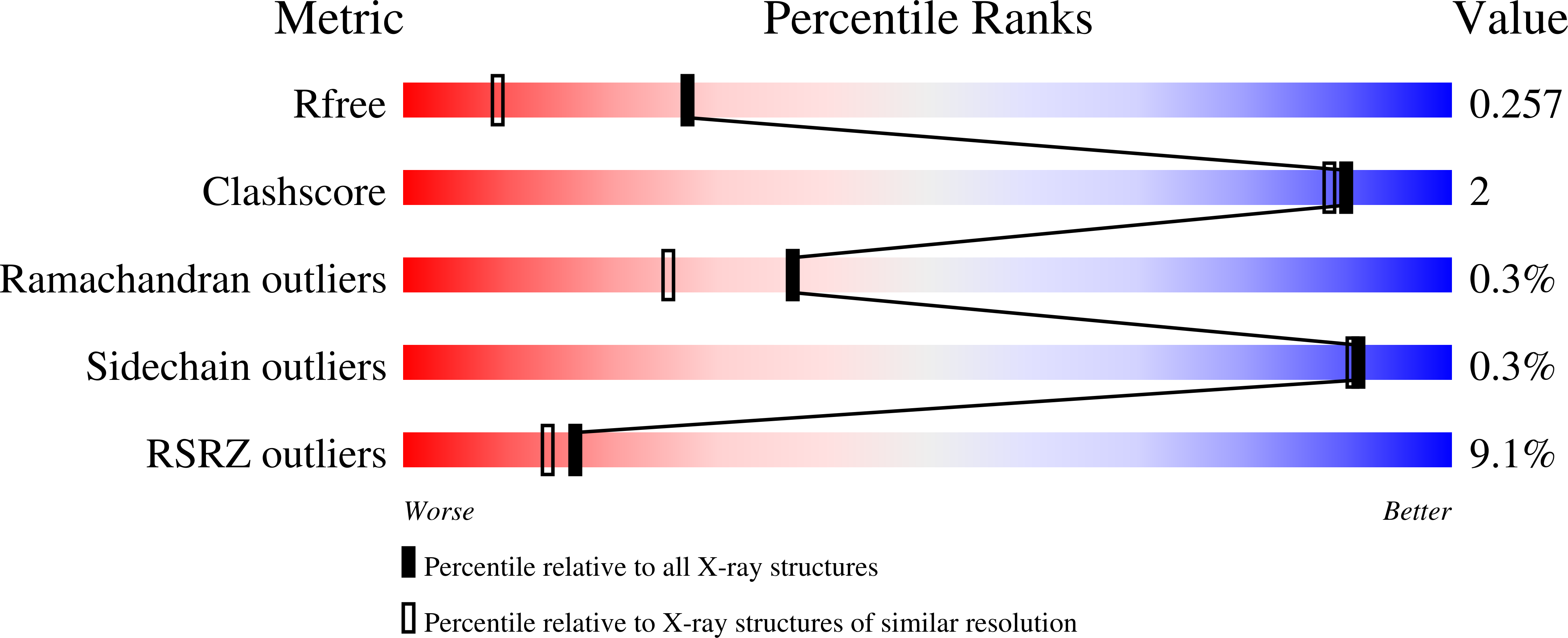
1.80 Å
R-Value Free:
0.25
R-Value Work:
0.22
Space Group:
P 64 2 2
Macromolecular Entities
Polymer Type:polypeptide(L)
Molecule:Catalytic domain from the BoNT-like toxin complex PG1 of Paeniclostridium ghonii
Chain IDs:A
Chain Length:394
Number of Molecules:1
Biological Source:Paraclostridium ghonii
Primary Citation
Identification and characterization of botulinum neurotoxin-like two-component toxins in Paeniclostridium ghonii.
Sci Adv 11 eadx6145 eadx6145 (2025)
PMID: 41223264 DOI: 10.1126/sciadv.adx6145

Abstact

Insecticidal bacterial proteins play key roles in insect-bacteria interactions and have been used as biopesticides. Here, we identify two insecticidal proteins in Paeniclostridium ghonii, designated PG-toxin 1 (PG1) and PG-toxin 2 (PG2), which are homologs of botulinum neurotoxins (BoNTs). Unlike BoNTs, PG1 and PG2 contain two separate proteins: One is the protease light chain (LC), and the other is the heavy chain containing the translocation domain and the receptor binding domain. Crystal and cryo-electron microscopy structures show a conserved BoNT-like architecture but without an interchain disulfide bond. Functional characterizations establish that the LCs of PG1 and PG2 cleave insect synaptosomal-associated protein 25 (SNAP25), but not human or rat SNAP25, and microinjection of PG1 and PG2 caused paralysis and death in Drosophila and Aedes mosquitoes. These findings identified unique two-component BoNT-like insecticidal proteins, revealing insights into the evolution of the BoNT family of toxins, and broadening our understanding of bacteria that can be used for biopest controls.

Legend

Protein

Chemical

Disease

Primary Citation of related structures
Feedback Form
Name
Email
Institute
Feedback