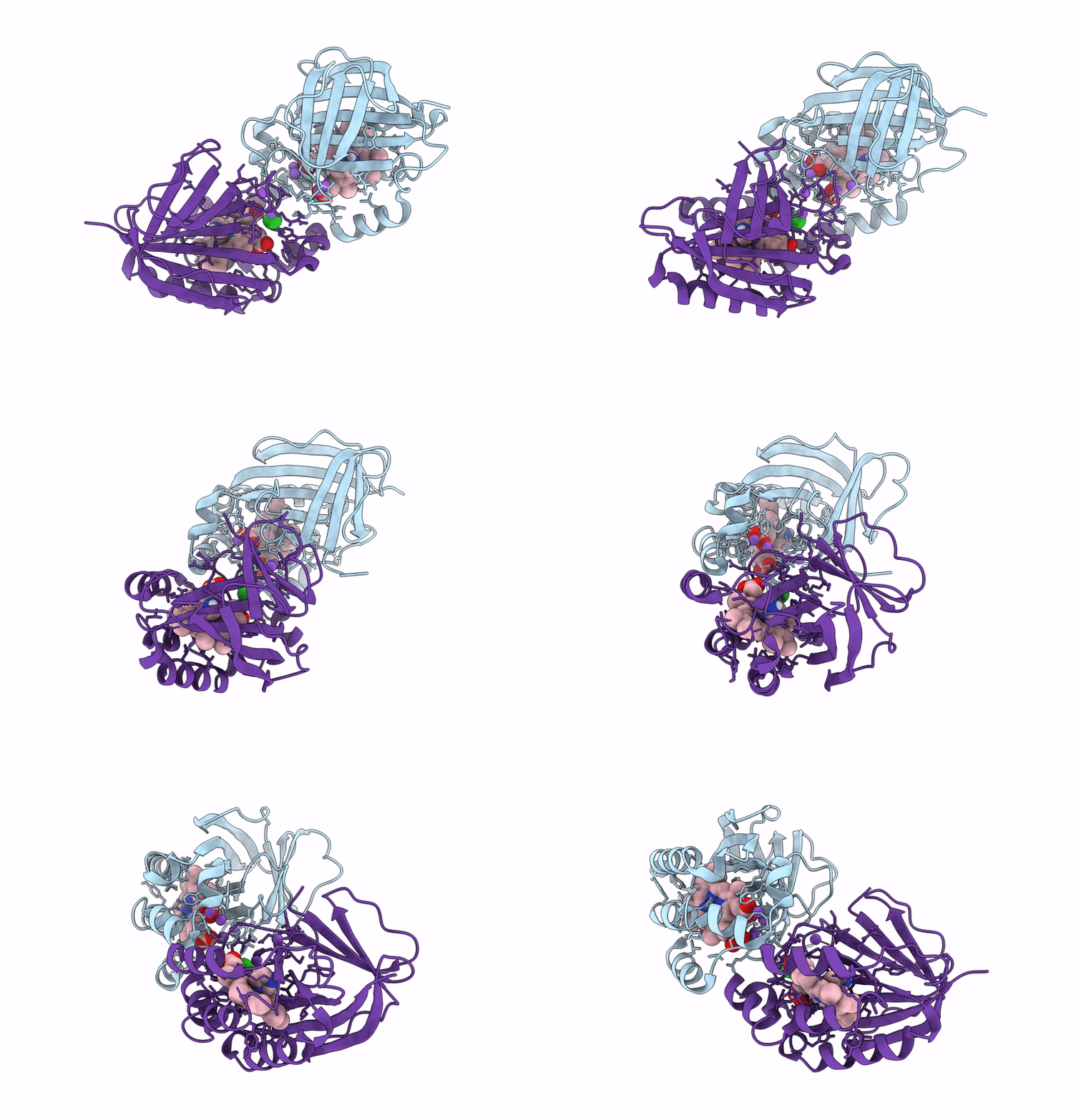
9GTJ image
Deposition Date 2024-09-18
Release Date 2025-06-11
Last Version Date 2025-10-22
Entry Detail
PDB ID:
9GTJ
Keywords:
Title:
Chlorite dismutase from Pseudomonas sp.
Biological Source:
Source Organism:
Pseudomonas (Taxon ID: 286)
Host Organism:
Method Details:
Experimental Method:
Resolution:
0.99 Å
R-Value Free:
0.16
R-Value Work:
0.14
R-Value Observed:
0.14
Space Group:
C 1 2 1
Macromolecular Entities
Structures with similar UniProt ID
Protein Blast
Polymer Type:polypeptide(L)
Molecule:Chlorite dismutase
Gene (Uniprot):SAMN05216605_1413
Chain IDs:A, B
Chain Length:193
Number of Molecules:2
Biological Source:Pseudomonas
Primary Citation
Biochemical and structural characterization of chlorite dismutase enzyme from Pseudomonas aeruginosa.
Febs J. 292 5398 5414 (2025)
PMID: 40458033 DOI: 10.1111/febs.70151

Abstact

Industrialization and urbanization have caused serious contamination of water bodies, and the removal of chemical contaminants has become a major challenge. Chlorite is a harmful anthropogenic compound with a serious environmental impact and has been detected in groundwater, drinking water, and soil. Enzymes are considered sustainable tools for bioremediation, with chlorite dismutase (Cld) being a notable example. This enzyme has unique properties owing to the rare dioxygen bond formation that it catalyzes. In the present study, we report the cloning, biochemical, and structural characterization of the dimeric Cld from Pseudomonas aeruginosa (PaCld). PaCld is a heme b oxidoreductase that can decompose chlorite (ClO 2 - $$ {\mathrm{ClO}}_2^{-} $$ or OClO-) into harmless chloride (Cl-) and dioxygen (O2) with high turnover rates. The structure of PaCld was determined at atomic (0.99 Å) resolution using X-ray crystallography. Additionally, steady-state kinetics and stability studies provided valuable insights into the catalytic mechanism of dimeric Clds. Apart from chlorite bioremediation of water, Clds can also be used in biomedical and synthetic biology as well as in enzymatic cascades with O2-utilizing enzymes.

Legend

Protein

Chemical

Disease

Primary Citation of related structures
Feedback Form
Name
Email
Institute
Feedback