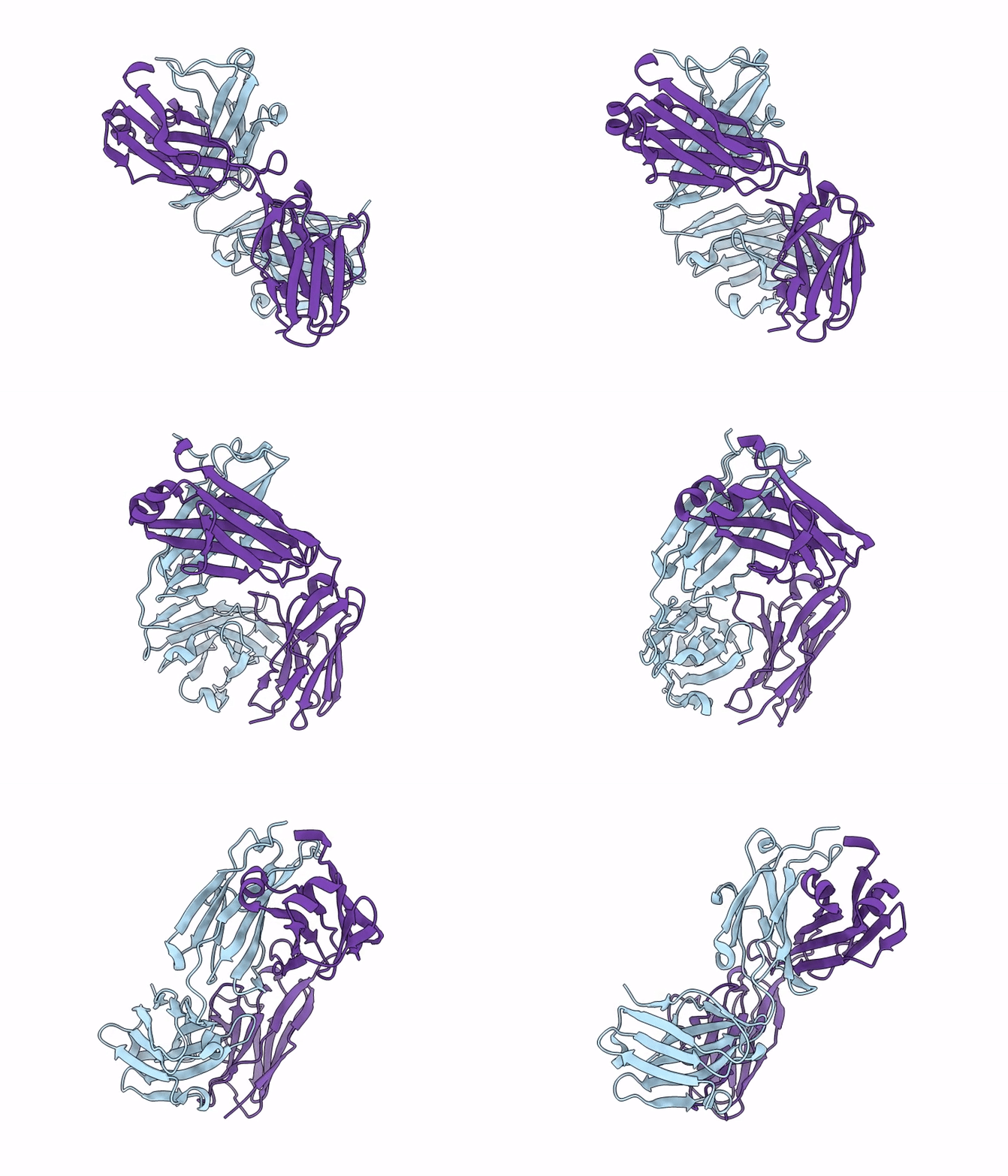
9GJV image
Deposition Date 2024-08-22
Release Date 2025-09-03
Last Version Date 2025-11-26
Entry Detail
PDB ID:
9GJV
Keywords:
Title:
Fab fragment of an antibody that recognises alpha-1 antitrypsin
Biological Source:
Source Organism:
Mus musculus (Taxon ID: 10090)
Method Details:
Experimental Method:
Resolution:
2.20 Å
R-Value Free:
0.26
R-Value Work:
0.24
R-Value Observed:
0.24
Space Group:
P 21 21 21

Macromolecular Entities
Polymer Type:polypeptide(L)
Molecule:FAB 9C5 heavy chain
Chain IDs:A (auth: H)
Chain Length:218
Number of Molecules:1
Biological Source:Mus musculus
Polymer Type:polypeptide(L)
Molecule:FAB 9C5 light chain
Chain IDs:B (auth: L)
Chain Length:214
Number of Molecules:1
Biological Source:Mus musculus
Primary Citation
The mechanism of pathogenic alpha 1 -antitrypsin aggregation in the human liver.
Proc.Natl.Acad.Sci.USA 122 e2507535122 e2507535122 (2025)
PMID: 41231946 DOI: 10.1073/pnas.2507535122

Abstact

Originating 2 to 3 millennia ago in a Scandinavian population, the SERPINA1 Z allele (Glu342Lys) is present in up to 2.5% of populations of Northern European descent and accounts for 95% of severe α1-antitrypsin deficiency. The α1-antitrypsin Z variant self-assembles into polymer chains that deposit within hepatocytes, predisposing to liver disease. Here, the 4.0Å subunit structure of polymers isolated directly from human liver tissue has been determined using cryoelectron microscopy. Challenges of flexibility, small subunit size, heterogeneous length, and preferred orientations were mitigated using antibody Fab domains and sample preparation strategies. This structure demonstrates that the formation of polymers in vivo involves self-incorporation of an exposed structural element (the reactive center loop) as an additional β-strand into the central β-sheet of α1-antitrypsin and displacement of a C-terminal region from one subunit with incorporation into the next. Unlike amyloid aggregation, this well-folded structure partially recapitulates a conformation adopted during normal function of the protein. These perturbations to the constituent α1-antitrypsin subunits of human tissue-derived polymers are consistent with a pronounced stability, their tendency toward long-chain forms, the ability of a subset to undergo canonical secretion, and the action of a class of small molecules that block polymerization in vivo.

Legend

Protein

Chemical

Disease

Primary Citation of related structures
Feedback Form
Name
Email
Institute
Feedback