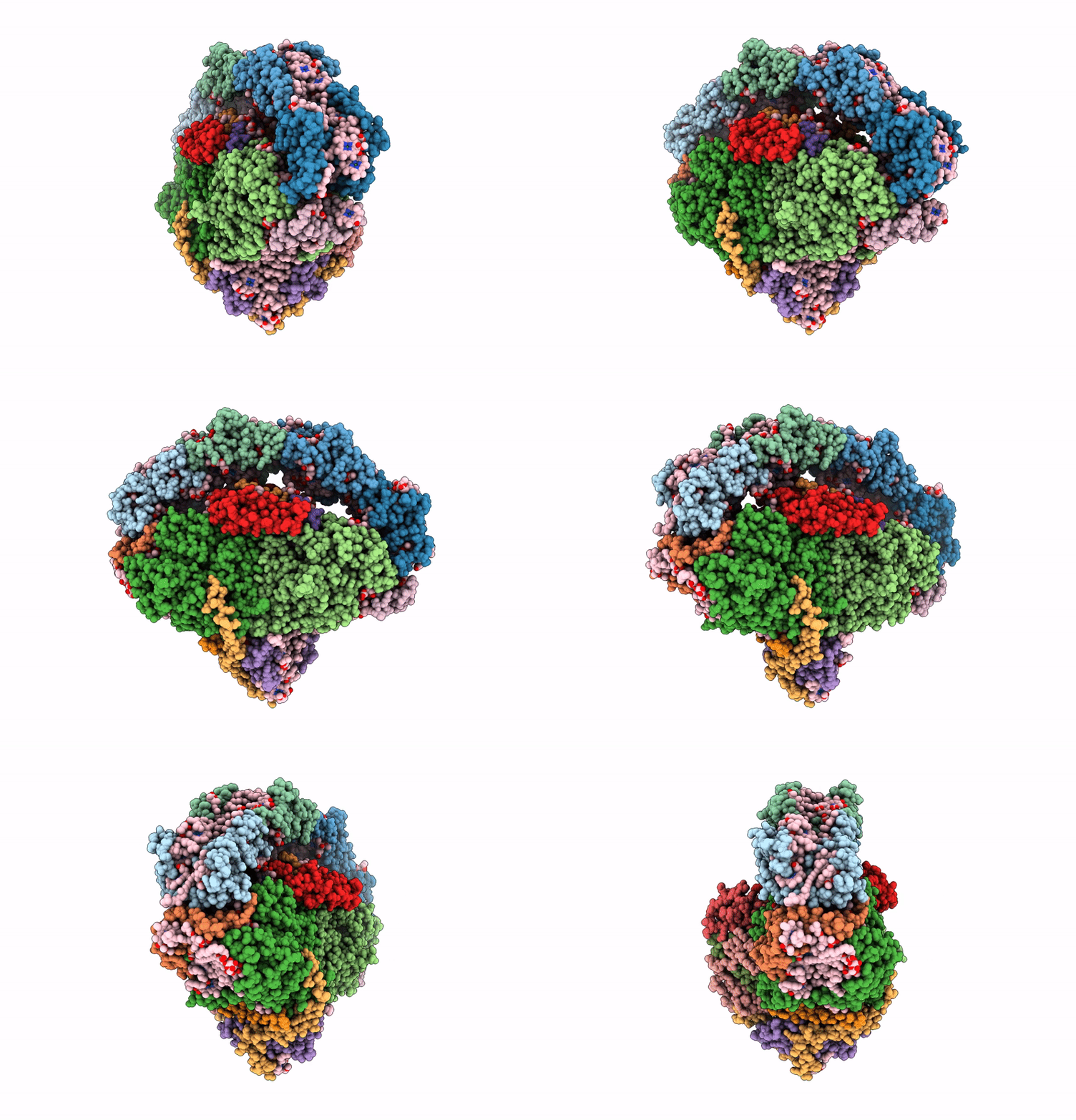
9GC2 image
Deposition Date 2024-08-01
Release Date 2025-08-13
Last Version Date 2025-11-19
Entry Detail
PDB ID:
9GC2
Keywords:
Title:
Cryo-EM structure of Arabidopsis thaliana PSI-LHCI- a603-NH mutant
Biological Source:
Source Organism:
Host Organism:
Method Details:
Experimental Method:
Resolution:
3.29 Å
Aggregation State:
PARTICLE
Reconstruction Method:
SINGLE PARTICLE
Macromolecular Entities
Structures with similar UniProt ID
Protein Blast
Polymer Type:polypeptide(L)
Molecule:Chlorophyll a-b binding protein 6, chloroplastic
Gene (Uniprot):LHCA1
Chain IDs:A (auth: 1)
Chain Length:206
Number of Molecules:1
Biological Source:Arabidopsis thaliana
Structures with similar UniProt ID
Protein Blast
Polymer Type:polypeptide(L)
Molecule:Photosystem I chlorophyll a/b-binding protein 2, chloroplastic
Gene (Uniprot):LHCA2
Chain IDs:B (auth: 2)
Chain Length:214
Number of Molecules:1
Biological Source:Arabidopsis thaliana
Structures with similar UniProt ID
Protein Blast
Polymer Type:polypeptide(L)
Molecule:Photosystem I chlorophyll a/b-binding protein 3-1, chloroplastic
Gene (Uniprot):LHCA3
Mutagens:N103H
Chain IDs:C (auth: 3)
Chain Length:234
Number of Molecules:1
Biological Source:Arabidopsis thaliana
Structures with similar UniProt ID
Protein Blast
Polymer Type:polypeptide(L)
Molecule:Chlorophyll a-b binding protein 4, chloroplastic
Gene (Uniprot):LHCA4
Mutagens:N99H
Chain IDs:D (auth: 4)
Chain Length:199
Number of Molecules:1
Biological Source:Arabidopsis thaliana
Structures with similar UniProt ID
Protein Blast
Polymer Type:polypeptide(L)
Molecule:Photosystem I P700 chlorophyll a apoprotein A1
Gene (Uniprot):psaA
Chain IDs:E (auth: A)
Chain Length:750
Number of Molecules:1
Biological Source:Arabidopsis thaliana
Structures with similar UniProt ID
Protein Blast
Polymer Type:polypeptide(L)
Molecule:Photosystem I P700 chlorophyll a apoprotein A2
Gene (Uniprot):psaB
Chain IDs:F (auth: B)
Chain Length:734
Number of Molecules:1
Biological Source:Arabidopsis thaliana
Structures with similar UniProt ID
Protein Blast
Polymer Type:polypeptide(L)
Molecule:Photosystem I iron-sulfur center
Gene (Uniprot):psaC
Chain IDs:G (auth: C)
Chain Length:81
Number of Molecules:1
Biological Source:Arabidopsis thaliana
Structures with similar UniProt ID
Protein Blast
Polymer Type:polypeptide(L)
Molecule:Photosystem I reaction center subunit II-2, chloroplastic
Gene (Uniprot):PSAD2
Chain IDs:H (auth: D)
Chain Length:160
Number of Molecules:1
Biological Source:Arabidopsis thaliana
Structures with similar UniProt ID
Protein Blast
Polymer Type:polypeptide(L)
Molecule:Photosystem I reaction center subunit IV B, chloroplastic
Gene (Uniprot):PSAE2
Chain IDs:I (auth: E)
Chain Length:99
Number of Molecules:1
Biological Source:Arabidopsis thaliana
Structures with similar UniProt ID
Protein Blast
Polymer Type:polypeptide(L)
Molecule:Photosystem I reaction center subunit III, chloroplastic
Gene (Uniprot):PSAF
Chain IDs:J (auth: F)
Chain Length:154
Number of Molecules:1
Biological Source:Arabidopsis thaliana
Structures with similar UniProt ID
Protein Blast
Polymer Type:polypeptide(L)
Molecule:Photosystem I reaction center subunit V, chloroplastic
Gene (Uniprot):PSAG
Chain IDs:K (auth: G)
Chain Length:100
Number of Molecules:1
Biological Source:Arabidopsis thaliana
Structures with similar UniProt ID
Protein Blast
Polymer Type:polypeptide(L)
Molecule:Photosystem I reaction center subunit VI-1, chloroplastic
Gene (Uniprot):PSAH1
Chain IDs:L (auth: H)
Chain Length:95
Number of Molecules:1
Biological Source:Arabidopsis thaliana
Structures with similar UniProt ID
Protein Blast
Polymer Type:polypeptide(L)
Molecule:Photosystem I reaction center subunit VIII
Gene (Uniprot):psaI
Chain IDs:M (auth: I)
Chain Length:37
Number of Molecules:1
Biological Source:Arabidopsis thaliana
Structures with similar UniProt ID
Protein Blast
Polymer Type:polypeptide(L)
Molecule:Photosystem I reaction center subunit IX
Gene (Uniprot):psaJ
Chain IDs:N (auth: J)
Chain Length:44
Number of Molecules:1
Biological Source:Arabidopsis thaliana
Structures with similar UniProt ID
Protein Blast
Polymer Type:polypeptide(L)
Molecule:Photosystem I reaction center subunit psaK, chloroplastic
Gene (Uniprot):PSAK
Chain IDs:P (auth: K)
Chain Length:84
Number of Molecules:1
Biological Source:Arabidopsis thaliana
Structures with similar UniProt ID
Protein Blast
Polymer Type:polypeptide(L)
Molecule:Photosystem I reaction center subunit XI, chloroplastic
Gene (Uniprot):PSAL
Chain IDs:O (auth: L)
Chain Length:169
Number of Molecules:1
Biological Source:Arabidopsis thaliana
Structures with similar UniProt ID
Protein Blast
Polymer Type:polypeptide(L)
Molecule:Photosystem I reaction center subunit N, chloroplastic
Gene (Uniprot):PSAN
Chain IDs:Q (auth: N)
Chain Length:85
Number of Molecules:1
Biological Source:Arabidopsis thaliana
Primary Citation
Structural determinants for red-shifted absorption in higher-plants Photosystem I.
New Phytol. 248 2331 2346 (2025)
PMID: 40955088 DOI: 10.1111/nph.70562

Abstact

Higher plants Photosystem I absorbs far-red light, enriched under vegetation canopies, through long-wavelength Chls to enhance photon capture. Far-red absorption originates from Chl pairs within the Lhca3 and Lhca4 subunits of the LHCI antenna, known as the 'red cluster', including Chls a603 and a609. We used reverse genetics to produce an Arabidopsis mutant devoid of red-shifted absorption, and we obtained high-resolution cryogenic electron microscopy structures of PSI-LHCI complexes from both wild-type and mutant plants. Computed excitonic coupling values suggested contributions from additional nearby pigment molecules, namely Chl a615 and violaxanthin in the L2 site, to far-red absorption. We investigated the structural determinants of far-red absorption by producing further Arabidopsis transgenic lines and analyzed the spectroscopic effects of mutations targeting these chromophores. The two structures solved were used for quantum mechanics calculations, revealing that excitonic interactions alone cannot explain far-red absorption, while charge transfer states were needed for accurate spectral simulations. Our findings demonstrate that the molecular mechanisms of light-harvesting under shaded conditions rely on very precise tuning of chromophore interactions, whose understanding is crucial for designing light-harvesting complexes with engineered absorption spectra.

Legend

Protein

Chemical

Disease

Primary Citation of related structures
Feedback Form
Name
Email
Institute
Feedback