9G8J image
Deposition Date 2024-07-23
Release Date 2025-06-04
Last Version Date 2025-11-26
Entry Detail
PDB ID:
9G8J
Title:
Structure of K+-dependent Na+-PPase from Thermotoga maritima in complex with zoledronate
Biological Source:
Source Organism:
Method Details:
Experimental Method:
Resolution:
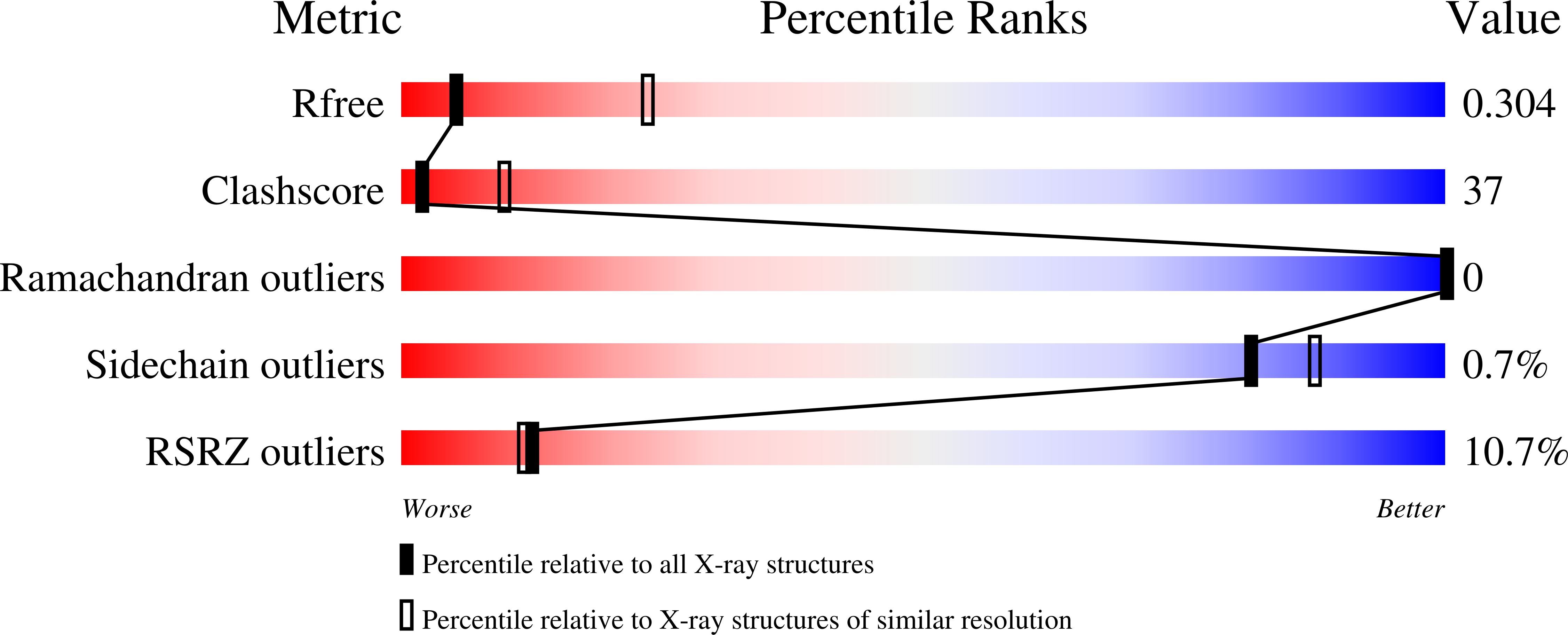
3.26 Å
R-Value Free:
0.30
R-Value Work:
0.26
R-Value Observed:
0.26
Space Group:
P 21 21 21
Macromolecular Entities
Structures with similar UniProt ID
Protein Blast
Polymer Type:polypeptide(L)
Molecule:K(+)-stimulated pyrophosphate-energized sodium pump
Gene (Uniprot):hppA
Chain IDs:A, B, C, D
Chain Length:735
Number of Molecules:4
Biological Source:Thermotoga maritima MSB8
Primary Citation

Abstact

Membrane-bound pyrophosphatases (mPPases) are homodimeric proteins that hydrolyse pyrophosphate and pump H+/Na+ across membranes. They are crucial for the virulence of protist pathogens, making them attractive drug targets. In this study, we investigate the inhibitory effects of seven distinct bisphosphonates against Thermotoga maritima mPPase to explore their mode of action and assist in future small molecule inhibitor development. We solved two structures of mPPase bound to the inhibitors in the enzyme active sites and probed the conformational dynamics of mPPase under multiple inhibitors and functionally relevant conditions by double electron-electron resonance (DEER) spectroscopy. We found that mPPase adopts distinct conformational equilibria in solution in the presence of different inhibitors, including states consistent with asymmetric binding in the active site (closed-open), but a symmetric apo-like conformation on the periplasmic side (open-open). Combined with solid-supported membrane-based electrophysiology recordings, this revealed that during catalysis, one monomer of the dimer remains open, and Na+ can only be pumped in a closed state. These results further support symmetry-breaking across the membrane, consistent with half-of-the-sites-reactivity.

Legend

Protein

Chemical

Disease

Primary Citation of related structures
Feedback Form
Name
Email
Institute
Feedback