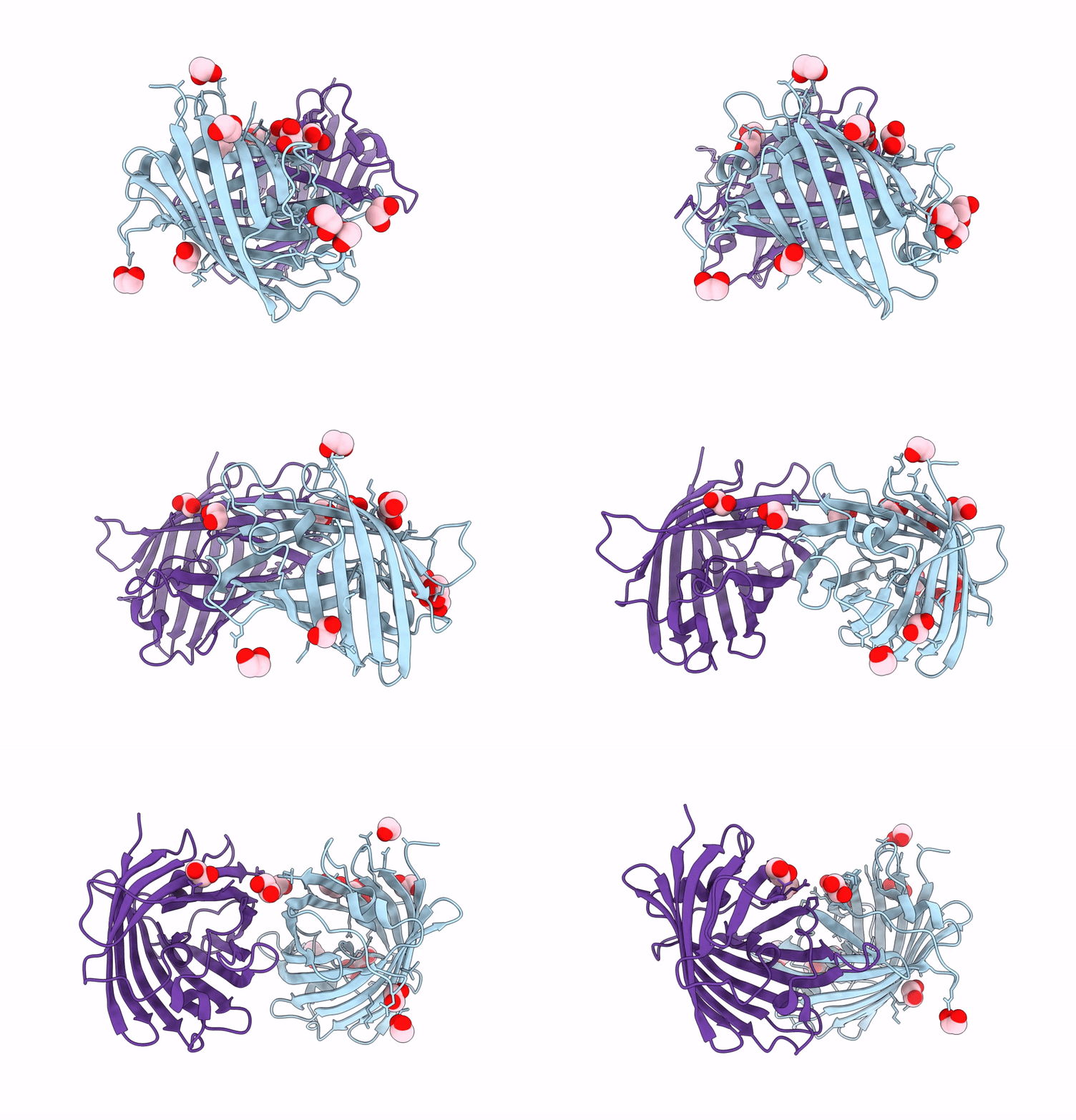
9G7Q image
Deposition Date 2024-07-22
Release Date 2025-05-21
Last Version Date 2025-11-26
Entry Detail
PDB ID:
9G7Q
Title:
Structure of the StayRose dimer
Biological Source:
Source Organism:
Method Details:
Experimental Method:
Resolution:
1.65 Å
R-Value Free:
0.17
R-Value Work:
0.15
Space Group:
P 61

Macromolecular Entities
Structures with similar UniProt ID
Protein Blast
Polymer Type:polypeptide(L)
Molecule:StayRose
Gene (Uniprot):CU17S
Chain IDs:A, B
Chain Length:229
Number of Molecules:2
Biological Source:Cytaeis uchidae
Modified Residue
Compound ID Chain ID Parent Comp ID Details 2D Image
A1IJF A GLY chromophore
Primary Citation

Abstact

Photobleaching of fluorescent proteins often limits the acquisition of high-quality images in microscopy. StayGold, a novel dimeric green fluorescent protein recently monomerised through sequence engineering, addresses this challenge with its high photostability. There is now focus on producing different colour StayGold derivatives to facilitate concurrent tagging of multiple targets. The unnatural amino acid 3-aminotyrosine has previously been shown to red-shift superfolder GFP upon incorporation into its chromophore via genetic code expansion. Here we apply the same strategy to red-shift StayGold through substitution of Tyrosine-58 with 3-aminotyrosine. The resultant red fluorescent protein, StayRose, shows an excitation wavelength maximum of 530 nm and an emission wavelength maximum of 588 nm. Importantly, the monomeric mStayRose retains the favourable photostability in vivo in E. coli and zebrafish embryos. A high-resolution crystal structure of StayRose confirms the modified structure of the amino chromophore within an unperturbed 3D fold. Although reliant on genetic code expansion, StayRose provides an important step towards developing red-shifted StayGold derivatives.

Legend

Protein

Chemical

Disease

Primary Citation of related structures
Feedback Form
Name
Email
Institute
Feedback