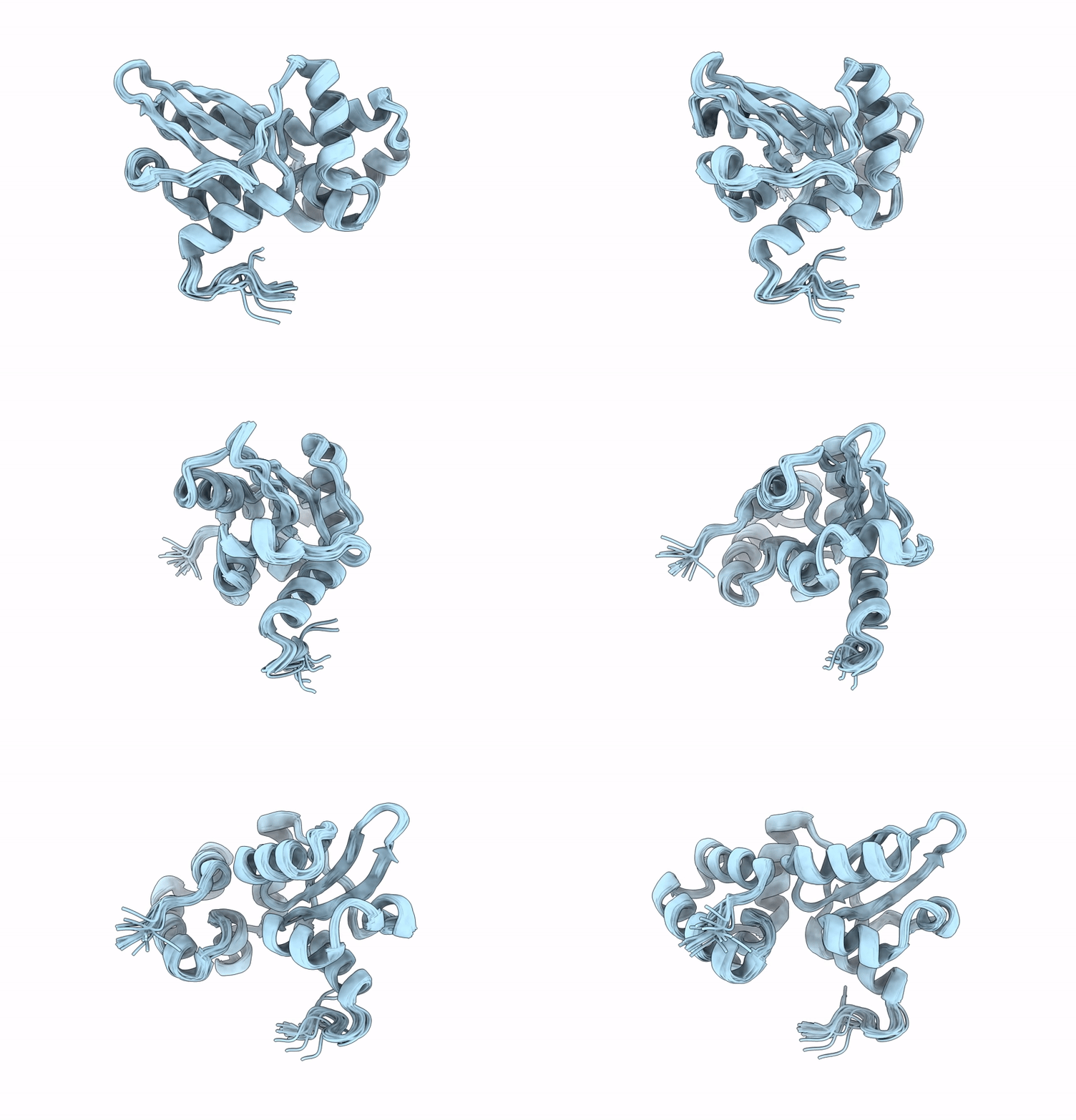
9G1W image
Deposition Date 2024-07-10
Release Date 2025-05-21
Last Version Date 2025-05-21
Entry Detail
PDB ID:
9G1W
Keywords:
Title:
NMR solution structure of the Thermus thermophilus PilF-GSPIIA domain
Biological Source:
Source Organism:
Method Details:
Experimental Method:
Conformers Calculated:
100
Conformers Submitted:
20
Selection Criteria:
target function

Macromolecular Entities
Structures with similar UniProt ID
Protein Blast
Polymer Type:polypeptide(L)
Molecule:Type IV pilus assembly ATPase PilB
Gene (Uniprot):pilB
Chain IDs:A
Chain Length:154
Number of Molecules:1
Biological Source:Thermus thermophilus HB27
Ligand Molecules
Primary Citation
NMR Solution Structure of the N-Terminal GSPII Domain from the Thermus Thermophilus Traffic ATPase PilF and Reconstruction of its c-di-GMP Binding Capability.
Chembiochem 26 e202400959 e202400959 (2025)
PMID: 39960869 DOI: 10.1002/cbic.202400959

Abstact

The cyclic dinucleotide c-di-GMP is an important second messenger molecule in bacteria and interacts with a variety of receptor molecules including RNA and protein domains. An important class of c-di-GMP-binding protein domains are the general secretory pathway type II (GSPII) domains as exemplified by the N-terminal domain of the ATPase MshE from Vibrio cholerae (MshEN). MshEN binds monomeric c-di-GMP via two consecutive copies of a 24-residue sequence motif, which form a compact 4-α-helical bundle. The ATPase PilF from Thermus thermophilus regulates pilus formation, motility and DNA-uptake. Its N-terminal section contains three consecutive GSPII domains (GSPII-A-GSPII-C) all with considerable sequence homology to MshEN. While the GSPII-B and the GSPII-C domains bind c-di-GMP, the GSPII-A domain does not. To determine why it is incapable of c-di-GMP-binding we determined the NMR-solution structure of this domain. Our structure shows how small deviations in the consensus motif sequence, a stabilizing N-terminal helical capping motif and intersubdomain interactions absent in MshEN cooperate to prevent c-di-GMP-binding. By combining point mutations and truncations, we re-established the c-di-GMP binding capability. Our findings shed new light on the evolution and functional diversification of GSPII domains and the importance of sequence variations for protein activity in this domain family.

Legend

Protein

Chemical

Disease

Primary Citation of related structures
Feedback Form
Name
Email
Institute
Feedback