9G0L image
Deposition Date 2024-07-08
Release Date 2025-02-19
Last Version Date 2025-02-19
Entry Detail
PDB ID:
9G0L
Keywords:
Title:
Crystal structure of the RING-ZnF1 fragment of SIAH1
Biological Source:
Source Organism:
Homo sapiens (Taxon ID: 9606)
Host Organism:
Method Details:
Experimental Method:
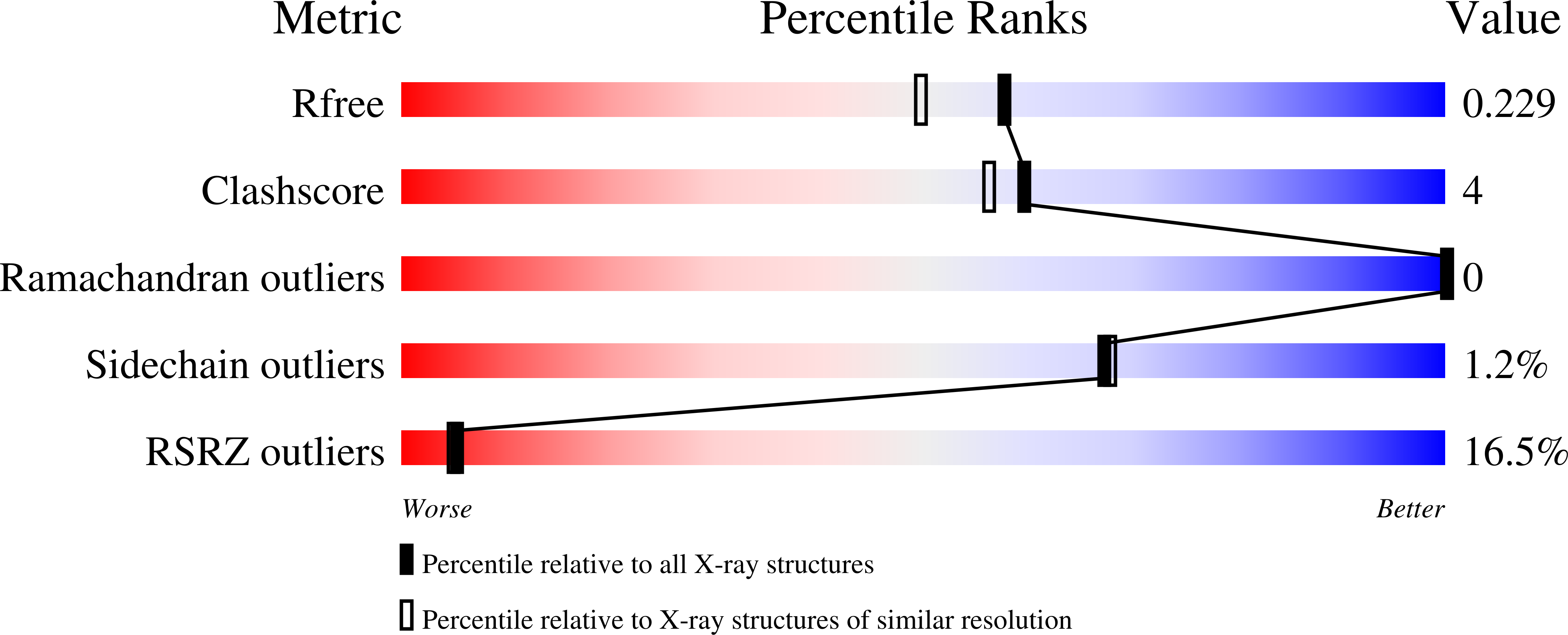
Resolution:
1.90 Å
R-Value Free:
0.23
R-Value Work:
0.20
R-Value Observed:
0.20
Space Group:
P 43 21 2
Macromolecular Entities
Structures with similar UniProt ID
Protein Blast
Polymer Type:polypeptide(L)
Molecule:E3 ubiquitin-protein ligase SIAH1
Gene (Uniprot):SIAH1
Chain IDs:A
Chain Length:107
Number of Molecules:1
Biological Source:Homo sapiens
Ligand Molecules
Primary Citation
RING dimerisation drives higher-order organisation of SINA/SIAH E3 ubiquitin ligases.
Febs J. ? ? ? (2025)
PMID: 39910688 DOI: 10.1111/febs.70000

Abstact

RING-type E3 ubiquitin ligases promote ubiquitylation by stabilising an active complex between a ubiquitin-loaded E2-conjugating enzyme and a protein substrate. To fulfil this function, the E3 ubiquitin-protein ligase SIAH1 and other SINA/SIAH subfamily RING-type E3 ligases employ an N-terminal catalytic RING domain and a C-terminal substrate-binding domain (SBD), separated by two zinc fingers. Here, we present the first crystal structure of the RING domain of human SIAH1, together with an adjacent zinc finger, revealing a potential RING dimer, which was validated in solution using static light scattering. RING dimerisation contributes to the E3 ligase activity of SIAH1 both in vitro and in cells. Moreover, as the RING domain is the second element, after the SBD, to independently favour homodimerisation within SINA/SIAH E3 ligases, we propose that alternating RING:RING and SBD:SBD interactions organise multiple copies of a SINA/SIAH protein into a higher-order homomultimer. In line with this hypothesis, fluorescently tagged full-length human SIAH1, human SIAH2 and fruit fly SINA show cytoplasmic clusters in human cells, whereas their distribution becomes more diffuse when RING dimerisation is disabled. The wild-type (WT) form of SIAH1, but not its RING dimerisation mutant, colocalises with aggregated synphilin-1A under proteasomal inhibition, suggesting that SIAH1 multimerisation might contribute to its reported preference for aggregated or multimeric substrates.

Legend

Protein

Chemical

Disease

Primary Citation of related structures
Feedback Form
Name
Email
Institute
Feedback