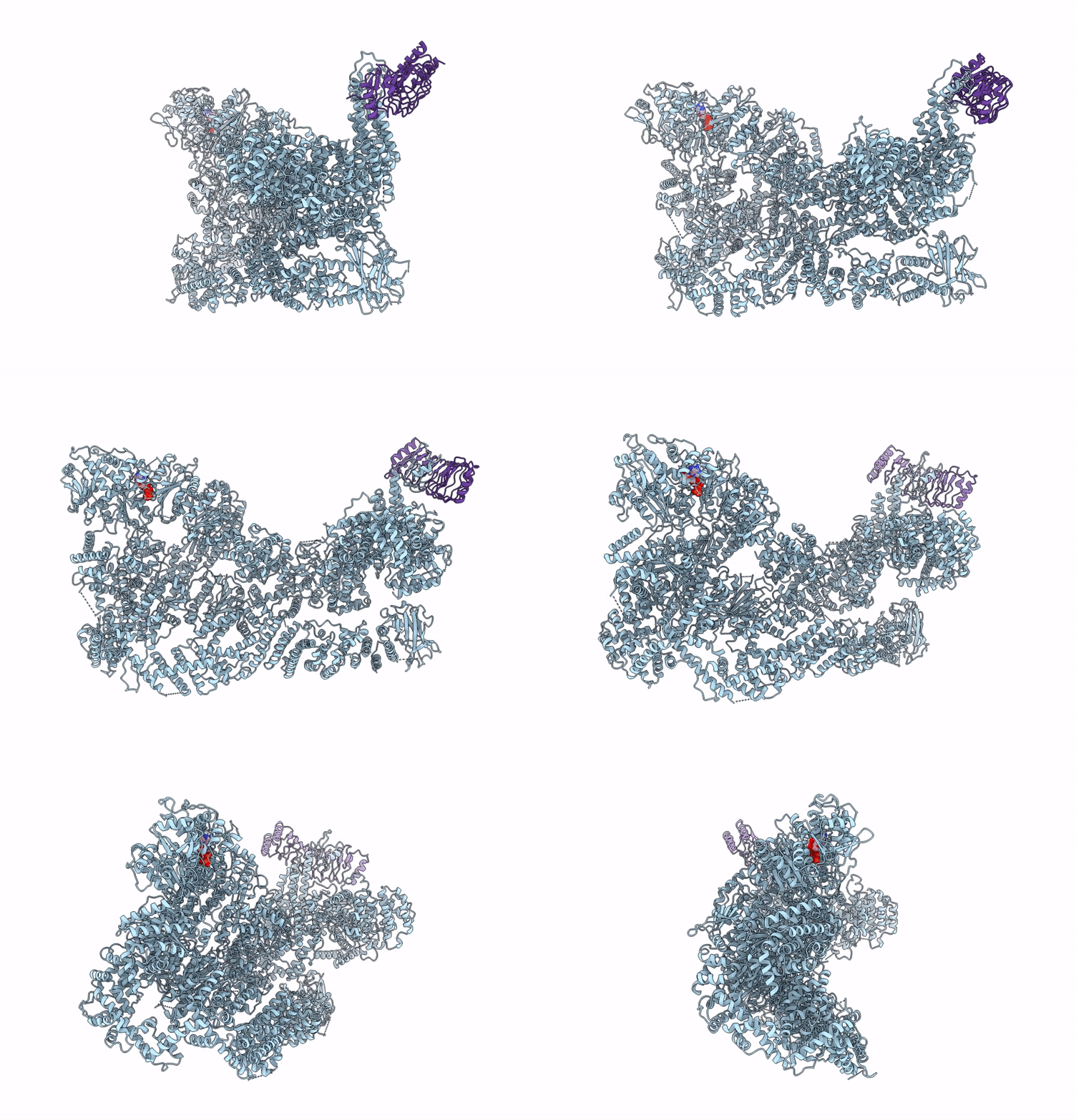
9G08 image
Deposition Date 2024-07-07
Release Date 2025-04-16
Last Version Date 2025-10-01
Entry Detail
PDB ID:
9G08
Title:
Structure of human RNF213 bound to the secreted effector IpaH1.4 from Shigella flexneri
Biological Source:
Source Organism:
Host Organism:
Method Details:
Experimental Method:
Resolution:
3.30 Å
Aggregation State:
PARTICLE
Reconstruction Method:
SINGLE PARTICLE

Macromolecular Entities
Structures with similar UniProt ID
Protein Blast
Polymer Type:polypeptide(L)
Molecule:E3 ubiquitin-protein ligase RNF213
Gene (Uniprot):RNF213
Mutagens:D1045N
Chain IDs:A
Chain Length:5247
Number of Molecules:1
Biological Source:Homo sapiens
Structures with similar UniProt ID
Protein Blast
Polymer Type:polypeptide(L)
Molecule:E3 ubiquitin-protein ligase IpaH1.4
Gene (Uniprot):ipaH1.4
Chain IDs:B
Chain Length:575
Number of Molecules:1
Biological Source:Shigella flexneri 5a str. M90T
Primary Citation
Shigella flexneri evades LPS ubiquitylation through IpaH1.4-mediated degradation of RNF213.
Nat.Struct.Mol.Biol. 32 1741 1751 (2025)
PMID: 40205224 DOI: 10.1038/s41594-025-01530-8

Abstact

Pathogens have evolved diverse strategies to counteract host immunity. Ubiquitylation of lipopolysaccharide (LPS) on cytosol-invading bacteria by the E3 ligase RNF213 creates 'eat me' signals for antibacterial autophagy, but whether and how cytosol-adapted bacteria avoid LPS ubiquitylation remains poorly understood. Here, we show that the enterobacterium Shigella flexneri actively antagonizes LPS ubiquitylation through IpaH1.4, a secreted effector protein with ubiquitin E3 ligase activity. IpaH1.4 binds to RNF213, ubiquitylates it and targets it for proteasomal degradation, thus counteracting host-protective LPS ubiquitylation. To understand how IpaH1.4 recognizes RNF213, we determined the cryogenic electron microscopy structure of the IpaH1.4-RNF213 complex. The specificity of the interaction is achieved through the leucine-rich repeat of IpaH1.4, which binds the RING domain of RNF213 by hijacking the conserved RING interface required for binding to ubiquitin-charged E2 enzymes. IpaH1.4 also targets other E3 ligases involved in inflammation and immunity through binding to the E2-interacting face of their RING domains, including the E3 ligase LUBAC that is required for the synthesis of M1-linked ubiquitin chains on cytosol-invading bacteria downstream of RNF213. We conclude that IpaH1.4 has evolved to antagonize multiple antibacterial and proinflammatory host E3 ligases.

Legend

Protein

Chemical

Disease

Primary Citation of related structures
Feedback Form
Name
Email
Institute
Feedback