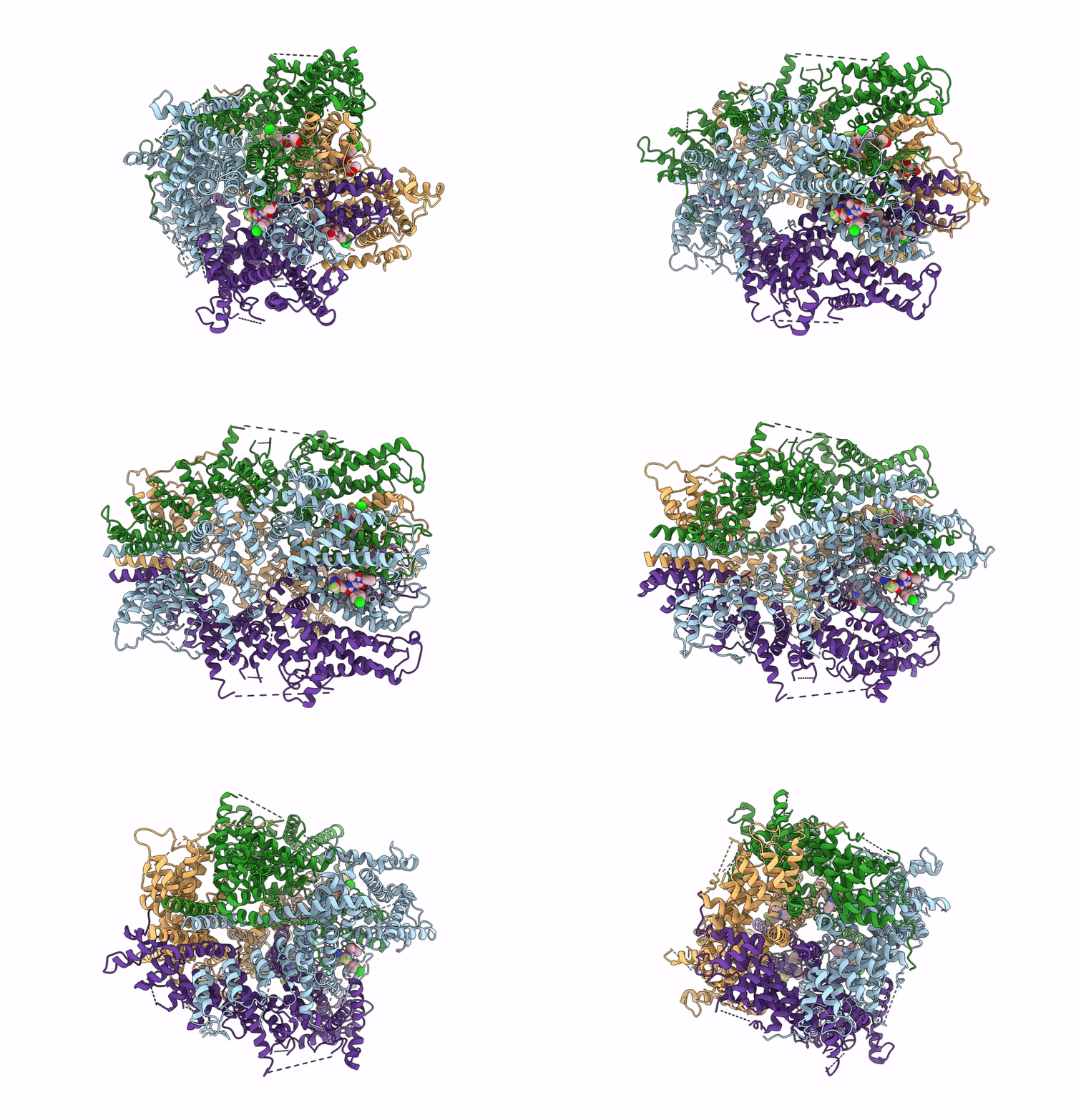
9FXM image
Deposition Date 2024-07-01
Release Date 2025-07-09
Last Version Date 2026-01-28
Entry Detail
PDB ID:
9FXM
Title:
TRPC4 in complex with Z-AzPico
Biological Source:
Source Organism(s):
Danio rerio (Taxon ID: 7955)
Expression System(s):
Method Details:
Experimental Method:
Resolution:
3.10 Å
Aggregation State:
PARTICLE
Reconstruction Method:
SINGLE PARTICLE
Macromolecular Entities
Structures with similar UniProt ID
Protein Blast
Polymer Type:polypeptide(L)
Molecule:Transient receptor potential cation channel subfamily c member 4a
Gene (Uniprot):trpc4b
Chain IDs:A, B, C, D
Chain Length:941
Number of Molecules:4
Biological Source:Danio rerio
Ligand Molecules
Primary Citation
Ideal efficacy photoswitching for chromocontrol of TRPC4/5 channel functions in live tissues.
Nat.Chem.Biol. ? ? ? (2026)
PMID: 41545580 DOI: 10.1038/s41589-025-02085-x

Abstact

Precisely probing the endogenous roles of target proteins is crucial for biological research. Photochemical tools can be photoactuated with high spatiotemporal resolution but often they are unreliable in vivo because spatiotemporal variations of reagent concentration result in inhomogeneous bioactivity. We now describe ideal efficacy photoswitching, a paradigm that internally compensates for reagent concentration by self-competitive binding, allowing purely wavelength-dependent chromocontrol over bioactivity that is consistent from cell culture to deep tissues. We demonstrate this with photoswitches for endogenous transient receptor potential (TRP) C4 and C5 ion channels, reproducibly delivering strong agonism under 360-nm illumination, weak agonism under 385-nm illumination and strong antagonism under 440-nm illumination. These ligands unlock a range of high-precision investigations in TRP biology, from neuronal activity to exocytosis, reproductive signaling and smooth muscle contractility. The ideal efficacy photoswitching paradigm should also unlock high-performance chromocontrol over a wide range of sensory or signaling channels and receptors even in vivo.

Legend

Protein

Chemical

Disease

Primary Citation of related structures
Feedback Form
Name
Email
Institute
Feedback