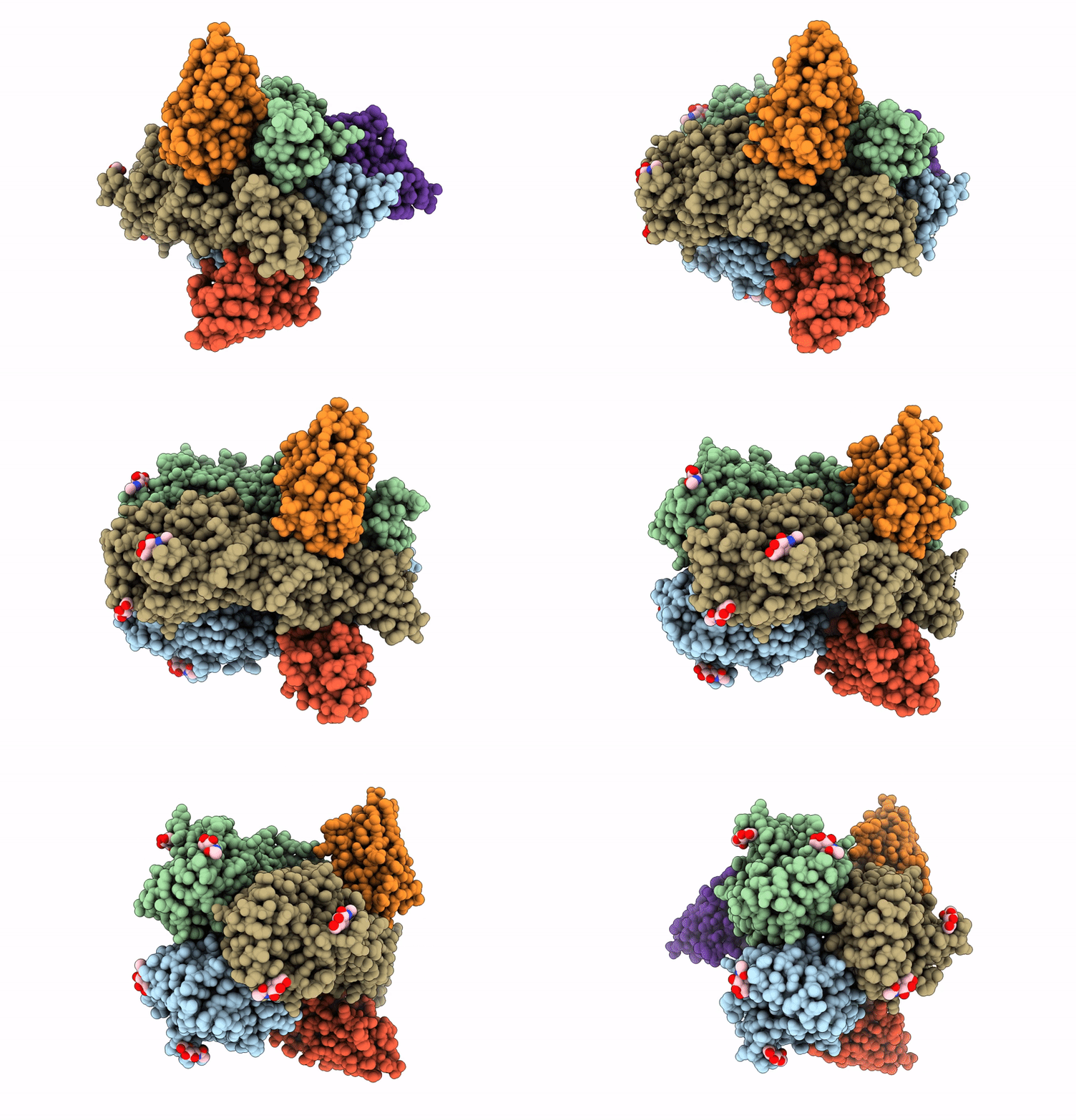
9FM1 image
Deposition Date 2024-06-05
Release Date 2025-07-09
Last Version Date 2025-07-16
Entry Detail
PDB ID:
9FM1
Title:
Cryo-EM structure of Influenza B/Washington/02/2019 virus hemagglutinin in complex with single-domain antibody hVHH-69.
Biological Source:
Source Organism:
Influenza B virus (Taxon ID: 11520)
Lama glama (Taxon ID: 9844)
Host Organism:
Method Details:
Experimental Method:
Resolution:
2.93 Å
Aggregation State:
PARTICLE
Reconstruction Method:
SINGLE PARTICLE

Macromolecular Entities
Structures with similar UniProt ID
Protein Blast
Polymer Type:polypeptide(L)
Molecule:Hemagglutinin
Gene (Uniprot):HA
Chain IDs:A, B, C
Chain Length:601
Number of Molecules:3
Biological Source:Influenza B virus
Polymer Type:polypeptide(L)
Molecule:Single-domain antibody hVHH-69
Chain IDs:D, E, F
Chain Length:124
Number of Molecules:3
Biological Source:Lama glama
Ligand Molecules
Primary Citation
Single-domain antibodies directed against hemagglutinin and neuraminidase protect against influenza B viruses.
Nat Commun 16 5831 5831 (2025)
PMID: 40593518 DOI: 10.1038/s41467-025-60232-3

Abstact

Influenza B viruses are antigenically diverse and contribute significantly to the annual influenza burden. Here we report influenza B virus neutralizing single-domain antibodies that target highly conserved regions of the hemagglutinin and neuraminidase. Structural studies by single particle electron cryo-microscopy (cryo-EM) revealed that one of these single-domain antibodies prevents the conformational transition of the viral hemagglutinin to the post-fusion state by targeting a quaternary epitope spanning two protomers in the hemagglutinin-stem region. A second single-domain antibody broadly inhibits influenza B neuraminidase activity, including an oseltamivir-resistant neuraminidase, and its complex with neuraminidase elucidated by single particle cryo-EM established that it binds to residues in the neuraminidase catalytic site. Head-to-tail fusions of these single-domain antibodies led to bispecific binders that further improved the neutralization breadth and potency against influenza B viruses. These single-domain antibodies, fused to a human IgG1-Fc domain, fully protected female mice against an otherwise lethal influenza B virus challenge. Our findings underscore the potential of engineered single-domain antibodies to help control influenza B virus infections.

Legend

Protein

Chemical

Disease

Primary Citation of related structures
Feedback Form
Name
Email
Institute
Feedback