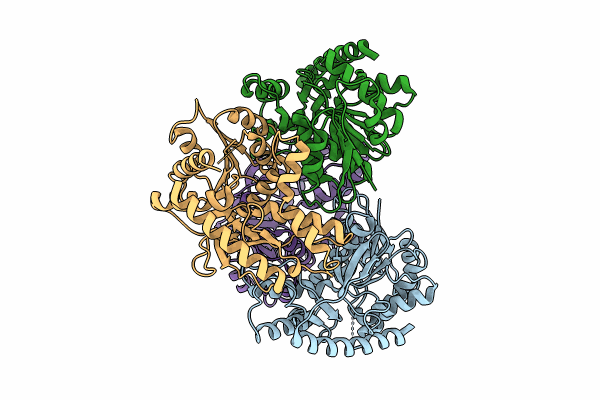
9FEE image
Deposition Date 2024-05-19
Release Date 2024-05-29
Last Version Date 2026-01-14
Entry Detail
PDB ID:
9FEE
Keywords:
Title:
Cryo-EM structure of Trypanosoma cruzi glycosomal malate dehydrogenase
Biological Source:
Source Organism(s):
Expression System(s):
Method Details:
Experimental Method:
Resolution:
3.03 Å
Aggregation State:
PARTICLE
Reconstruction Method:
SINGLE PARTICLE
Macromolecular Entities
Structures with similar UniProt ID
Protein Blast
Polymer Type:polypeptide(L)
Molecule:malate dehydrogenase
Gene (Uniprot):Tc00.1047053506503.69
Chain IDs:A, B, C, D
Chain Length:331
Number of Molecules:4
Biological Source:Trypanosoma cruzi strain CL Brener
Ligand Molecules
Primary Citation
Structure of Trypanosoma peroxisomal import complex unveils conformational heterogeneity.
Nat Commun 16 11398 11398 (2025)
PMID: 41381475 DOI: 10.1038/s41467-025-66207-8

Abstact

Peroxisomes are membrane enclosed organelles hosting diverse metabolic processes in eukaryotic cells. Having no protein synthetic abilities, peroxisomes import all required enzymes from the cytosol through a peroxin (Pex) import system. Peroxisome targeting sequence 1 (PTS1)-tagged cargo is recognized by cytosolic receptor, Pex5. The cargo-Pex5 complex docks at the peroxisomal membrane translocon, composed of Pex14 and Pex13, facilitating translocation into the peroxisomal lumen. Despite its significance, the structural basis of the process is only partially understood. Here, we characterize the cargo-Pex5-Pex14NTD ternary complex from Trypanosoma cruzi. Cryo-electron microscopy maps enabled model building for Pex5 (residues 327-462 and 487-653) bound to malate dehydrogenase (MDH; residues 1-323) cargo tetramer and Pex14NTD (residues 21-85). The model provides insight into conformational heterogeneity and identifies secondary interfaces. Specifically, we observe that orientations of Pex5 relative to MDH span a 17° angle. Additionally, PTS1- and Wxxx(F/Y)-independent contact surfaces are observed at MDH-Pex5 and Pex5-Pex14NTD interfaces, respectively. Mutational analysis indicates that the non-PTS1 MDH-Pex5 interface does not significantly contribute to the affinity, but limits the conformational heterogeneity of MDH-Pex5 interface. The Pex5-Pex14NTD interface constitutes an extended binding site of Pex14NTD over Pex5. We discuss the implications of these findings for understanding peroxisomal import mechanism.

Legend

Protein

Chemical

Disease

Primary Citation of related structures
Feedback Form
Name
Email
Institute
Feedback