9EVA image
Deposition Date 2024-03-28
Release Date 2025-04-09
Last Version Date 2025-12-17
Entry Detail
PDB ID:
9EVA
Keywords:
Title:
3DFlex refinement of the CryoEM structure of DeCLIC nanodisc with 10mM calcium
Biological Source:
Source Organism(s):
Expression System(s):
Method Details:
Experimental Method:
Resolution:
2.34 Å
Aggregation State:
PARTICLE
Reconstruction Method:
SINGLE PARTICLE
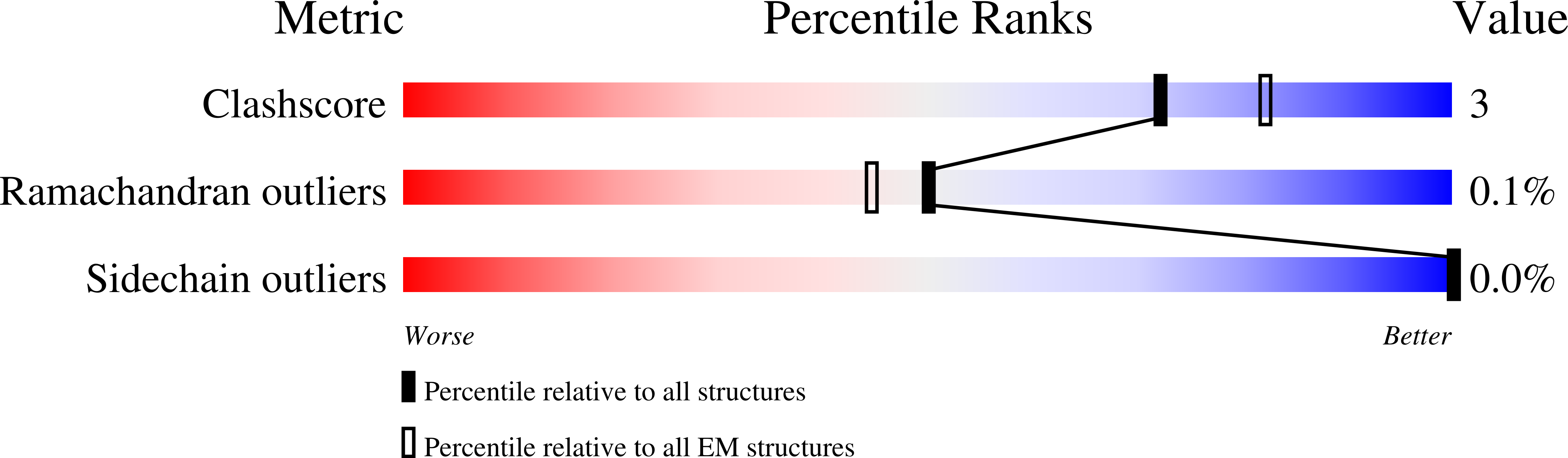
Macromolecular Entities
Structures with similar UniProt ID
Protein Blast
Polymer Type:polypeptide(L)
Molecule:Neur_chan_LBD domain-containing protein
Gene (Uniprot):JKP90_15375
Chain IDs:A, B, C, D, E
Chain Length:642
Number of Molecules:5
Biological Source:Desulfofustis sp. PB-SRB1
Ligand Molecules
Primary Citation
Calcium stabilizes the flexible N-terminal domain of the bacterial ion channel DeCLIC.
J Struct Biol X 12 100139 100139 (2025)
PMID: 41328424 DOI: 10.1016/j.yjsbx.2025.100139

Abstact

Pentameric ligand-gated ion channels (pLGICs) are responsible for the rapid conversion of chemical to electrical signals. In addition to the canonical extracellular and transmembrane domains, some prokaryotic pLGICs contain an N-terminal domain (NTD) of unclear structure and function. In one such case, the calcium-sensitive channel DeCLIC, the NTD appears to accelerate gating; however, its evident flexibility has posed a challenge to model building, and its role in calcium sensitivity is unclear. Here we report cryo-EM structures of DeCLIC in circularized lipid nanodiscs, achieving the highest resolution reported so far, and enabling definition of calcium-binding sites in both the N-terminal and canonical extracellular domains. In addition to the symmetric state, calcium depletion promoted an asymmetric conformation of the NTD, offering a structural rationale for small-angle scattering results. Behavior of these structures in molecular dynamics simulations demonstrated calcium stabilization of the NTD. These features of DeCLIC offer a model system for ion-channel modulation by a flexible accessory domain, potentially conserved in structurally homologous systems across evolution.

Legend

Protein

Chemical

Disease

Primary Citation of related structures
Feedback Form
Name
Email
Institute
Feedback