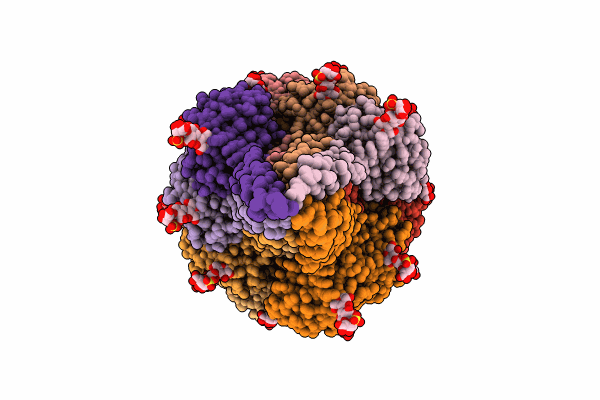
9ETU image
Deposition Date 2024-03-27
Release Date 2024-07-17
Last Version Date 2024-11-20
Entry Detail
PDB ID:
9ETU
Title:
Archaellum filament from the Halobacterium salinarum deltaAgl27 strain
Biological Source:
Source Organism:
Method Details:
Experimental Method:
Resolution:
3.33 Å
Aggregation State:
HELICAL ARRAY
Reconstruction Method:
HELICAL
Macromolecular Entities
Structures with similar UniProt ID
Protein Blast
Polymer Type:polypeptide(L)
Molecule:Archaellin
Chain IDs:A, B, C, D, E, F, G, H, I, J, K, L, M, N, O, P, Q, R, S, T, U, V, W, X, Y
Chain Length:193
Number of Molecules:25
Biological Source:Halobacterium salinarum
Ligand Molecules
Primary Citation
Perturbed N-glycosylation of Halobacterium salinarum archaellum filaments leads to filament bundling and compromised cell motility.
Nat Commun 15 5841 5841 (2024)
PMID: 38992036 DOI: 10.1038/s41467-024-50277-1

Abstact

The swimming device of archaea-the archaellum-presents asparagine (N)-linked glycans. While N-glycosylation serves numerous roles in archaea, including enabling their survival in extreme environments, how this post-translational modification contributes to cell motility remains under-explored. Here, we report the cryo-EM structure of archaellum filaments from the haloarchaeon Halobacterium salinarum, where archaellins, the building blocks of the archaellum, are N-glycosylated, and the N-glycosylation pathway is well-resolved. We further determined structures of archaellum filaments from two N-glycosylation mutant strains that generate truncated glycans and analyzed their motility. While cells from the parent strain exhibited unidirectional motility, the N-glycosylation mutant strain cells swam in ever-changing directions within a limited area. Although these mutant strain cells presented archaellum filaments that were highly similar in architecture to those of the parent strain, N-linked glycan truncation greatly affected interactions between archaellum filaments, leading to dramatic clustering of both isolated and cell-attached filaments. We propose that the N-linked tetrasaccharides decorating archaellins act as physical spacers that minimize the archaellum filament aggregation that limits cell motility.

Legend

Protein

Chemical

Disease

Primary Citation of related structures
Feedback Form
Name
Email
Institute
Feedback