9ETR image
Deposition Date 2024-03-26
Release Date 2024-12-04
Last Version Date 2025-01-08
Entry Detail
PDB ID:
9ETR
Keywords:
Title:
Crystal structure of PARP1 catalytic domain bound to AZD9574
Biological Source:
Source Organism:
Homo sapiens (Taxon ID: 9606)
Host Organism:
Method Details:
Experimental Method:
Resolution:
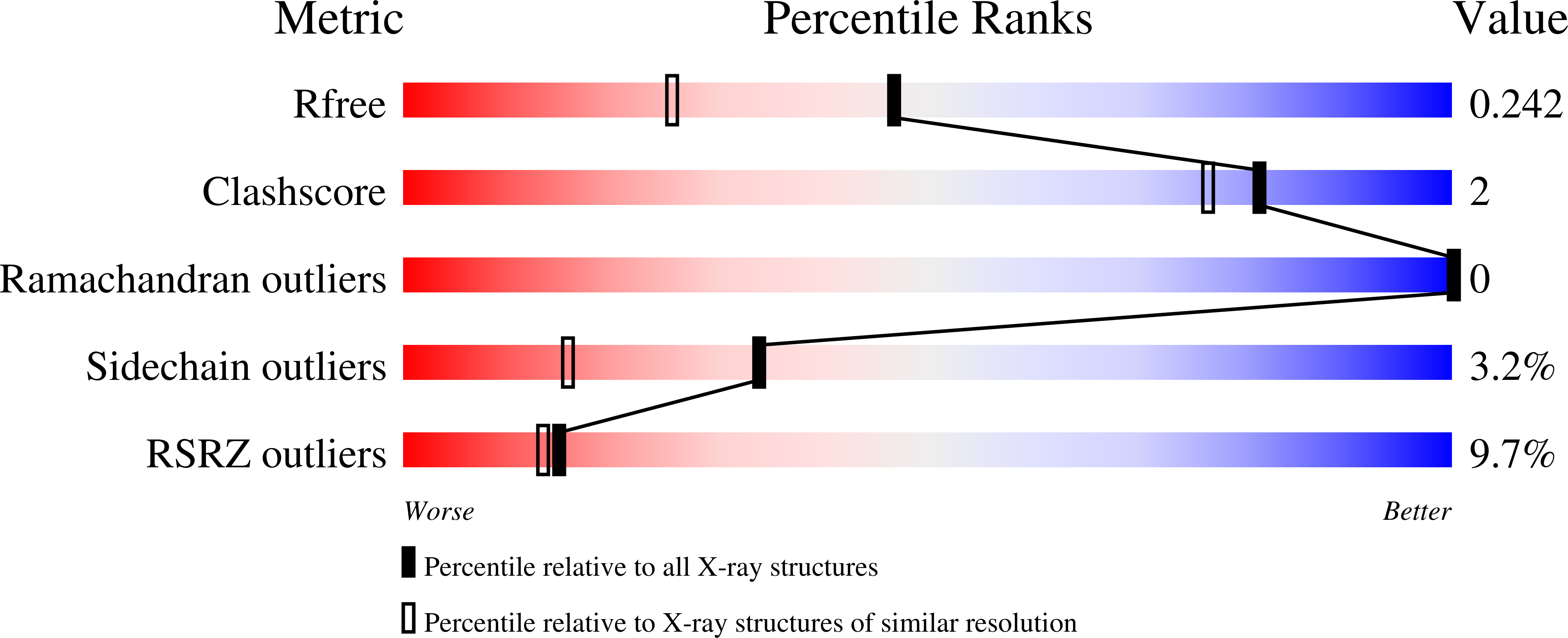
1.82 Å
R-Value Free:
0.25
R-Value Work:
0.21
R-Value Observed:
0.21
Space Group:
P 21 21 21
Macromolecular Entities
Structures with similar UniProt ID
Protein Blast
Polymer Type:polypeptide(L)
Molecule:Poly [ADP-ribose] polymerase 1, processed C-terminus
Gene (Uniprot):PARP1
Chain IDs:A, B
Chain Length:355
Number of Molecules:2
Biological Source:Homo sapiens
Primary Citation
Discovery of 6-Fluoro-5-{4-[(5-fluoro-2-methyl-3-oxo-3,4-dihydroquinoxalin-6-yl)methyl]piperazin-1-yl}- N -methylpyridine-2-carboxamide (AZD9574): A CNS-Penetrant, PARP1-Selective Inhibitor.
J.Med.Chem. 67 21717 21728 (2024)
PMID: 39655996 DOI: 10.1021/acs.jmedchem.4c01725

Abstact

PARP inhibitors have attracted considerable interest in drug discovery due to the clinical success of first-generation agents such as olaparib, niraparib, rucaparib, and talazoparib. Their success lies in their ability to trap PARP to DNA; however, first-generation PARP inhibitors were not strictly optimized for trapping nor for selectivity among the PARP enzyme family. Previously we described the discovery of the second-generation PARP inhibitor AZD5305, a selective PARP1-DNA trapper. AZD5305 maintained the antitumor efficacy of first-generation PARP inhibitors while exhibiting lower hematological toxicity. Recently, there has been interest in central nervous system (CNS)-penetrant PARP inhibitors for CNS malignancies and other neurological conditions; however, AZD5305 is not CNS penetrant. Herein we describe the discovery and optimization of a series of CNS-penetrant, PARP1-selective inhibitors and PARP1-DNA trappers, culminating in the discovery of AZD9574, a compound that maintains the PARP1 selectivity of AZD5305 with improved permeability, reduced efflux, and increased CNS penetration.

Legend

Protein

Chemical

Disease

Primary Citation of related structures
Feedback Form
Name
Email
Institute
Feedback