9EP8 image
Deposition Date 2024-03-18
Release Date 2024-09-25
Last Version Date 2024-11-27
Entry Detail
PDB ID:
9EP8
Keywords:
Title:
Crystal structure of ROCK2 in complex with a 8-(azaindolyl)-benzoazepinone inhibitor
Biological Source:
Source Organism:
Homo sapiens (Taxon ID: 9606)
Host Organism:
Method Details:
Experimental Method:
Resolution:
2.63 Å
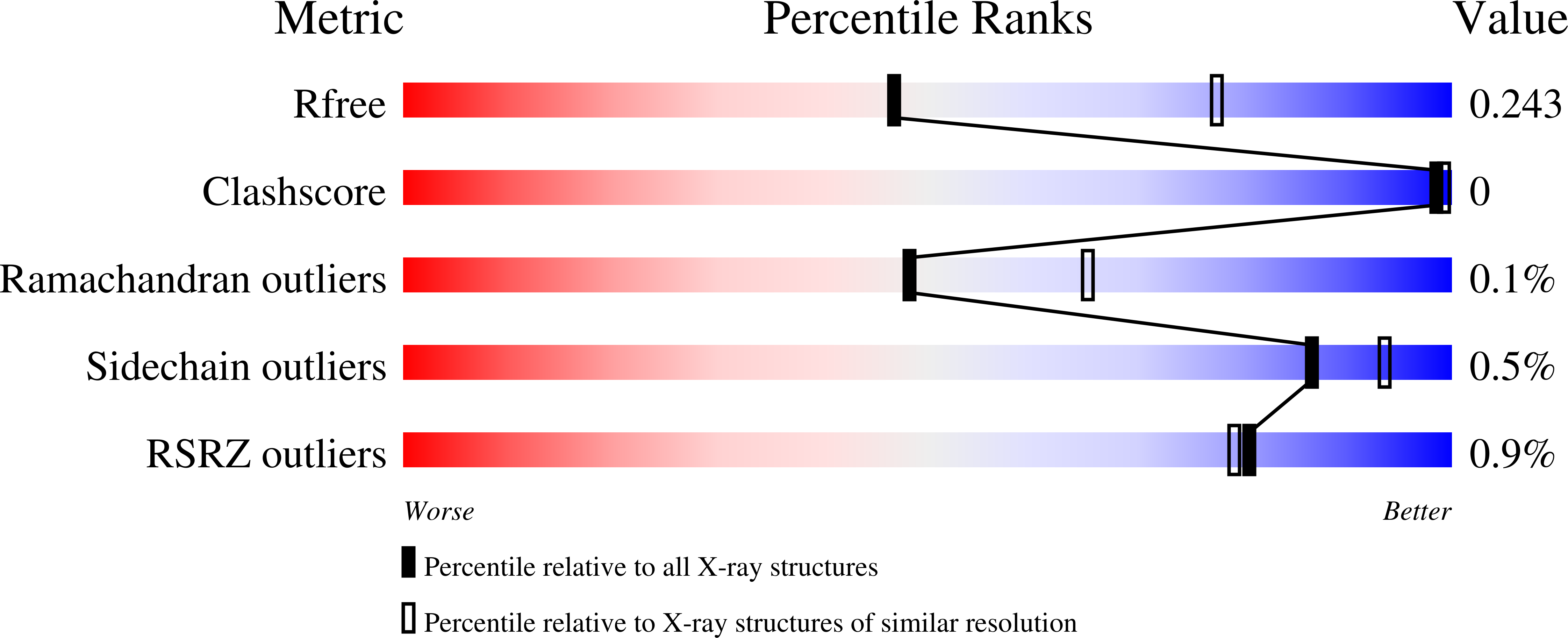
R-Value Free:
0.24
R-Value Work:
0.20
R-Value Observed:
0.20
Space Group:
C 1 2 1
Macromolecular Entities
Structures with similar UniProt ID
Protein Blast
Polymer Type:polypeptide(L)
Molecule:Rho-associated protein kinase 2
Gene (Uniprot):ROCK2
Chain IDs:A, B, C, D
Chain Length:402
Number of Molecules:4
Biological Source:Homo sapiens
Primary Citation
Design and synthesis of novel 8-(azaindolyl)-benzoazepinones as potent and selective ROCK inhibitors.
Rsc Med Chem 15 3862 3879 (2024)
PMID: 39297059 DOI: 10.1039/d4md00313f

Abstact

We report the characterization of potent and selective ROCK inhibitors identified through a core-hopping strategy. A virtual screening workflow, combining ligand- and structure-based methods, was applied on a known series of ROCK inhibitors bearing an acetamido-thiazole scaffold. The most promising replacement of the central core was represented by a benzoazepinone ring, which was selected as a starting point for a subsequent chemical exploration. The overall design approach exploited previous SARs available for congeneric series and crystallographic information to optimize the hinge-binding group as well as the terminal aromatic moiety interacting with the glycine-rich loop. The introduction of elongated and flexible charged groups led to compound 15, which exhibited sub-nanomolar potencies in biochemical and cellular assays, as well as a remarkable selectivity over PKA. HDX studies not only supported the postulated binding mode of compound 15 but also confirmed the crucial role of specific ROCK peptide segments in driving ligand selectivity.

Legend

Protein

Chemical

Disease

Primary Citation of related structures
Feedback Form
Name
Email
Institute
Feedback