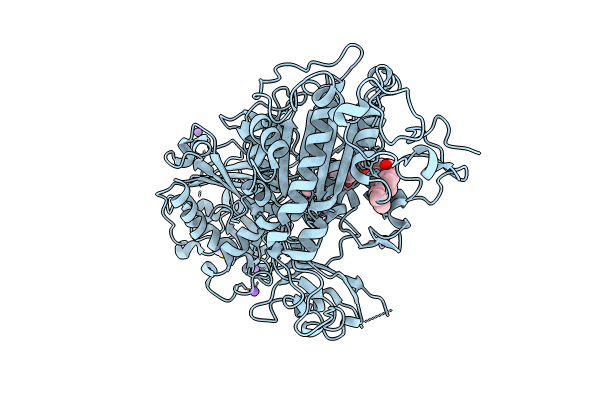
9ENT image
Deposition Date 2024-03-13
Release Date 2024-07-31
Last Version Date 2024-11-20
Entry Detail
PDB ID:
9ENT
Keywords:
Title:
SSX structure of Autotaxin in cryogenic conditions
Biological Source:
Source Organism:
Host Organism:
Method Details:
Experimental Method:
Resolution:
2.20 Å
R-Value Free:
0.23
R-Value Work:
0.19
R-Value Observed:
0.19
Space Group:
P 1

Macromolecular Entities
Structures with similar UniProt ID
Protein Blast
Polymer Type:polypeptide(L)
Molecule:Ectonucleotide pyrophosphatase/phosphodiesterase family member 2
Gene (Uniprot):Enpp2
Mutagens:N410A
Chain IDs:A
Chain Length:862
Number of Molecules:1
Biological Source:Rattus norvegicus
Primary Citation
In situ serial crystallography facilitates 96-well plate structural analysis at low symmetry.
Iucrj 11 780 791 (2024)
PMID: 39008358 DOI: 10.1107/S2052252524005785

Abstact

The advent of serial crystallography has rejuvenated and popularized room-temperature X-ray crystal structure determination. Structures determined at physiological temperature reveal protein flexibility and dynamics. In addition, challenging samples (e.g. large complexes, membrane proteins and viruses) form fragile crystals that are often difficult to harvest for cryo-crystallography. Moreover, a typical serial crystallography experiment requires a large number of microcrystals, mainly achievable through batch crystallization. Many medically relevant samples are expressed in mammalian cell lines, producing a meager quantity of protein that is incompatible with batch crystallization. This can limit the scope of serial crystallography approaches. Direct in situ data collection from a 96-well crystallization plate enables not only the identification of the best diffracting crystallization condition but also the possibility for structure determination under ambient conditions. Here, we describe an in situ serial crystallography (iSX) approach, facilitating direct measurement from crystallization plates mounted on a rapidly exchangeable universal plate holder deployed at a microfocus beamline, ID23-2, at the European Synchrotron Radiation Facility. We applied our iSX approach on a challenging project, autotaxin, a therapeutic target expressed in a stable human cell line, to determine the structure in the lowest-symmetry P1 space group at 3.0 Å resolution. Our in situ data collection strategy provided a complete dataset for structure determination while screening various crystallization conditions. Our data analysis reveals that the iSX approach is highly efficient at a microfocus beamline, improving throughput and demonstrating how crystallization plates can be routinely used as an alternative method of presenting samples for serial crystallography experiments at synchrotrons.

Legend

Protein

Chemical

Disease

Primary Citation of related structures
Feedback Form
Name
Email
Institute
Feedback