9EJ8 image
Deposition Date 2024-11-27
Release Date 2026-02-18
Last Version Date 2026-02-18
Entry Detail
PDB ID:
9EJ8
Keywords:
Title:
Structure of the Lactate Monooxygenase mutant Y44N, Y152F, H290S, T181A, F184P
Biological Source:
Source Organism(s):
Expression System(s):
Method Details:
Experimental Method:
Resolution:
1.42 Å
R-Value Free:
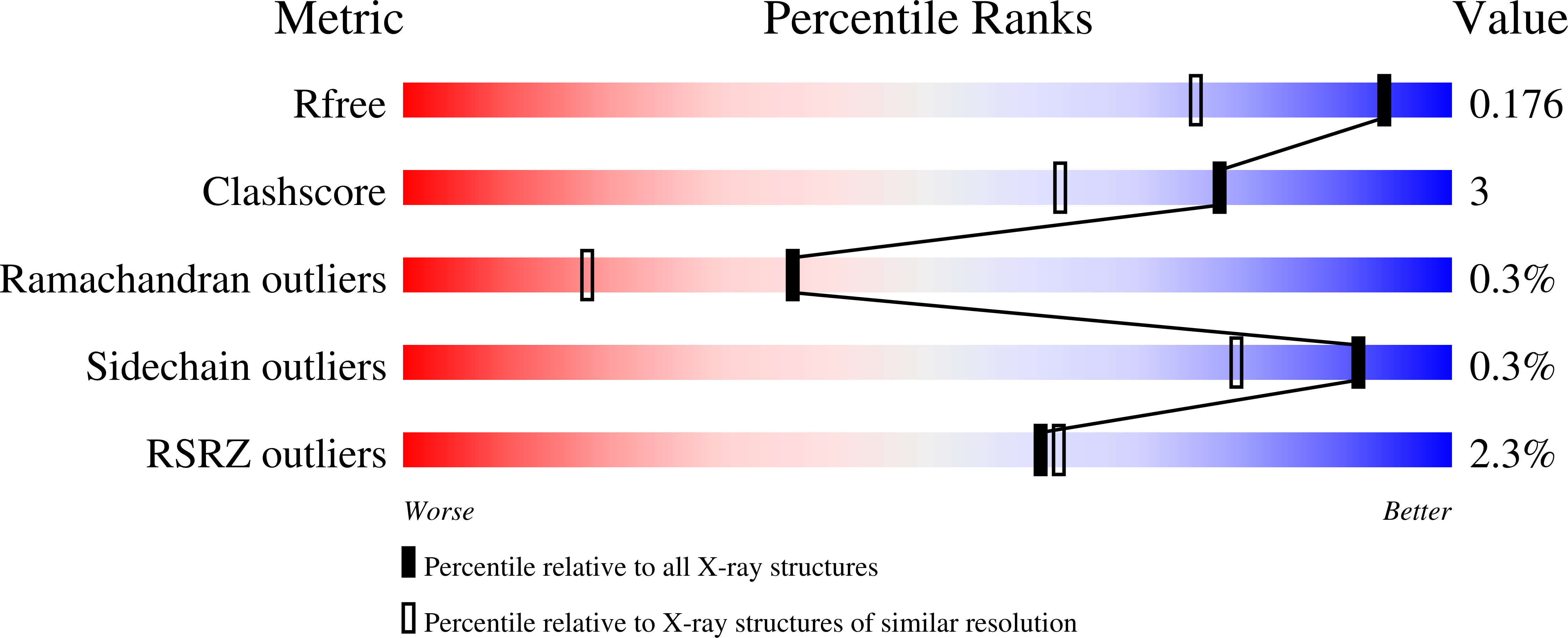
0.17
R-Value Work:
0.15
R-Value Observed:
0.15
Space Group:
I 4 2 2
Macromolecular Entities
Structures with similar UniProt ID
Protein Blast
Polymer Type:polypeptide(L)
Molecule:L-lactate 2-monooxygenase
Mutagens:Y44N, Y152F, H290S, T181A, F184P
Chain IDs:A
Chain Length:402
Number of Molecules:1
Biological Source:Mycolicibacterium smegmatis
Primary Citation
Photoenzymatic Csp 3 -Csp 3 bond formation via enzyme-templated radical-radical coupling.
Proc.Natl.Acad.Sci.USA 123 e2529018123 e2529018123 (2026)
PMID: 41662517 DOI: 10.1073/pnas.2529018123

Abstact

Cross-couplings are essential reactions in modern chemical synthesis, enabling the rapid construction of complex molecules from simple precursors. Transition metal catalysts are prized for these transformations because their reactivity and selectivity can be tuned via judicious selection of the metal and ligand. Although enzymes offer analogous opportunities for tuning via protein engineering, their application to cross-coupling remains limited, as nature relies on alternative paradigms for building molecular complexity. Here, we report the cross-coupling of alkyl halides and benzylic carboxylic acids using an engineered flavin-dependent lactate monooxygenase-a photoenzyme. The enzyme achieves this feat by exploiting the redox versatility of the flavin cofactor. Stoichiometric experiments, ultrafast spectroscopy, and computational studies support a mechanism in which photoexcited flavin quinone initiates the reaction via oxidative decarboxylation to generate a benzylic radical. The resulting flavin semiquinone can reduce the alkyl halide to form a second organic radical within the protein active site, which rapidly engages in C(sp3)-C(sp3) bond formation. A variant was engineered to control the stereochemical outcome of this radical-radical coupling event, highlighting the ability of the protein to alter the energetic barrier for a mechanistic step that is traditionally understood to be near barrierless. This work demonstrates that the scope for nonnative reaction mechanisms in biocatalysis far exceeds previously established bounds and has potential to solve a variety of reactivity challenges in cross-coupling chemistry.

Legend

Protein

Chemical

Disease

Primary Citation of related structures
Feedback Form
Name
Email
Institute
Feedback