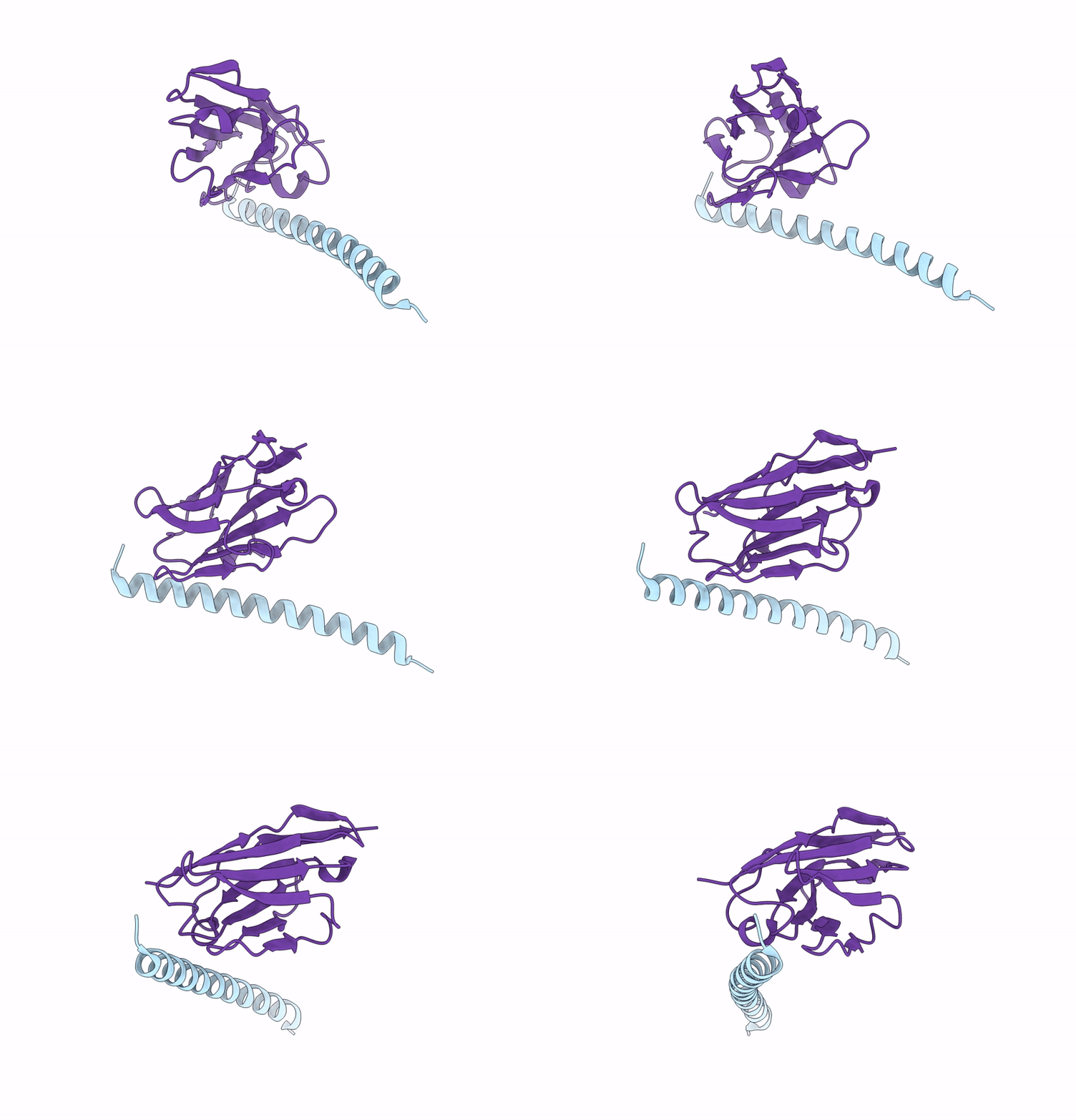
9EIU image
Deposition Date 2024-11-26
Release Date 2025-02-26
Last Version Date 2025-09-10
Entry Detail
PDB ID:
9EIU
Title:
Crystal structure of the human Cavin1 HR1 TS/DD mutant domain bound to nanobody B7
Biological Source:
Source Organism:
Homo sapiens (Taxon ID: 9606)
Vicugna pacos (Taxon ID: 30538)
Host Organism:
Method Details:
Experimental Method:
Resolution:
4.00 Å
R-Value Free:
0.26
R-Value Work:
0.20
R-Value Observed:
0.20
Space Group:
P 3
Macromolecular Entities
Structures with similar UniProt ID
Protein Blast
Polymer Type:polypeptide(L)
Molecule:Caveolae-associated protein 1
Gene (Uniprot):CAVIN1
Chain IDs:A
Chain Length:116
Number of Molecules:1
Biological Source:Homo sapiens
Polymer Type:polypeptide(L)
Molecule:Nanobody B7
Chain IDs:B
Chain Length:121
Number of Molecules:1
Biological Source:Vicugna pacos
Ligand Molecules
Primary Citation
Nanobodies against Cavin1 reveal structural flexibility and regulated interactions of its N-terminal coiled-coil domain.
J.Cell.Sci. 138 ? ? (2025)
PMID: 40260863 DOI: 10.1242/jcs.263756

Abstact

Caveolae are abundant plasma membrane structures that regulate signalling, membrane homeostasis and mechanoprotection. Their formation is driven by caveolins and cavins and their coordinated interactions with lipids. Here, we developed nanobodies against the trimeric HR1 coiled-coil domain of Cavin1. We identified specific nanobodies that do not perturb Cavin1 membrane binding and localise to caveolae when expressed in cells. The crystal structure of a nanobody-Cavin 1 HR1 complex reveals a symmetric 3:3 architecture as validated by mutagenesis. In this structure, the C-terminal half of the HR1 domain is disordered, suggesting that the nanobody stabilises an open conformation of Cavin1, which has previously been identified as important for membrane interactions. A phosphomimic mutation in a threonine-serine pair proximal to this region reveals selective regulation of Cavin2 and Cavin3 association. These studies provide new insights into cavin domains required for assembly of multiprotein caveolar assemblies and describe new nanobody tools for structural and functional studies of caveolae.

Legend

Protein

Chemical

Disease

Primary Citation of related structures
Feedback Form
Name
Email
Institute
Feedback