9EBY image
Deposition Date 2024-11-13
Release Date 2025-06-18
Last Version Date 2025-07-09
Entry Detail
PDB ID:
9EBY
Keywords:
Title:
Crystal structure of RufO in complex with MRYLH
Biological Source:
Source Organism:
Method Details:
Experimental Method:
Resolution:
2.03 Å
R-Value Free:
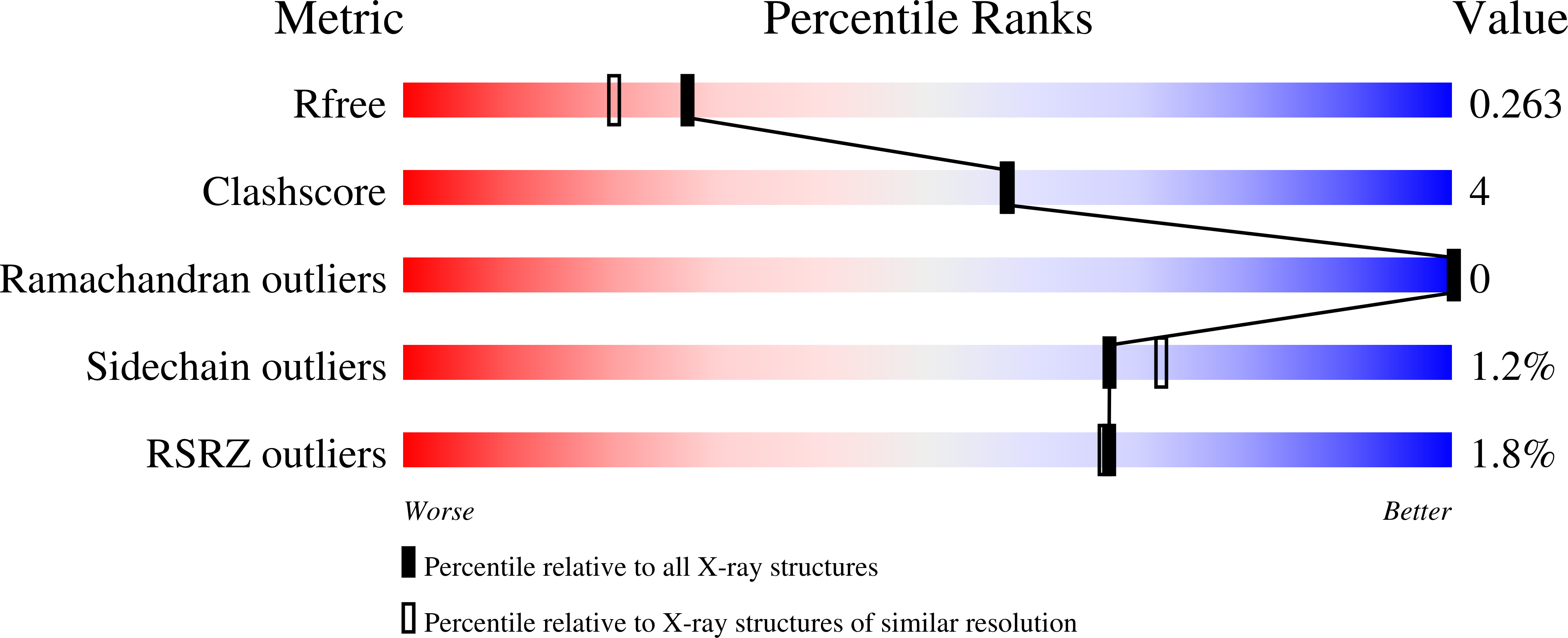
0.26
R-Value Work:
0.20
R-Value Observed:
0.20
Space Group:
P 21 21 21
Macromolecular Entities
Structures with similar UniProt ID
Protein Blast
Polymer Type:polypeptide(L)
Molecule:Cytochrome P450
Gene (Uniprot):rufO
Chain IDs:A
Chain Length:395
Number of Molecules:1
Biological Source:Streptomyces atratus
Polymer Type:polypeptide(L)
Molecule:MET-ARG-TYR-LEU-HIS
Chain IDs:B
Chain Length:5
Number of Molecules:1
Biological Source:Streptomyces atratus
Primary Citation
Molecular Basis for Peptide Nitration by a Novel Cytochrome P450 Enzyme in RiPP Biosynthesis.
Acs Catalysis 15 10391 10404 (2025)
PMID: 40568218 DOI: 10.1021/acscatal.5c01932

Abstact

RufO is a unique cytochrome P450 enzyme (CYP) involved in the biosynthesis of rufomycin, an antituberculosis cyclic peptide featuring an unusual nitrated tyrosine. Recent studies have clarified RufO's role in producing ribosomally synthesized and post-translationally modified peptides (RiPPs). Despite growing interest in nitrating enzymes and RiPP biosynthesis, the mechanism by which RufO recognizes and nitrates its pentapeptide substrate, MRYLH, remains poorly understood. In this study, we use a combination of spectroscopic, kinetic, and structural techniques to elucidate the molecular basis for peptide binding and heme-based nitration in RufO. Peptide binding is an endothermic process with a dissociation constant of 0.78 μM. Unlike most CYPs, RufO does not undergo the typical spin state conversion nor exhibit a significant increase in reduction potential upon substrate binding. The minimal perturbation to the heme center may lead to RufO's lack of specificity for redox partners. However, significant shifts in the vibrational frequencies of carbonyl complexes upon substrate binding indicate a more polar heme distal site that favors a nonlinear binding conformation of diatomic gas molecules. These distinctive features contrast with TxtE, the only other CYP known to catalyze aromatic nitration. A 1.51 Å resolution crystal structure reveals that substrate binding induces significant conformational changes in the distal pocket, particularly in the regions interacting with Arg-2 and His-5 of the MRYLH peptide. While Tyr-3 is positioned similarly to its counterpart in P450Blt, a paralog that catalyzes peptide cross-linking, an extended hydrogen-bonding network constraining His-5 is unique to RufO and likely contributes to its distinct nitration activity. Furthermore, transient kinetic data suggest the sequential binding of O2 followed by •NO and characterize a ferric-superoxo intermediate essential for the nitration activity. This study provides valuable insights into the substrate specificity and catalytic mechanisms of CYPs involved in nitration reactions and RiPP biosynthesis.

Legend

Protein

Chemical

Disease

Primary Citation of related structures
Feedback Form
Name
Email
Institute
Feedback