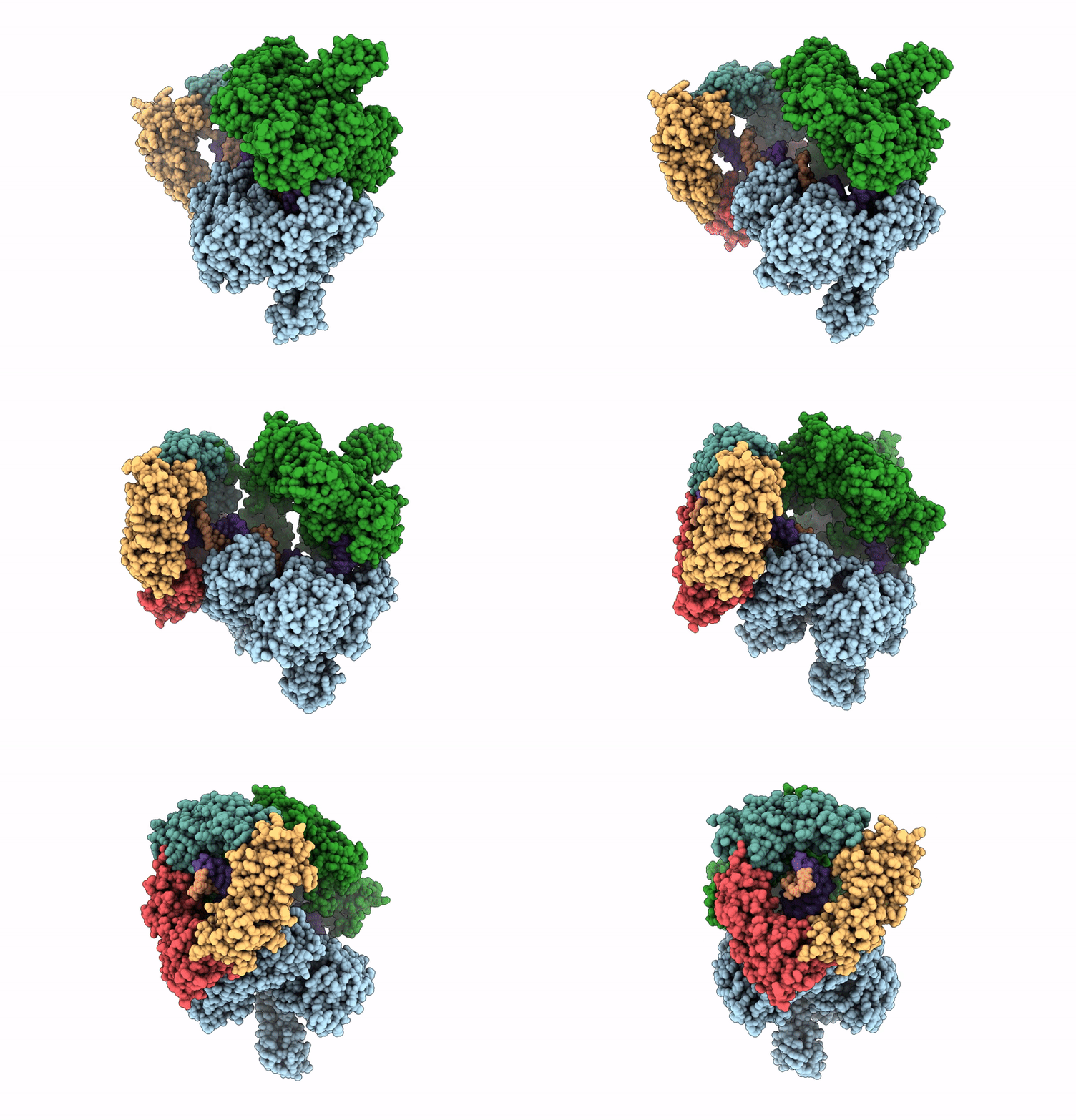
9EA2 image
Deposition Date 2024-11-10
Release Date 2025-11-19
Last Version Date 2026-01-14
Entry Detail
PDB ID:
9EA2
Keywords:
Title:
T4 Bacteriophage Replicative Polymerase Captured in Polymerase Exchange State 2
Biological Source:
Source Organism(s):
Expression System(s):
Method Details:
Experimental Method:
Resolution:
3.70 Å
Aggregation State:
PARTICLE
Reconstruction Method:
SINGLE PARTICLE
Macromolecular Entities
Structures with similar UniProt ID
Protein Blast
Polymer Type:polypeptide(L)
Molecule:DNA-directed DNA polymerase
Chain IDs:A, C
Chain Length:898
Number of Molecules:2
Biological Source:Escherichia phage T4
Structures with similar UniProt ID
Protein Blast
Polymer Type:polypeptide(L)
Molecule:Sliding clamp
Gene (Uniprot):45
Chain IDs:B, D, E
Chain Length:228
Number of Molecules:3
Biological Source:Escherichia phage T4
Polymer Type:polydeoxyribonucleotide
Molecule:DNA (5'-AGC TAT GAC CAT GAT TAC GAA TTG ddC-3')
Chain IDs:F (auth: P)
Chain Length:25
Number of Molecules:1
Biological Source:synthetic construct
Polymer Type:polydeoxyribonucleotide
Molecule:DNA (38-MER)
Chain IDs:G (auth: T)
Chain Length:38
Number of Molecules:1
Biological Source:synthetic construct
Ligand Molecules
Primary Citation
Structural insights into the exchange mechanism of a replicative DNA polymerase.
Nucleic Acids Res. 53 ? ? (2025)
PMID: 41459747 DOI: 10.1093/nar/gkaf1359

Abstact

Replicative DNA polymerases are distinguished by their speed, processivity, and fidelity. While speed and fidelity arise from the polymerase's intrinsic catalytic and proofreading activities, processivity is typically attributed to the DNA sliding clamp that tethers the polymerase to DNA. However, additional mechanisms may also contribute. The T4 bacteriophage polymerase can exchange on-the-fly, a process likely contributing to its ∼10-fold higher synthesis rate compared with human polymerases. Here, we reconstituted the T4 holoenzyme and polymerase exchange complexes using purified gp43 polymerase, gp45 sliding clamp, and a primer-template DNA substrate. Cryo-electron microscopy (cryo-EM) analysis revealed either one or two polymerases bound to the clamp and DNA. In the one-polymerase complex, the DNA threads perpendicularly through the clamp, supporting processive synthesis. In contrast, the two-polymerase complex displays a markedly tilted DNA orientation, impeding sliding and representing exchange intermediates. Three distinct conformational states of the two-polymerase complex define a multistep exchange mechanism. To our knowledge, these findings provide the first molecular-level view of replicative polymerase exchange.

Legend

Protein

Chemical

Disease

Primary Citation of related structures
Feedback Form
Name
Email
Institute
Feedback