9E94 image
Deposition Date 2024-11-07
Release Date 2026-02-11
Last Version Date 2026-02-11
Entry Detail
PDB ID:
9E94
Title:
Cryo-EM structure of human TWIK-2 at pH 7.5
Biological Source:
Source Organism(s):
Homo sapiens (Taxon ID: 9606)
Expression System(s):
Method Details:
Experimental Method:
Resolution:
3.67 Å
Aggregation State:
PARTICLE
Reconstruction Method:
SINGLE PARTICLE
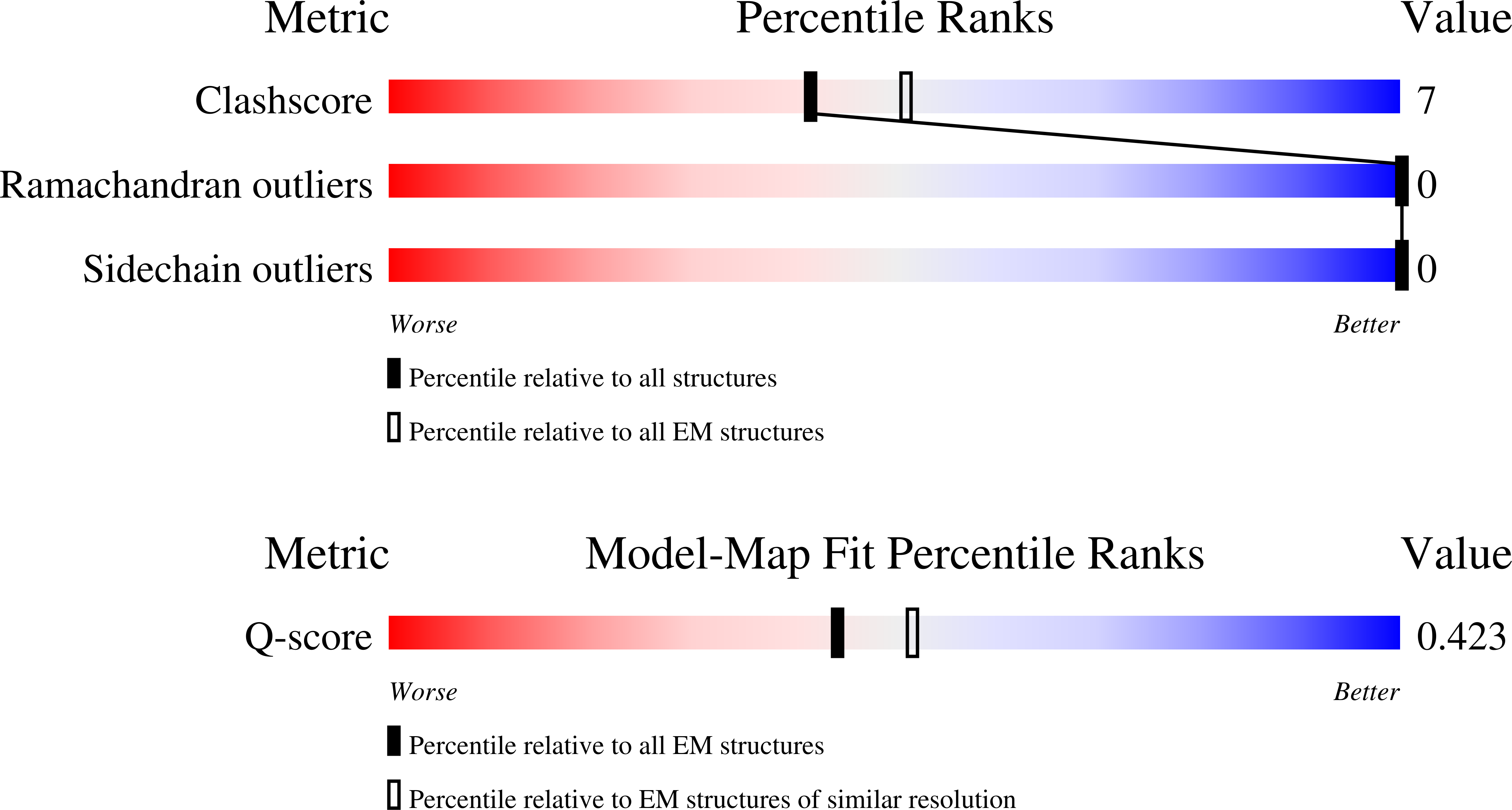
Macromolecular Entities
Structures with similar UniProt ID
Protein Blast
Polymer Type:polypeptide(L)
Molecule:Potassium channel subfamily K member 6
Gene (Uniprot):KCNK6
Chain IDs:A, B
Chain Length:313
Number of Molecules:2
Biological Source:Homo sapiens
Primary Citation
Insights into the structure and modulation of human TWIK-2.
Nat Commun ? ? ? (2026)
PMID: 41617707 DOI: 10.1038/s41467-026-69072-1

Abstact

The Tandem of pore domain in a Weak Inward Rectifying K+ channel 2 (TWIK-2; KCNK6) is a member of the Two-Pore Domain K+ (K2P) channel family, which is associated with pulmonary hypertension, lung injury, and inflammation. Despite its physiological relevance, the structure, regulatory mechanisms, and selective modulators of TWIK-2 remain largely unknown. Here, we present a 3.7 Å single particle cryo-electron microscopy structure of human TWIK-2 and highlight its conserved and distinctive features. Using automated whole-cell patch clamp recordings, we demonstrate that gating in TWIK-2 is voltage-dependent and insensitive to changes in the extracellular pH. We identify key residues that influence TWIK-2 activity by employing site-directed mutagenesis and provide insights into the possible lipid-mediated mechanism of TWIK-2 regulation. Additionally, we demonstrate the application of high-throughput automated whole-cell patch clamp platforms to screen small molecule modulators of TWIK-2. Our work serves as a foundation for designing high-throughput small molecule screening campaigns to identify specific high-affinity TWIK-2 modulators, including promising- anti-inflammatory therapeutics.

Legend

Protein

Chemical

Disease

Primary Citation of related structures
Feedback Form
Name
Email
Institute
Feedback