9DY8 image
Deposition Date 2024-10-13
Release Date 2025-08-13
Last Version Date 2025-08-13
Entry Detail
PDB ID:
9DY8
Keywords:
Title:
Crystal structure of HLA-B*18:01 in complex with PEMTFFSVK, an 9-mer epitope from Influenza B
Biological Source:
Source Organism:
Method Details:
Experimental Method:
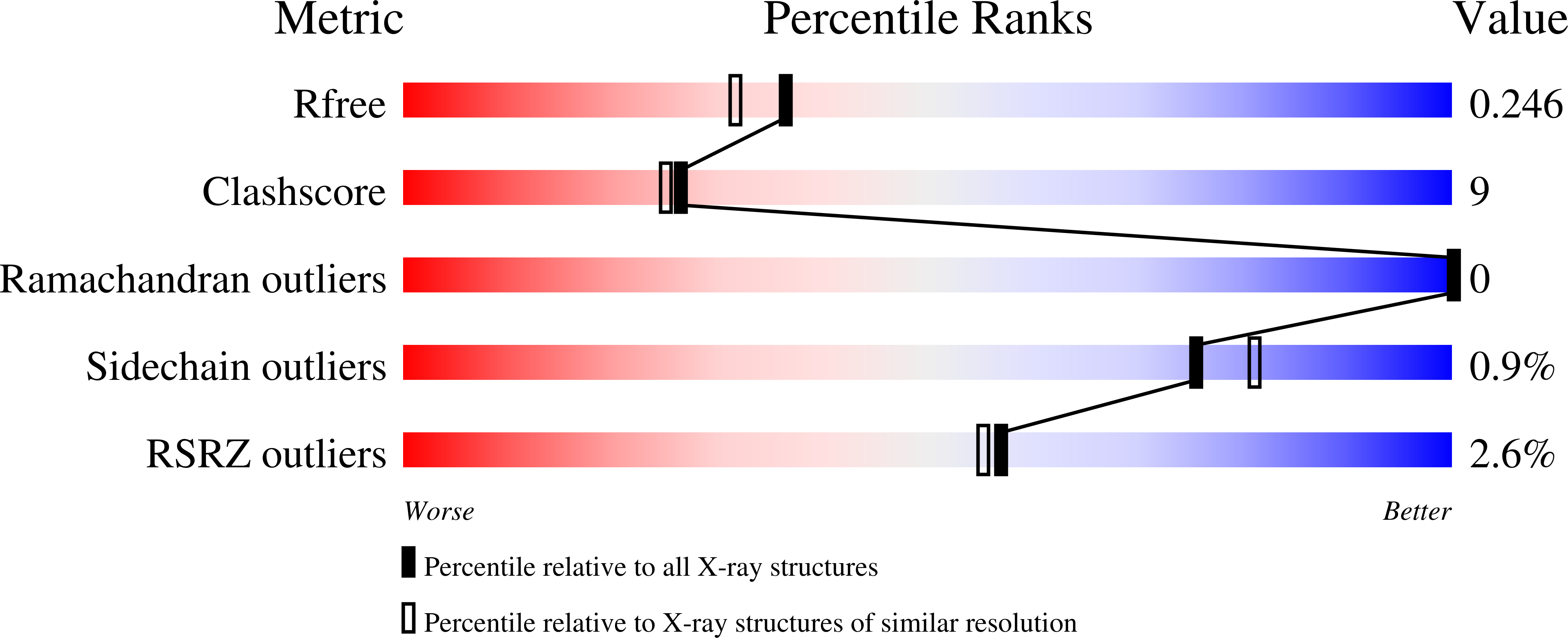
Resolution:
2.00 Å
R-Value Free:
0.24
R-Value Work:
0.19
R-Value Observed:
0.19
Space Group:
P 21 21 21
Macromolecular Entities
Structures with similar UniProt ID
Protein Blast
Polymer Type:polypeptide(L)
Molecule:MHC class I antigen
Gene (Uniprot):HLA-B
Chain IDs:A
Chain Length:276
Number of Molecules:1
Biological Source:Homo sapiens
Structures with similar UniProt ID
Protein Blast
Polymer Type:polypeptide(L)
Molecule:Beta-2-microglobulin
Gene (Uniprot):B2M
Chain IDs:B
Chain Length:100
Number of Molecules:1
Biological Source:Homo sapiens
Structures with similar UniProt ID
Protein Blast
Polymer Type:polypeptide(L)
Molecule:RNA-directed RNA polymerase catalytic subunit
Gene (Uniprot):PB1
Chain IDs:C
Chain Length:9
Number of Molecules:1
Biological Source:Influenza B virus (B/Wisconsin/22/2017)
Primary Citation
Characterisation of an influenza B virus-derived peptide presented by HLA-B*18:01.
Biochem.J. 482 811 820 (2025)
PMID: 40587260 DOI: 10.1042/BCJ20240739

Abstact

The influenza B virus (IBV) can pose a significant threat to global health. Despite this, IBV is understudied compared with influenza A virus (IAV). CD8+ T cells have proven highly effective in reducing influenza disease severity. In addition, pre-existing immune responses towards IAV epitopes may provide protection against homologous IBV-derived peptides due to T cell cross-reactivity. To exploit the advantages of T cells for future vaccine developments, a better understanding of the IBV-derived peptide presentation by the highly polymorphic human leukocyte antigen (HLA) is required. We previously determined that the IAV-derived PB1177-A peptide was presented by the HLA-B*18:01 molecule and induced CD8+ T cell responses. Here, we assessed the PB1177-A IBV homologue (PB1177-B). Intracellular cytokine staining assays showed that PB1177-B was unable to activate CD8+ T cells from several HLA-B*18:01+ samples tested. We determined that the IAVand IBV-derived PB1177 adopted different stability and conformation in the cleft of HLA-B*18:01. Molecular dynamics analysis on the crystal structure showed that PB1177-B had a central flexible region with a large hydrophobic patch formed by two phenylalanine residues, not present in PB1177-A. The flexibility and the lower stability of the HLA-B*18:01-PB1177-B complex may hinder CD8+ T cell receptor binding, underpinning the lack of CD8+ T cell activation observed. This provides additional insights into the differences between IAVand IBV-specific CD8+ T cell responses.

Legend

Protein

Chemical

Disease

Primary Citation of related structures
Feedback Form
Name
Email
Institute
Feedback