9DVG image
Deposition Date 2024-10-07
Release Date 2024-10-23
Last Version Date 2025-12-24
Entry Detail
PDB ID:
9DVG
Keywords:
Title:
Crystal Structure of a DARPin Fused to the 1TEL Crystallization Chaperone via a Direct Helical Fusion in a 2-Fold Crystal Form
Biological Source:
Source Organism(s):
Expression System(s):
Method Details:
Experimental Method:
Resolution:
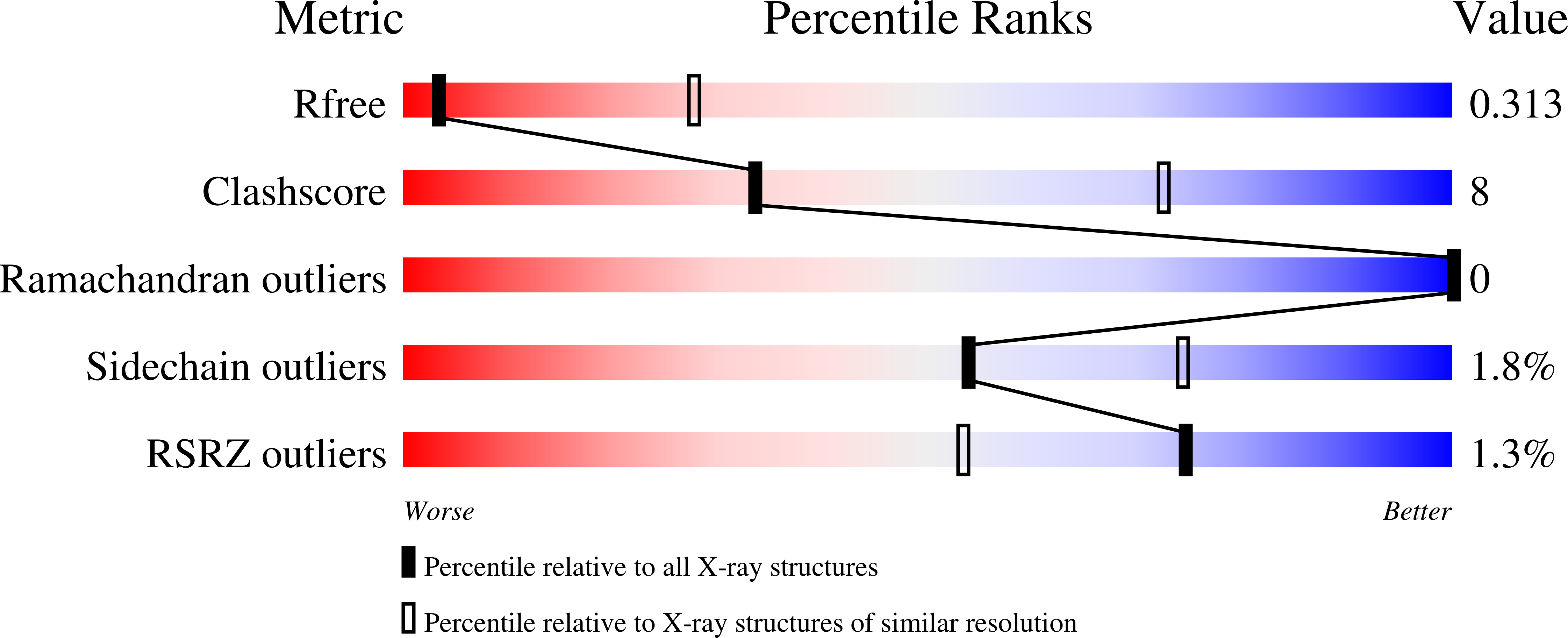
3.54 Å
R-Value Free:
0.30
R-Value Work:
0.26
R-Value Observed:
0.26
Space Group:
P 65
Macromolecular Entities
Structures with similar UniProt ID
Protein Blast
Polymer Type:polypeptide(L)
Molecule:Transcription factor ETV6,DARPin
Gene (Uniprot):ETV6
Mutagens:V112E in ETV6 (Uniprot numbering)
Chain IDs:A
Chain Length:243
Number of Molecules:1
Biological Source:Homo sapiens, synthetic construct
Ligand Molecules
Primary Citation

Abstact

UNLABELLED Fusing a variant of the sterile alpha motif domain of the human translocation ETS leukaemia protein (TELSAM) to a protein of interest has been shown to significantly enhance crystallization propensity. TELSAM is a pH-dependent, polymer-forming protein crystallization chaperone which, when covalently fused to a protein of interest, forms a stable, well-ordered crystal lattice. However, despite its success, a challenge persists in that crystal quality and diffraction limits appear to be heavily dependent on the choice of linker between TELSAM and the protein of interest, with identification of a functional linker relying on trial-and-error methods. Likewise, previous studies revealed that the 10xHis tag at the TELSAM N-terminus can either facilitate or hinder the ordered crystallization of target proteins attached via flexible or semi-flexible linkers. To address these challenges, we designed multiple constructs with several types of linkers-rigid (helical fusion), semi-flexible (Pro-Ala n), and flexible (poly-Gly)-of varying lengths to fuse a designed ankyrin repeat protein (DARPin) to the TELSAM C-terminus. Semi-flexible and flexible linker constructs were made with and without the 10xHis tag. Our findings indicate that short semi-flexible and rigid linkers consistently yield large crystals within 24 hours with a DARPin target protein, but that flexible linkers perform best with a TNK1 UBA domain target protein. Removing the 10xHis tag enhanced crystallization rates, improved crystal morphology, and increased the crystallization propensity of semi-flexible and flexible linker constructs. While removing the His tag did not have a significant effect on crystal size, it improved the diffraction limits and crystal quality of the 1TEL-PA-DARPin construct. These results suggest that the ideal linker selection primarily depends on the properties of the target protein. Our data support the recommendation to use a short yet flexible or semi-flexible linker between TELSAM and the target protein to facilitate protein crystallization and high-resolution structure determination. SYNOPSIS In this study, we examine the effect of short to medium-length flexible, semi-flexible, and rigid linkers on the crystallization of a DARPin fused to the 1TEL protein crystallization chaperone, demonstrating that while rigid linkers impair crystallization and reduce diffraction quality, the ideal linker character remain target-protein dependent.

Legend

Protein

Chemical

Disease

Primary Citation of related structures
Feedback Form
Name
Email
Institute
Feedback