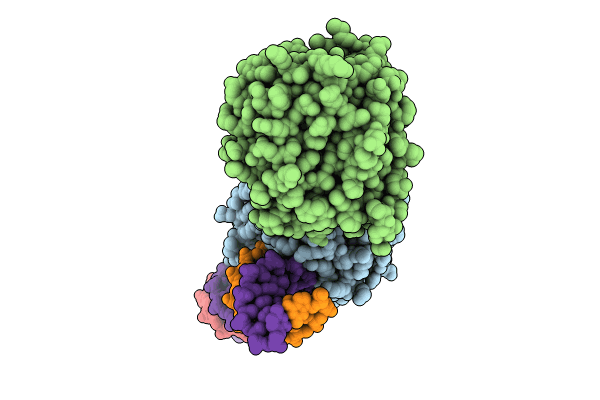
9DP3 image
Deposition Date 2024-09-20
Release Date 2024-10-09
Last Version Date 2025-10-29
Entry Detail
PDB ID:
9DP3
Keywords:
Title:
APE1 N174D Product Complex with Abasic DNA
Biological Source:
Source Organism:
Host Organism:
Method Details:
Experimental Method:
Resolution:
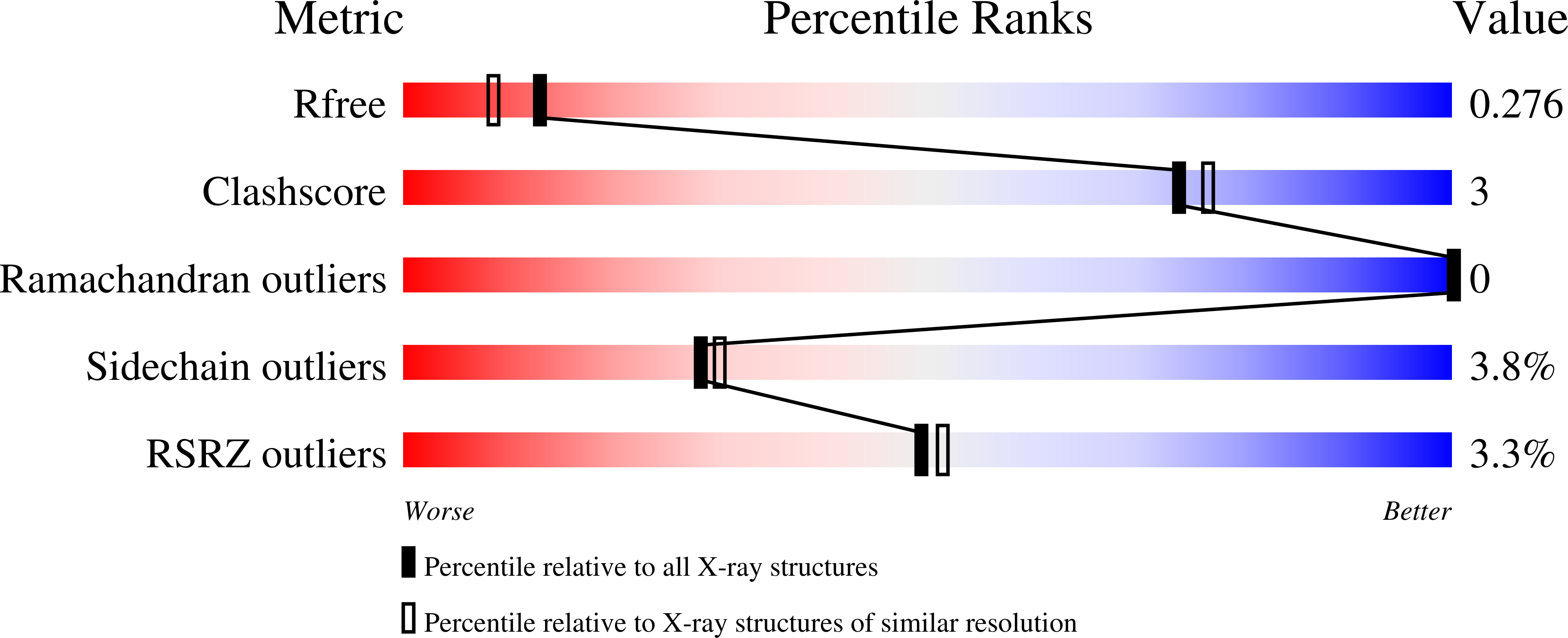
2.10 Å
R-Value Free:
0.27
R-Value Work:
0.25
R-Value Observed:
0.25
Space Group:
P 1
Macromolecular Entities
Structures with similar UniProt ID
Protein Blast
Polymer Type:polypeptide(L)
Molecule:DNA repair nuclease/redox regulator APEX1, mitochondrial
Gene (Uniprot):APEX1
Mutagens:tr1-42, C138A, N174D
Chain IDs:A, B
Chain Length:276
Number of Molecules:2
Biological Source:Homo sapiens
Polymer Type:polydeoxyribonucleotide
Molecule:DNA (5'-D(P*(3DR)P*CP*GP*AP*CP*GP*GP*AP*TP*CP*C)-3')
Chain IDs:C (auth: D)
Chain Length:11
Number of Molecules:1
Biological Source:synthetic construct
Polymer Type:polydeoxyribonucleotide
Molecule:DNA (5'-D(*GP*CP*TP*GP*AP*TP*GP*CP*GP*C)-3')
Chain IDs:D (auth: E)
Chain Length:10
Number of Molecules:1
Biological Source:synthetic construct
Polymer Type:polydeoxyribonucleotide
Molecule:DNA (5'-D(*GP*GP*AP*TP*CP*CP*GP*TP*CP*GP*GP*GP*CP*GP*CP*AP*TP*CP*AP*GP*C)-3')
Chain IDs:E (auth: F)
Chain Length:21
Number of Molecules:1
Biological Source:synthetic construct
Ligand Molecules
Primary Citation
APE1 active site residue Asn174 stabilizes the AP site and is essential for catalysis.
J.Biol.Chem. 301 110655 110655 (2025)
PMID: 40902980 DOI: 10.1016/j.jbc.2025.110655

Abstact

Apurinic/apyrimidinic (AP) sites are common and highly mutagenic DNA lesions that can arise spontaneously or as intermediates during base excision repair. The enzyme apurinic/apyrimidinic endonuclease 1 (APE1) initiates repair of AP sites by cleaving the DNA backbone at the AP site via its endonuclease activity. Here, we investigated the functional role of the APE1 active site residue N174 that contacts the AP site during catalysis. To do so, we rationally designed four APE1 mutants (N174A, N174D, N174Q, and N174K) that altered the hydrogen bonding potential, electronegativity, and side chain length of residue 174. Kinetic analysis determined that AP site cleavage was impaired in our APE1N174A, APE1N174D, and APE1N174K mutants, but not in our APE1N174Q mutant. Using X-ray crystallography and molecular dynamic simulations of our APE1 mutants, we attributed the poor cleavage of our APE1N174A and APE1N174D mutants to lack of hydrogen bonding between residue 174 and the AP site. From these experiments, we also discovered that the altered charge of residue 174 in APE1N174D and APE1N174K mutants contributed to impaired cleavage. From analysis of our mutants, we determined that in APE1WT, N174 stabilizes AP DNA within the APE1 active site via hydrogen bonding promoting cleavage of AP sites. We also found that the neutral charge of N174 in APE1WT contributes to an optimal electrostatic environment during the APE1 endonuclease reaction resulting in efficient AP site cleavage. Cumulatively, we demonstrate the importance of N174 in APE1's function and provide new insights into the molecular mechanism by which APE1 processes AP sites during DNA repair.

Legend

Protein

Chemical

Disease

Primary Citation of related structures
Feedback Form
Name
Email
Institute
Feedback