Planned Maintenance: Some services may turn out to be unavailable from 15th January, 2026 to 16th January, 2026. We apologize for the inconvenience!

9DOR image
Deposition Date 2024-09-19
Release Date 2025-11-19
Last Version Date 2025-12-31
Entry Detail
PDB ID:
9DOR
Keywords:
Title:
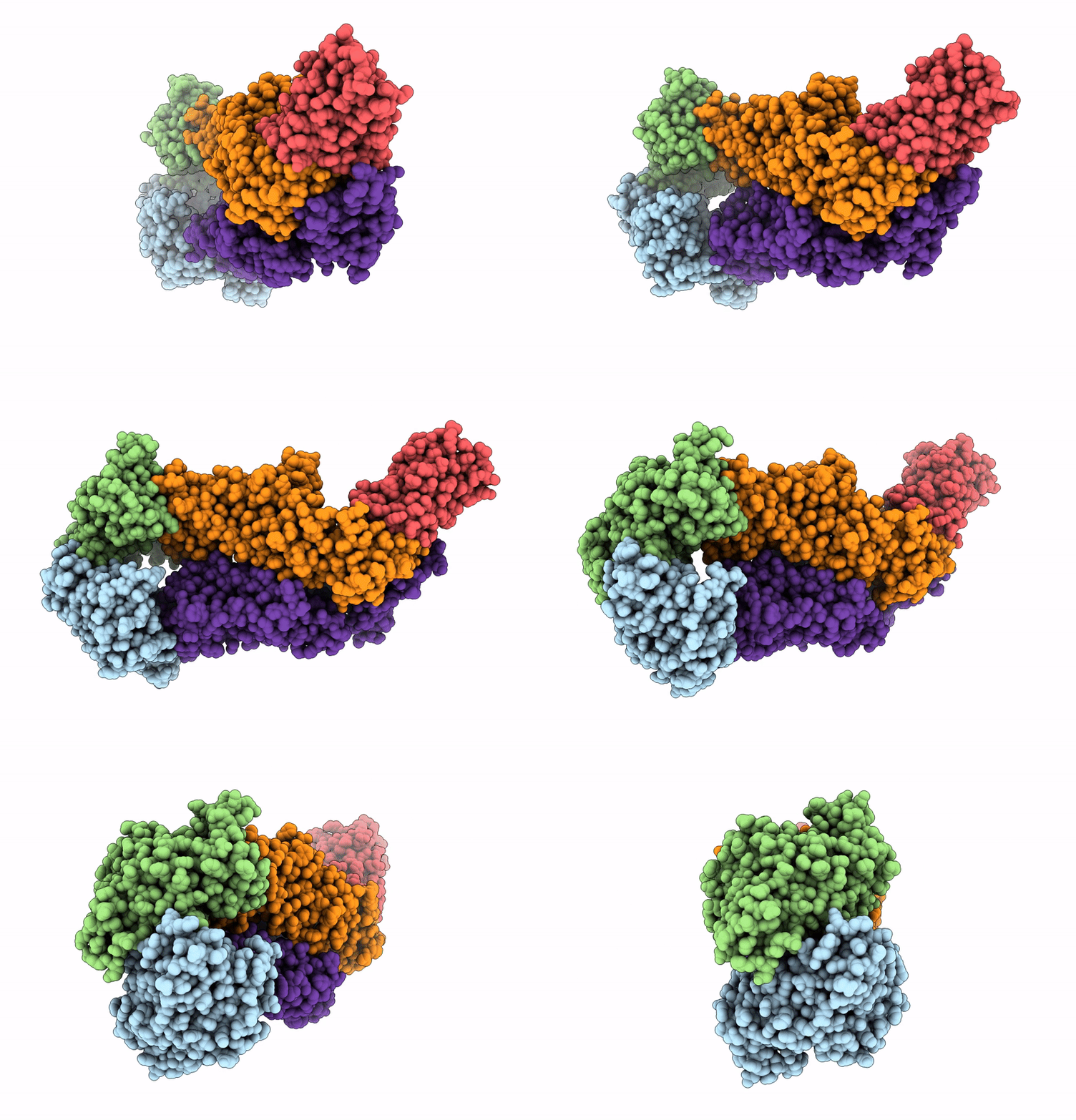
Cryo-EM structure of LptB2FGC apo-II
Biological Source:
Source Organism(s):
Expression System(s):
Method Details:
Experimental Method:
Resolution:
3.61 Å
Aggregation State:
PARTICLE
Reconstruction Method:
SINGLE PARTICLE
Macromolecular Entities
Structures with similar UniProt ID
Protein Blast
Polymer Type:polypeptide(L)
Molecule:Lipopolysaccharide export system ATP-binding protein LptB
Gene (Uniprot):lptB_3
Chain IDs:A (auth: B), B (auth: A)
Chain Length:252
Number of Molecules:2
Biological Source:Pseudomonas aeruginosa
Structures with similar UniProt ID
Protein Blast
Polymer Type:polypeptide(L)
Molecule:Lipopolysaccharide export system protein LptC
Gene (Uniprot):lptC
Chain IDs:E (auth: C)
Chain Length:193
Number of Molecules:1
Biological Source:Pseudomonas aeruginosa
Structures with similar UniProt ID
Protein Blast
Polymer Type:polypeptide(L)
Molecule:Lipopolysaccharide export system permease protein LptF
Gene (Uniprot):lptF
Chain IDs:D (auth: F)
Chain Length:375
Number of Molecules:1
Biological Source:Pseudomonas aeruginosa
Structures with similar UniProt ID
Protein Blast
Polymer Type:polypeptide(L)
Molecule:Permease
Gene (Uniprot):lptG
Chain IDs:C (auth: G)
Chain Length:358
Number of Molecules:1
Biological Source:Pseudomonas aeruginosa
Ligand Molecules
Primary Citation
Structural snapshots of Pseudomonas aeruginosa LptB 2 FG and LptB 2 FGC reveal insights into lipopolysaccharide recognition and transport.
Nat Commun 16 11384 11384 (2025)
PMID: 41407669 DOI: 10.1038/s41467-025-66182-0

Abstact

Gram-negative bacteria are intrinsically resistant to many antibiotics because of densely packed lipopolysaccharides (LPS) in the outer leaflet of their outer membrane (OM), which acts as a highly effective barrier towards the spontaneous permeation of toxic molecules, including antibiotics. LPS are extracted from the inner membrane by the ABC transporter LptB2FGC and translocated across the periplasm via a protein bridge to the OM. While structural studies have elucidated aspects of Lpt function in enterobacteria, little is known about how this system operates in divergent species such as Pseudomonas aeruginosa, a major human pathogen. Here, we report five cryo-electron microscopy structures of P. aeruginosa LptB2FG and LptB2FGC, revealing a rigid body movement in the periplasmic β-jellyroll domains necessary for LPS to shuttle through the periplasmic space. Notably, these structures exhibit a significantly smaller LPS binding cavity compared to previously determined models, suggesting the ligand-unbound states of the transporter. Mass spectrometry and molecular dynamics simulations indicate that the phosphate groups of LPS are the key determinants for binding and that the transporter can also accommodate cardiolipin. Together, these findings reveal previously unappreciated structural diversity in the Lpt system and provide mechanistic insight into how pathogenic Gram-negative bacteria tailor LPS recognition and transport. This understanding offers new avenues for the development of novel inhibitors targeting membrane biogenesis.

Legend

Protein

Chemical

Disease

Primary Citation of related structures
Feedback Form
Name
Email
Institute
Feedback