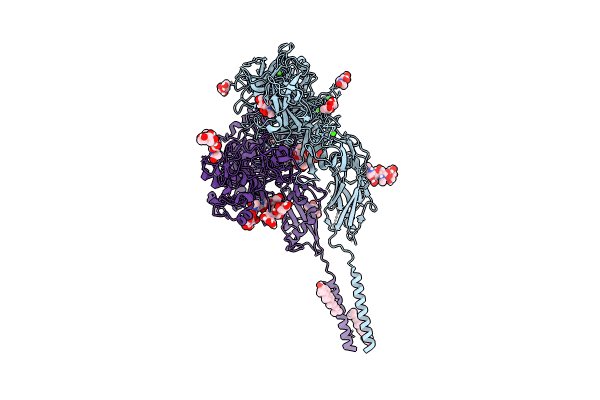
9DEQ image
Deposition Date 2024-08-29
Release Date 2024-10-16
Last Version Date 2024-10-30
Entry Detail
PDB ID:
9DEQ
Keywords:
Title:
Cryo-EM structures of full-length integrin alphaIIbbeta3 in native lipids complexed with modified tirofiban
Biological Source:
Source Organism:
Homo sapiens (Taxon ID: 9606)
Method Details:
Experimental Method:
Resolution:
4.10 Å
Aggregation State:
CELL
Reconstruction Method:
SINGLE PARTICLE
Macromolecular Entities
Structures with similar UniProt ID
Protein Blast
Polymer Type:polypeptide(L)
Molecule:Integrin alpha-IIb
Gene (Uniprot):ITGA2B
Chain IDs:A
Chain Length:1008
Number of Molecules:1
Biological Source:Homo sapiens
Structures with similar UniProt ID
Protein Blast
Polymer Type:polypeptide(L)
Molecule:Integrin beta-3
Gene (Uniprot):ITGB3
Chain IDs:B
Chain Length:762
Number of Molecules:1
Biological Source:Homo sapiens
Primary Citation
Platelet integrin alpha IIb beta 3 plays a key role in a venous thrombogenesis mouse model.
Nat Commun 15 8612 8612 (2024)
PMID: 39366965 DOI: 10.1038/s41467-024-52869-3

Abstact

Venous thrombosis (VT) is a common vascular disease associated with reduced survival and a high recurrence rate. VT is initiated by the accumulation of platelets and neutrophils at sites of endothelial cell activation. A role for platelet αIIbβ3 in VT is not established, a task complicated by the increased bleeding risk caused by partial agonists such as tirofiban. Here, we show that m-tirofiban, a modified version of tirofiban, does not agonize αIIbβ3 based on lack of neoepitope expression and the cryo-EM structure of m-tirofiban/full-length αIIbβ3 complex. m-tirofiban abolishes agonist-induced platelet aggregation while preserving clot retraction ex vivo and, unlike tirofiban, it suppresses venous thrombogenesis in a mouse model without increasing bleeding. These findings establish a key role for αIIbβ3 in VT initiation and suggest that m-tirofiban and compounds with a similar structurally-defined mechanism of action merit consideration as potential thromboprophylaxis agents in patients at high risk for VT and hemorrhage.

Legend

Protein

Chemical

Disease

Primary Citation of related structures
Feedback Form
Name
Email
Institute
Feedback