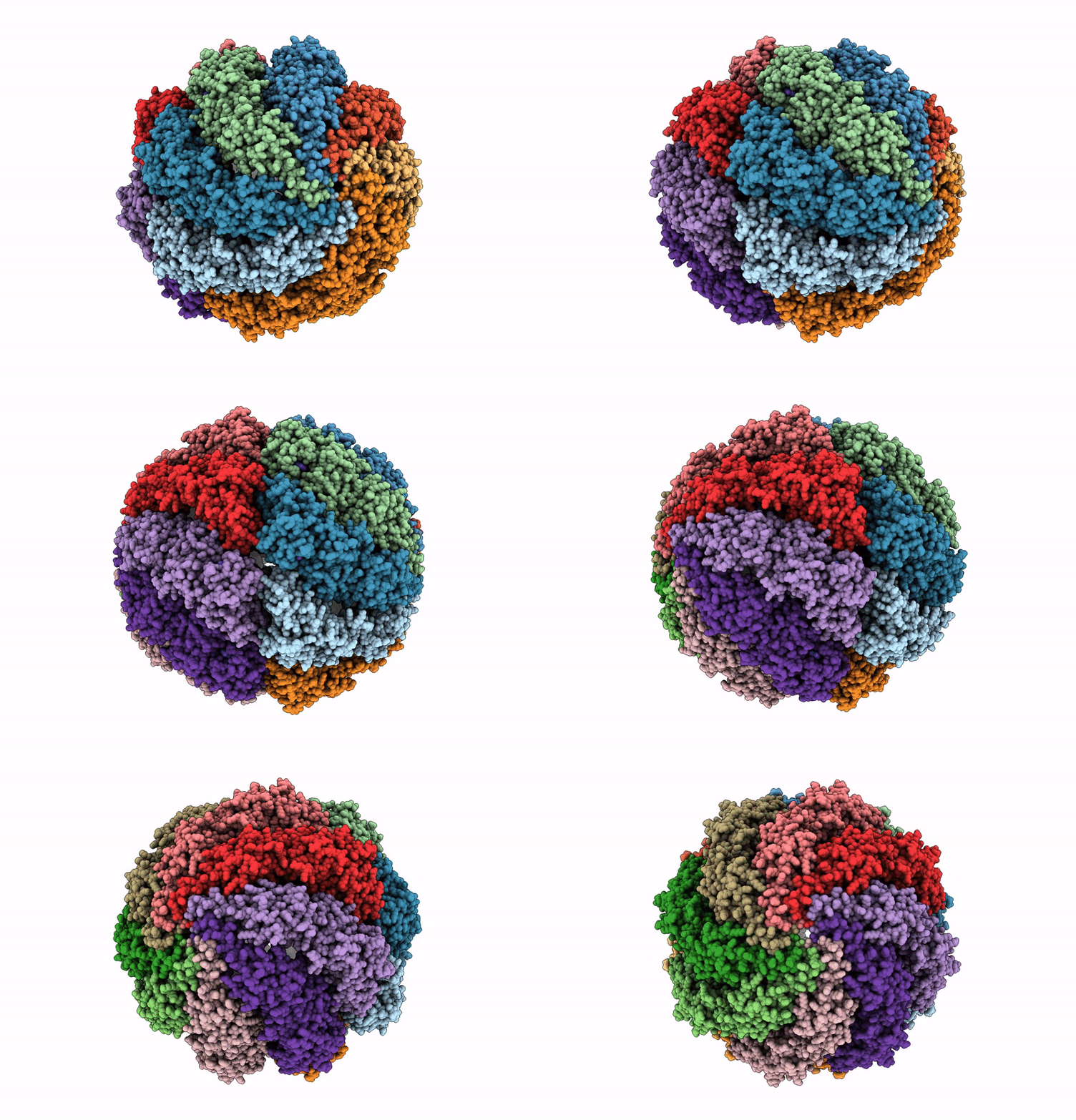
9CPK image
Deposition Date 2024-07-18
Release Date 2025-07-30
Last Version Date 2025-10-08
Entry Detail
PDB ID:
9CPK
Keywords:
Title:
D8 symmetry reconstruction of MmCPn in closed state
Biological Source:
Source Organism:
Method Details:
Experimental Method:
Resolution:
2.56 Å
Aggregation State:
PARTICLE
Reconstruction Method:
SUBTOMOGRAM AVERAGING
Macromolecular Entities
Structures with similar UniProt ID
Protein Blast
Polymer Type:polypeptide(L)
Molecule:Chaperonin
Chain IDs:A (auth: B), B (auth: J), C (auth: K), D (auth: L), E (auth: M), F (auth: A), G (auth: C), H (auth: D), I (auth: N), J (auth: E), K (auth: F), L (auth: G), M (auth: H), N (auth: I), O, P
Chain Length:543
Number of Molecules:16
Biological Source:Methanococcus maripaludis
Primary Citation
Cost-benefit analysis of cryogenic electron tomography subtomogram averaging of chaperonin MmCpn at near atomic resolution.
Structure 33 372 380.e2 (2025)
PMID: 39644888 DOI: 10.1016/j.str.2024.11.008

Abstact

Cryogenic electron microscopy single particle analysis (cryoEM-SPA) has evolved into a routine approach for determining macromolecule structures to near-atomic resolution. Cryogenic electron tomography subtomogram averaging (cryoET-STA) toward a similar resolution, in contrast, is still under active development. Here, we use the archeal chaperonin MmCpn as a model macromolecule to quantitatively investigate the resolution limiting factors of cryoET-STA in terms of cumulative electron dose, ice thickness, subtomogram numbers, and tilt angle ranges. By delineating the feasibility and experimental factors of attaining near atomic resolution structure with cryoET-STA, especially the effect of electron damage through the tilt series and inelastic scattering at various ice thickness, we encourage a customized tilt series collection strategy for efficient throughput. This study provides a biophysical basis for the application of cryoET-STA (for highly symmetric molecules like MmCpn) toward high resolution and the rationales in using cryoET-STA to achieve an efficient outcome at the desired resolution.

Legend

Protein

Chemical

Disease

Primary Citation of related structures
Feedback Form
Name
Email
Institute
Feedback