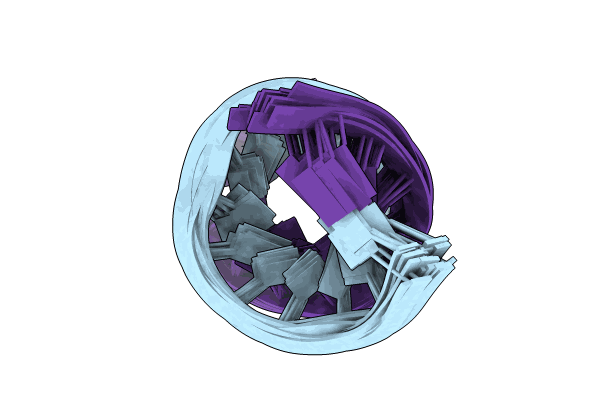
9CPJ image
Deposition Date 2024-07-18
Release Date 2024-08-07
Last Version Date 2024-08-07
Entry Detail
PDB ID:
9CPJ
Keywords:
Title:
Structures of small molecules bound to RNA repeat expansions that cause Huntington's disease-like 2 and myotonic dystrophy type 1
Biological Source:
Source Organism:
Homo sapiens (Taxon ID: 9606)
Method Details:
Experimental Method:
Conformers Calculated:
100
Conformers Submitted:
20
Selection Criteria:
structures with the least restraint violations
Macromolecular Entities
Polymer Type:polyribonucleotide
Molecule:RNA (5'-R(*GP*AP*CP*AP*GP*CP*UP*GP*CP*UP*GP*UP*C)-3')
Chain IDs:A, B
Chain Length:13
Number of Molecules:2
Biological Source:Homo sapiens
Ligand Molecules
Primary Citation
Structures of small molecules bound to RNA repeat expansions that cause Huntington's disease-like 2 and myotonic dystrophy type 1.
Bioorg.Med.Chem.Lett. ? 129888 129888 (2024)
PMID: 39002937 DOI: 10.1016/j.bmcl.2024.129888

Abstact

Trinucleotide repeat expansions fold into long, stable hairpins and cause a variety of incurable RNA gain-of-function diseases such as Huntington's disease, the myotonic dystrophies, and spinocerebellar ataxias. One approach for treating these diseases is to bind small molecules to these structured RNAs. Both Huntington's disease-like 2 (HDL2) and myotonic dystrophy type 1 (DM1) are caused by a r(CUG) repeat expansion, or r(CUG)exp. The RNA folds into a hairpin structure with a periodic array of 1 × 1 nucleotide UU loops (5'CUG/3'GUC; where the underlined nucleotides indicate the Us in the internal loop) that sequester various RNA-binding proteins (RBPs) and hence the source of its gain-of-function. Here, we report nuclear magnetic resonance (NMR)-refined structures of single 5'CUG/3'GUC motifs in complex with three different small molecules, a di-guandinobenzoate (1), a derivative of 1 where the guanidino groups have been exchanged for imidazole (2), and a quinoline with improved drug-like properties (3). These structures were determined using NMR spectroscopy and simulated annealing with restrained molecular dynamics (MD). Compounds 1, 2, and 3 formed stacking and hydrogen bonding interactions with the 5'CUG/3'GUC motif. Compound 3 also formed van der Waals interactions with the internal loop. The global structure of each RNA-small molecule complexes retains an A-form conformation, while the internal loops are still dynamic but to a lesser extent compared to the unbound form. These results aid our understanding of ligand-RNA interactions and enable structure-based design of small molecules with improved binding affinity for and biological activity against r(CUG)exp. As the first ever reported structures of a r(CUG) repeat bound to ligands, these structures can enable virtual screening campaigns combined with machine learning assisted de novo design.

Legend

Protein

Chemical

Disease

Primary Citation of related structures
Feedback Form
Name
Email
Institute
Feedback