9CMT image
Deposition Date 2024-07-15
Release Date 2025-05-28
Last Version Date 2025-05-28
Entry Detail
PDB ID:
9CMT
Keywords:
Title:
The crystal structure of HP1alpha CSD-Agno complex
Biological Source:
Source Organism:
Homo sapiens (Taxon ID: 9606)
JC polyomavirus (Taxon ID: 10632)
Method Details:
Experimental Method:
Resolution:
3.17 Å
R-Value Free:
0.28
R-Value Work:
0.24
R-Value Observed:
0.25
Space Group:
P 41 21 2
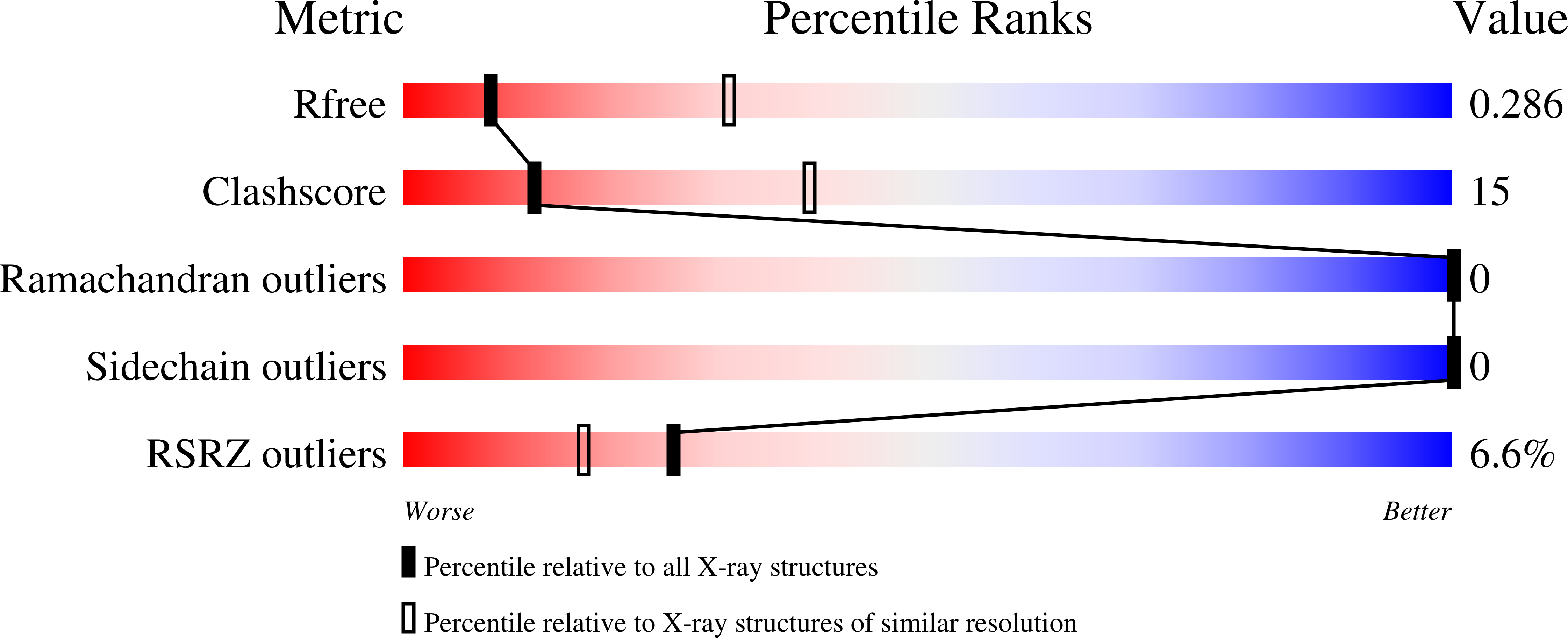
Macromolecular Entities
Structures with similar UniProt ID
Protein Blast
Polymer Type:polypeptide(L)
Molecule:Chromobox protein homolog 5
Gene (Uniprot):CBX5
Mutagens:C133S, T145S
Chain IDs:A, B, D, E
Chain Length:65
Number of Molecules:4
Biological Source:Homo sapiens
Structures with similar UniProt ID
Protein Blast
Polymer Type:polypeptide(L)
Molecule:Agnoprotein
Chain IDs:C, F
Chain Length:16
Number of Molecules:2
Biological Source:JC polyomavirus
Ligand Molecules
Primary Citation

Abstact

Chronically persistent viruses are integral components of the organismal ecosystem in humans and animals 1 2 . Many of these viruses replicate and accumulate within the cell nucleus 3 . The nuclear location allows viruses to evade cytoplasmic host viral sensors and promotes viral replication 4 . One of the unexplored and puzzling aspects of the viral nuclear lifecycle involves the virus's ability to deal with the physical constraints of nuclear architecture. To replicate and accumulate within the nucleus in large numbers sufficient for infection spreading, DNA viruses need to overcome the spatial limitations imposed by chromatin and the nuclear matrix. We found that one of the most widespread and potentially lethal human viruses, the JC polyomavirus 5 , interferes with nuclear heterochromatin to create virus-occupied space. The JC virus's impact on heterochromatin is mediated by the viral nonstructural protein, Agnoprotein (Agno). Agno's interference with heterochromatin is governed by structurally diverse mimics of host epigenetic regulators that facilitate virus-induced chromatin reorganization and a dramatic decline in nuclear stiffness in the infected cells. The JCV epigenetic mimicry is critical for the virus infection, as evident from reduced replication of mimic-mutant viruses. Our data suggest that modulation of nuclear mechanical properties is a novel strategy enabling chronicity of the JC and possibly other nuclear virus infections.

Legend

Protein

Chemical

Disease

Primary Citation of related structures
Feedback Form
Name
Email
Institute
Feedback